Thank you for visiting SNEWPapers!
Sign up free
Phenix Gazette
Alexandria, Virginia
What is this article about?
The U.S. Supreme Court judges delivered opinions on the constitutional validity of state insolvent laws, with Chief Justice Marshall, Justice Story, and Justice Duvall ruling them void for discharging contracts, while the other four judges found them valid in some cases, particularly for in-state creditors on post-law contracts.
Clipping
OCR Quality
Full Text
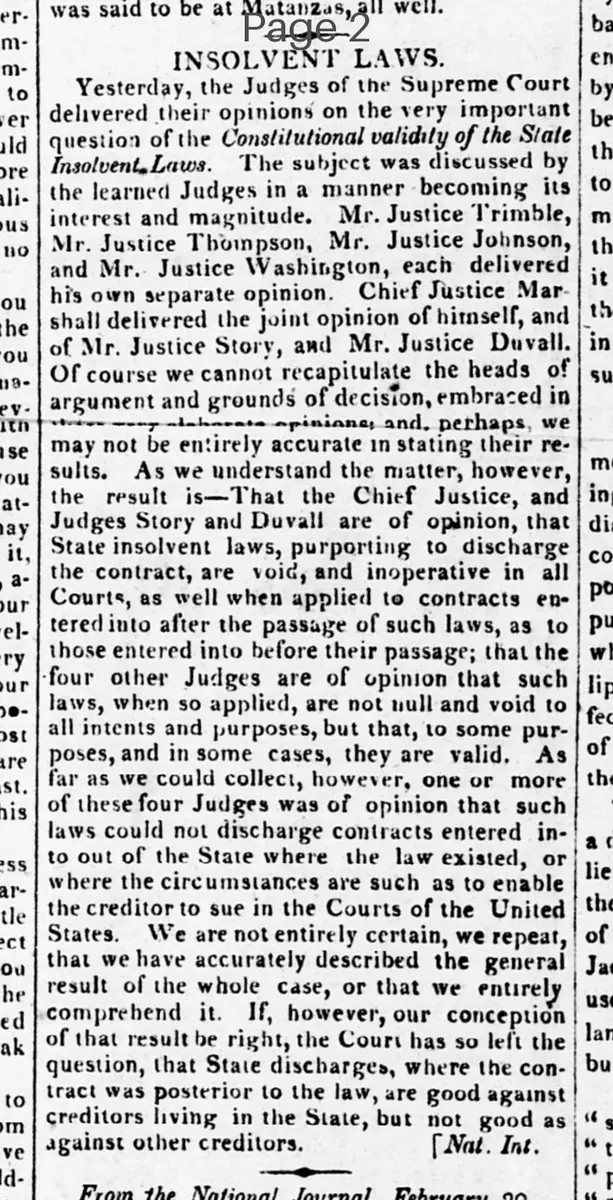
Yesterday, the Judges of the Supreme Court delivered their opinions on the very important question of the Constitutional validity of the State Insolvent Laws. The subject was discussed by the learned Judges in a manner becoming its interest and magnitude. Mr. Justice Trimble, Mr. Justice Thompson, Mr. Justice Johnson, and Mr. Justice Washington, each delivered his own separate opinion. Chief Justice Marshall delivered the joint opinion of himself, and of Mr. Justice Story, and Mr. Justice Duvall.
Of course we cannot recapitulate the heads of argument and grounds of decision, embraced in these opinions, and, perhaps, we may not be entirely accurate in stating their results. As we understand the matter, however, the result is—That the Chief Justice, and Judges Story and Duvall are of opinion, that State insolvent laws, purporting to discharge the contract, are void, and inoperative in all Courts, as well when applied to contracts entered into after the passage of such laws, as to those entered into before their passage; that the four other Judges are of opinion that such laws, when so applied, are not null and void to all intents and purposes, but that, to some purposes, and in some cases, they are valid. As far as we could collect, however, one or more of these four Judges was of opinion that such laws could not discharge contracts entered into out of the State where the law existed, or where the circumstances are such as to enable the creditor to sue in the Courts of the United States. We are not entirely certain, we repeat, that we have accurately described the general result of the whole case, or that we entirely comprehend it. If, however, our conception of that result be right, the Court has so left the question, that State discharges, where the contract was posterior to the law, are good against creditors living in the State, but not good as against other creditors.
Nat. Int.
What sub-type of article is it?
What keywords are associated?
What entities or persons were involved?
Domestic News Details
Event Date
Yesterday
Key Persons
Outcome
the chief justice, judges story and duvall opined that state insolvent laws purporting to discharge contracts are void and inoperative in all courts for both pre- and post-passage contracts; the four other judges opined such laws are valid in some purposes and cases, but not for out-of-state contracts or where creditors can sue in u.s. courts; state discharges for post-law contracts are good against in-state creditors but not others.
Event Details
Judges of the Supreme Court delivered opinions on the constitutional validity of state insolvent laws, discussed in a manner befitting its importance; Trimble, Thompson, Johnson, and Washington each gave separate opinions; Marshall delivered the joint opinion for himself, Story, and Duvall.