Thank you for visiting SNEWPapers!
Sign up free
Domestic News
January 19, 1822
Richmond Enquirer
Richmond, Richmond County, Virginia
What is this article about?
Washington correspondent details congressional inaction on major bills, debate on Indian Department appropriation deficit, emerging presidential election influences, and doubts over West India trade restrictions' success, dated Jan. 18, 1822.
Clipping
OCR Quality
95%
Excellent
Full Text
RICHMOND, JANUARY 19, 1822.
TO THE
ENQUIRER:
WASHINGTON CITY, 18th Jan. 1822.
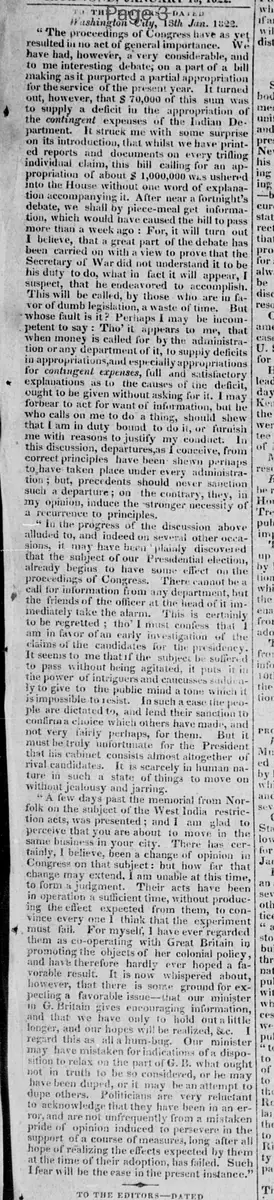
The proceedings of Congress have as yet resulted in no act of general importance. We have had, however, a very considerable, and to me interesting debate; on a part of a bill making as it purported a partial appropriation for the service of the present year. It turned out, however, that $70,000 of this sum was to supply a deficit in the appropriation of the contingent expenses of the Indian Department. It struck me with some surprise on its introduction, that whilst we have printed reports and documents on every trifling individual claim, this bill calling for an appropriation of about $1,000,000 was ushered into the House without one word of explanation accompanying it. After near a fortnight's debate, we shall by piece-meal get information, which would have caused the bill to pass more than a week ago: For, it will turn out I believe, that a great part of the debate has been carried on with a view to prove that the Secretary of War did not understand it to be his duty to do, what in fact it will appear, I suspect, that he endeavored to accomplish. This will be called, by those who are in favor of dumb legislation, a waste of time. But whose fault is it? Perhaps I may be incompetent to say: Tho' it appears to me, that when money is called for by the administration or any department of it, to supply deficits in appropriations, and especially appropriations for contingent expenses, full and satisfactory explanations as to the causes of the deficit, ought to be given without asking for it. I may forbear to act for want of information, but he who calls on me to do a thing, should shew that I am in duty bound to do it, or furnish me with reasons to justify my conduct. In this discussion, departures, as I conceive, from correct principles have been shewn perhaps to have taken place under every administration; but, precedents should never sanction such a departure; on the contrary, they, in my opinion, induce the stronger necessity of a recurrence to principles.
In the progress of the discussion above alluded to, and indeed on several other occasions, it may have been plainly discovered that the subject of our Presidential election, already begins to have some effect on the proceedings of Congress. There cannot be a call for information from any department, but the friends of the officer at the head of it immediately take the alarm. This is certainly to be regretted: tho' I must confess that I am in favor of an early investigation of the claims of the candidates for the presidency. It seems to me that if the subject be suffer'd to pass without being agitated, it puts it in the power of intriguers and caucusses suddenly to give to the public mind a tone which it is impossible to resist. In such a case the people are dictated to, and lend their sanction to confirm a choice which others have made, and not very fairly perhaps, for them. But it must be truly unfortunate for the President that his cabinet consists almost altogether of rival candidates. It is scarcely in human nature in such a state of things to move on without jealousy and jarring.
A few days past the memorial from Norfolk on the subject of the West India restriction acts, was presented; and I am glad to perceive that you are about to move in the same business in your city. There has certainly, I believe, been a change of opinion in Congress on that subject: but how far that change may extend, I am unable at this time, to form a judgment. Their acts have been in operation a sufficient time, without producing the effect expected from them, to convince every one I think that the experiment must fail. For myself, I have ever regarded them as co-operating with Great Britain in promoting the objects of her colonial policy, and have therefore hardly ever hoped a favorable result. It is now whispered about, however, that there is some ground for expecting a favorable issue--that our minister in G. Britain gives encouraging information, and that we have only to hold out a little longer, and our hopes will be realized, &c. I regard this as all a hum-bug. Our minister may have mistaken for indications of a disposition to relax on the part of G. B. what ought not in truth to be so considered, or he may have been duped, or it may be an attempt to dupe others. Politicians are very reluctant to acknowledge that they have been in an error, and are not unfrequently from a mistaken pride of opinion induced to persevere in the support of a course of measures, long after all hope of realizing the effects expected by them at the time of their adoption, has failed. Such I fear will be the case in the present instance.
TO THE
ENQUIRER:
WASHINGTON CITY, 18th Jan. 1822.
The proceedings of Congress have as yet resulted in no act of general importance. We have had, however, a very considerable, and to me interesting debate; on a part of a bill making as it purported a partial appropriation for the service of the present year. It turned out, however, that $70,000 of this sum was to supply a deficit in the appropriation of the contingent expenses of the Indian Department. It struck me with some surprise on its introduction, that whilst we have printed reports and documents on every trifling individual claim, this bill calling for an appropriation of about $1,000,000 was ushered into the House without one word of explanation accompanying it. After near a fortnight's debate, we shall by piece-meal get information, which would have caused the bill to pass more than a week ago: For, it will turn out I believe, that a great part of the debate has been carried on with a view to prove that the Secretary of War did not understand it to be his duty to do, what in fact it will appear, I suspect, that he endeavored to accomplish. This will be called, by those who are in favor of dumb legislation, a waste of time. But whose fault is it? Perhaps I may be incompetent to say: Tho' it appears to me, that when money is called for by the administration or any department of it, to supply deficits in appropriations, and especially appropriations for contingent expenses, full and satisfactory explanations as to the causes of the deficit, ought to be given without asking for it. I may forbear to act for want of information, but he who calls on me to do a thing, should shew that I am in duty bound to do it, or furnish me with reasons to justify my conduct. In this discussion, departures, as I conceive, from correct principles have been shewn perhaps to have taken place under every administration; but, precedents should never sanction such a departure; on the contrary, they, in my opinion, induce the stronger necessity of a recurrence to principles.
In the progress of the discussion above alluded to, and indeed on several other occasions, it may have been plainly discovered that the subject of our Presidential election, already begins to have some effect on the proceedings of Congress. There cannot be a call for information from any department, but the friends of the officer at the head of it immediately take the alarm. This is certainly to be regretted: tho' I must confess that I am in favor of an early investigation of the claims of the candidates for the presidency. It seems to me that if the subject be suffer'd to pass without being agitated, it puts it in the power of intriguers and caucusses suddenly to give to the public mind a tone which it is impossible to resist. In such a case the people are dictated to, and lend their sanction to confirm a choice which others have made, and not very fairly perhaps, for them. But it must be truly unfortunate for the President that his cabinet consists almost altogether of rival candidates. It is scarcely in human nature in such a state of things to move on without jealousy and jarring.
A few days past the memorial from Norfolk on the subject of the West India restriction acts, was presented; and I am glad to perceive that you are about to move in the same business in your city. There has certainly, I believe, been a change of opinion in Congress on that subject: but how far that change may extend, I am unable at this time, to form a judgment. Their acts have been in operation a sufficient time, without producing the effect expected from them, to convince every one I think that the experiment must fail. For myself, I have ever regarded them as co-operating with Great Britain in promoting the objects of her colonial policy, and have therefore hardly ever hoped a favorable result. It is now whispered about, however, that there is some ground for expecting a favorable issue--that our minister in G. Britain gives encouraging information, and that we have only to hold out a little longer, and our hopes will be realized, &c. I regard this as all a hum-bug. Our minister may have mistaken for indications of a disposition to relax on the part of G. B. what ought not in truth to be so considered, or he may have been duped, or it may be an attempt to dupe others. Politicians are very reluctant to acknowledge that they have been in an error, and are not unfrequently from a mistaken pride of opinion induced to persevere in the support of a course of measures, long after all hope of realizing the effects expected by them at the time of their adoption, has failed. Such I fear will be the case in the present instance.
What sub-type of article is it?
Politics
Indian Affairs
Economic
What keywords are associated?
Congressional Debate
Appropriation Bill
Indian Department
Presidential Election
West India Restrictions
Where did it happen?
Washington City
Domestic News Details
Primary Location
Washington City
Event Date
18th Jan. 1822
Event Details
Letter reports on congressional debate over appropriation bill including $70,000 for Indian Department deficit, lack of explanations for expenditures, influence of presidential election on proceedings, presentation of Norfolk memorial on West India restriction acts, and skepticism about their effectiveness.