Thank you for visiting SNEWPapers!
Sign up free
Story
August 5, 1856
The Western Democrat
Charlotte, Mecklenburg County, North Carolina
What is this article about?
In 1856, traveler 'The Wanderer' describes a railroad journey from Weldon, NC, through Raleigh, Hillsborough, and Charlotte to Columbia, SC, highlighting scenic oak groves, fertile lands, state institutions, and mineral riches of North Carolina.
Clipping
OCR Quality
98%
Excellent
Full Text
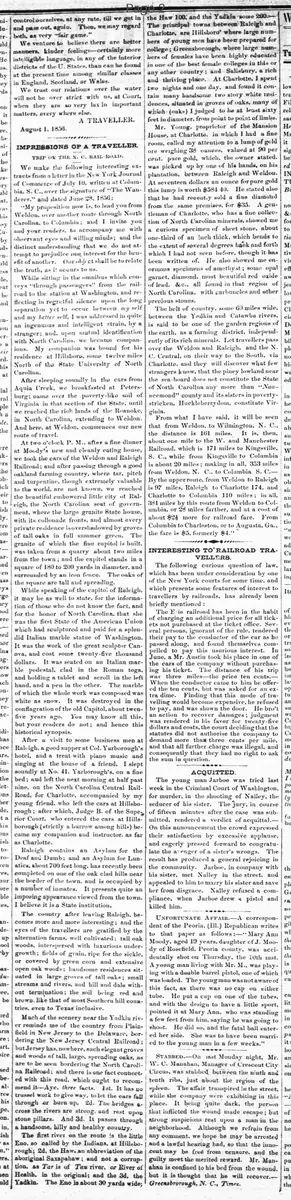
IMPRESSIONS OF A TRAVELLER.
TRIP ON THE S. C. RAIL-ROAD.
We make the following interesting extracts from a letter in the New York Journal of Commerce of July 10, written at Columbia, S. C., over the signature of "The Wanderer," and dated June 28, 1856;
"My proposition now is, to lead you from Weldon, over another route through North Carolina, to Columbia: and I invite you and your readers, to accompany me with observant eyes and willing minds; and the distinct understanding that we do not attempt to prejudice one interest for the benefit of another. Our object shall be to relate the truth, as it occurs to us.
While sitting in the omnibus which conveys "through passengers" from the rail-road to the station at Washington, and reflecting in regretful silence upon the long separation yet to occur between my self and my better self, I was addressed in quite an ingenuous and intelligent strain, by a stranger; and, upon mutual identification with North Carolina, we became companions. My companion was bound for his residence at Hillsboro, some twelve miles North of the State University of North Carolina.
After sleeping soundly in the cars from Aquia Creek, we breakfasted at Petersburg; came over the poverty-like soil of Virginia in that section of the State, until we reached the rich lands of the Roanoke, in North Carolina, extending to Weldon. And here, at Weldon, commences our new route of travel.
At two o'clock P. M., after a fine dinner at Moody's new and cleanly eating house, we took the cars of the Weldon and Raleigh Railroad; and after passing through a good oakland farming country, where tar, pitch and turpentine, though extremely valuable to the world, are not known, we reached the beautiful embowered little city of Raleigh, the North Carolina seat of government, where the large granite State house, with its colonnade fronts, and almost every private residence is overshadowed by groves of tall oaks in full summer green. The granite of which the fine capitol is built, was taken from a quarry about two miles from the town : and the capitol stands in a square of 180 to 200 yards in diameter, and surrounded by an iron fence. The oaks of the square are tall and spreading.
While speaking of the capitol of Raleigh it may be as well to state, for the information of those who do not know the fact, and for the honor of North Carolina, that she was the first State of the American Union which had sculptured and paid for a splendid Italian marble statue of Washington. It was the work of the great sculptor Canova, and cost some twenty-five thousand dollars. It was seated on an Italian marble pedestal, clad in the Roman toga, and holding a tablet and scroll in the left hand, and a pen in the other. The marble of which the whole work was composed was white as snow. It was destroyed in the conflagration of the old Capitol, about twenty-five years ago. You may know all this but your readers do not; and hence this historical synopsis.
After a visit to some business men at Raleigh, a good supper at Col. Yarborough's hotel, and a treat with piano music and singing at the house of a friend, I slept soundly at No. 41, Yarborough's, on a fine bed; and left the next morning at half past nine, on the North Carolina Central Rail. Road, for Charlotte, accompanied by my young friend, who left the cars at Hillsborough; after which, Judge B. of the Superior Court, who entered the cars at Hillsborough (strictly a burrow among hills) became my companion and instructor, as far as Charlotte.
Raleigh contains an Asylum for the Deaf and Dumb: and an Asylum for Lunatics, about 700 feet long, has recently been completed on one of the oak clad hills near the border of the town, and is occupied by a number of inmates. It presents quite an imposing appearance viewed from the town. I believe it is a State institution.
The country after leaving Raleigh, becomes more and more interesting; and the eyes of the travellers are gratified by the alternation farms, well cultivated; tall oak woods, interspersed with luxurious undergrowth; fields of grain, ripe for the sickle, or covered by green corn and extensive open oak woods; handsome residences situated in large groves of tall oaks; small streams and rivers, and hill and dale without termination; the soil being red and brown, like that of most Southern hill countries, even to Texas inclusive.
Much of the scenery near the Yadkin river reminds me of the country from Plainfield in New Jersey to the Delaware, bordering the New Jersey Central Railroad: but Jersey has, nowhere, such elegant groves and woods of tall, large, spreading oaks, as are to be seen bordering the North Carolina Railroad; and there is one fact connected with this road, which ought to recommend it—Aye, three facts. 1st. It has no trussed work to give way, to let the cars fall through or burn up. 2d. The bridges across the rivers are strong, and rest upon stone pillars. And 3d. It passes through a handsome, hilly and healthy country.
The first river on the route is the little Eno, so called by the Indians, at Hillsborough; 2d, the Haw., an abbreviation of the aboriginal Saxapahaw; and not a corruption, as Tar is of Tau river, or River of Health, in the original; and the 3d, the Yadkin. The Eno is about 30 yards wide; the Haw 100, and the Yadkin some 200.
The principal towns between Raleigh and Charlotte, are Hillsboro' where large numbers of young men have been prepared for college; Greensborough, where large numbers of females have been highly educated in one of the best female colleges in this or any other country; and Salisbury, a rich and thriving place. At Charlotte, I spent two nights and one day, and found it contain many handsome two story white residences, situated in groves of oaks, many of which oaks I judged to be at least sixty feet in diameter, from point to point of limbs.
Mr. Young, proprietor of the Mansion House, at Charlotte, in which I had a fine room, called my attention to a lump of gold ore weighing 38 ounces, valued at 90 per cent, pure gold, which, the owner stated, was picked up by one of his hands, on his plantation, between Raleigh and Weldon. At seventeen dollars an ounce for pure gold this lump is worth $584 40. He stated also that he had recently sold a fine diamond from the same premises, for $35. A gentleman of Charlotte, who has a fine collection of North Carolina minerals, showed me a curious specimen of sheet stone, about one-third of an inch thick, which bends to the extent of several degrees back and forth which I had not seen before, though it has been written of. He also showed me enormous specimens of amethyst; some opal garnet, diamond, most beautiful red oxide of lead, &c., all found in that region of North Carolina, with carbuncles and other precious stones.
The belt of country, some 60 miles wide, between the Yadkin and Catawba rivers, is said to be one of the garden regions of the earth, as a farming district, independently of its rich minerals. Let travellers pass over the Weldon and Raleigh, and the N. C. Central, on their way to the South, via Charlotte, and they will discover what few strangers know, that the piney lowland near the sea-board does not constitute the State of North Carolina any more than "Nansemond" county and its sisters in poverty-stricken, Huckleberrydom, constitute Virginia.
From what I have said, it will be seen that from Weldon, to Wilmington, N. C., the distance is 161 miles. It is, then, about one mile to the W. and Manchester Railroad, which is 171 miles to Kingsville, S. C., while from Kingsville to Columbia is about 20 miles; making in all, 353 miles from Weldon, N. C., to Columbia S. C.
By the upper route, from Weldon to Raleigh is 97 miles, Raleigh to Charlotte 174, and Charlotte to Columbia 110 miles: in all 381 miles by this route from Weldon to Columbia, or 28 miles farther, and at a cost of about $2 more for railroad fare. From Columbia to Charleston, or to Augusta, Ga., the fare is $5, formerly $4."
TRIP ON THE S. C. RAIL-ROAD.
We make the following interesting extracts from a letter in the New York Journal of Commerce of July 10, written at Columbia, S. C., over the signature of "The Wanderer," and dated June 28, 1856;
"My proposition now is, to lead you from Weldon, over another route through North Carolina, to Columbia: and I invite you and your readers, to accompany me with observant eyes and willing minds; and the distinct understanding that we do not attempt to prejudice one interest for the benefit of another. Our object shall be to relate the truth, as it occurs to us.
While sitting in the omnibus which conveys "through passengers" from the rail-road to the station at Washington, and reflecting in regretful silence upon the long separation yet to occur between my self and my better self, I was addressed in quite an ingenuous and intelligent strain, by a stranger; and, upon mutual identification with North Carolina, we became companions. My companion was bound for his residence at Hillsboro, some twelve miles North of the State University of North Carolina.
After sleeping soundly in the cars from Aquia Creek, we breakfasted at Petersburg; came over the poverty-like soil of Virginia in that section of the State, until we reached the rich lands of the Roanoke, in North Carolina, extending to Weldon. And here, at Weldon, commences our new route of travel.
At two o'clock P. M., after a fine dinner at Moody's new and cleanly eating house, we took the cars of the Weldon and Raleigh Railroad; and after passing through a good oakland farming country, where tar, pitch and turpentine, though extremely valuable to the world, are not known, we reached the beautiful embowered little city of Raleigh, the North Carolina seat of government, where the large granite State house, with its colonnade fronts, and almost every private residence is overshadowed by groves of tall oaks in full summer green. The granite of which the fine capitol is built, was taken from a quarry about two miles from the town : and the capitol stands in a square of 180 to 200 yards in diameter, and surrounded by an iron fence. The oaks of the square are tall and spreading.
While speaking of the capitol of Raleigh it may be as well to state, for the information of those who do not know the fact, and for the honor of North Carolina, that she was the first State of the American Union which had sculptured and paid for a splendid Italian marble statue of Washington. It was the work of the great sculptor Canova, and cost some twenty-five thousand dollars. It was seated on an Italian marble pedestal, clad in the Roman toga, and holding a tablet and scroll in the left hand, and a pen in the other. The marble of which the whole work was composed was white as snow. It was destroyed in the conflagration of the old Capitol, about twenty-five years ago. You may know all this but your readers do not; and hence this historical synopsis.
After a visit to some business men at Raleigh, a good supper at Col. Yarborough's hotel, and a treat with piano music and singing at the house of a friend, I slept soundly at No. 41, Yarborough's, on a fine bed; and left the next morning at half past nine, on the North Carolina Central Rail. Road, for Charlotte, accompanied by my young friend, who left the cars at Hillsborough; after which, Judge B. of the Superior Court, who entered the cars at Hillsborough (strictly a burrow among hills) became my companion and instructor, as far as Charlotte.
Raleigh contains an Asylum for the Deaf and Dumb: and an Asylum for Lunatics, about 700 feet long, has recently been completed on one of the oak clad hills near the border of the town, and is occupied by a number of inmates. It presents quite an imposing appearance viewed from the town. I believe it is a State institution.
The country after leaving Raleigh, becomes more and more interesting; and the eyes of the travellers are gratified by the alternation farms, well cultivated; tall oak woods, interspersed with luxurious undergrowth; fields of grain, ripe for the sickle, or covered by green corn and extensive open oak woods; handsome residences situated in large groves of tall oaks; small streams and rivers, and hill and dale without termination; the soil being red and brown, like that of most Southern hill countries, even to Texas inclusive.
Much of the scenery near the Yadkin river reminds me of the country from Plainfield in New Jersey to the Delaware, bordering the New Jersey Central Railroad: but Jersey has, nowhere, such elegant groves and woods of tall, large, spreading oaks, as are to be seen bordering the North Carolina Railroad; and there is one fact connected with this road, which ought to recommend it—Aye, three facts. 1st. It has no trussed work to give way, to let the cars fall through or burn up. 2d. The bridges across the rivers are strong, and rest upon stone pillars. And 3d. It passes through a handsome, hilly and healthy country.
The first river on the route is the little Eno, so called by the Indians, at Hillsborough; 2d, the Haw., an abbreviation of the aboriginal Saxapahaw; and not a corruption, as Tar is of Tau river, or River of Health, in the original; and the 3d, the Yadkin. The Eno is about 30 yards wide; the Haw 100, and the Yadkin some 200.
The principal towns between Raleigh and Charlotte, are Hillsboro' where large numbers of young men have been prepared for college; Greensborough, where large numbers of females have been highly educated in one of the best female colleges in this or any other country; and Salisbury, a rich and thriving place. At Charlotte, I spent two nights and one day, and found it contain many handsome two story white residences, situated in groves of oaks, many of which oaks I judged to be at least sixty feet in diameter, from point to point of limbs.
Mr. Young, proprietor of the Mansion House, at Charlotte, in which I had a fine room, called my attention to a lump of gold ore weighing 38 ounces, valued at 90 per cent, pure gold, which, the owner stated, was picked up by one of his hands, on his plantation, between Raleigh and Weldon. At seventeen dollars an ounce for pure gold this lump is worth $584 40. He stated also that he had recently sold a fine diamond from the same premises, for $35. A gentleman of Charlotte, who has a fine collection of North Carolina minerals, showed me a curious specimen of sheet stone, about one-third of an inch thick, which bends to the extent of several degrees back and forth which I had not seen before, though it has been written of. He also showed me enormous specimens of amethyst; some opal garnet, diamond, most beautiful red oxide of lead, &c., all found in that region of North Carolina, with carbuncles and other precious stones.
The belt of country, some 60 miles wide, between the Yadkin and Catawba rivers, is said to be one of the garden regions of the earth, as a farming district, independently of its rich minerals. Let travellers pass over the Weldon and Raleigh, and the N. C. Central, on their way to the South, via Charlotte, and they will discover what few strangers know, that the piney lowland near the sea-board does not constitute the State of North Carolina any more than "Nansemond" county and its sisters in poverty-stricken, Huckleberrydom, constitute Virginia.
From what I have said, it will be seen that from Weldon, to Wilmington, N. C., the distance is 161 miles. It is, then, about one mile to the W. and Manchester Railroad, which is 171 miles to Kingsville, S. C., while from Kingsville to Columbia is about 20 miles; making in all, 353 miles from Weldon, N. C., to Columbia S. C.
By the upper route, from Weldon to Raleigh is 97 miles, Raleigh to Charlotte 174, and Charlotte to Columbia 110 miles: in all 381 miles by this route from Weldon to Columbia, or 28 miles farther, and at a cost of about $2 more for railroad fare. From Columbia to Charleston, or to Augusta, Ga., the fare is $5, formerly $4."
What sub-type of article is it?
Journey
Historical Event
What themes does it cover?
Exploration
Nature
What keywords are associated?
Railroad Journey
North Carolina
Raleigh
Charlotte
Oak Groves
Minerals
Yadkin River
What entities or persons were involved?
The Wanderer
Judge B.
Mr. Young
Where did it happen?
North Carolina (Weldon, Raleigh, Hillsborough, Charlotte) To Columbia, S. C.
Story Details
Key Persons
The Wanderer
Judge B.
Mr. Young
Location
North Carolina (Weldon, Raleigh, Hillsborough, Charlotte) To Columbia, S. C.
Event Date
June 28, 1856
Story Details
Traveler recounts railroad trip from Weldon through North Carolina's scenic, oak-rich landscapes, towns like Raleigh and Charlotte, state institutions, rivers, and mineral discoveries, promoting the route to Columbia, SC.