Thank you for visiting SNEWPapers!
Sign up free
The New Hampshire Gazette
Portsmouth, Rockingham County, New Hampshire
What is this article about?
Account of the Terrible privateer's engagement with a French destroyer, resulting in capture, heavy casualties including Capt. Death's death, and brutal treatment of survivors taken to St. Maloes, France.
Clipping
OCR Quality
Full Text
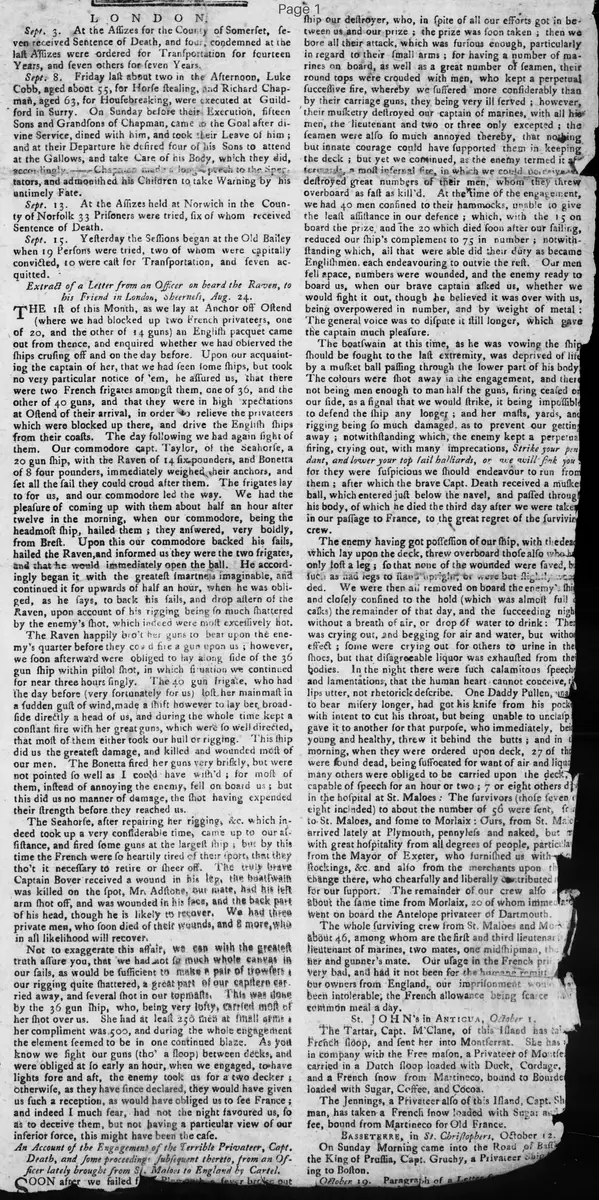
Soon after we sailed the fever broke out on ship our destroyer, who, in spite of all our efforts got in between us and our prize; the prize was soon taken; then we bore all their attack, which was furious enough, particularly in regard to their small arms; for having a number of marines on board, as well as a great number of seamen, their round tops were crowded with men, who kept a perpetual musketry fire, whereby we suffered more considerably than by their carriage guns, they being very ill served; however, their musketry destroyed our captain of marines, with all his men, the lieutenant and two or three only excepted; the seamen were also so much annoyed thereby, that nothing but innate courage could have supported them in keeping the deck; but yet we continued, as the enemy termed it afterwards, a most infernal resistance, in which we could perceive destroyed great numbers of their men, whom they threw overboard as fast as killed. At the time of the engagement, we had 40 men confined to their hammocks, unable to give the least assistance in our defence; which, with the 15 on board the prize and the 20 which died soon after our sailing, reduced our ship's complement to 75 in number; notwithstanding which, all that were able did their duty as became Englishmen, each endeavouring to outvie the rest. Our men fell apace, numbers were wounded, and the enemy ready to board us, when our brave captain asked us, whether we would fight it out, though he believed it was over with us, being overpowered in number, and by weight of metal: The general voice was to dispute it till the last, which gave the captain much pleasure. The boatswain at this time, as he was vowing the ship should be fought to the last extremity, was deprived of life by a musket ball passing through the lower part of his body. The colours were shot away in the engagement, and there not being men enough to man half the guns, firing ceased on our side, as a signal that we would strike, it being impossible to defend the ship any longer; and her masts, yards, and rigging being so much damaged, as to prevent our getting away; notwithstanding which, the enemy kept a perpetual firing, crying out, with many imprecations, Strike your pendant, and lower your topsail halliards, or we will sink you, for they were suspicious we should endeavour to run from them; after which the brave Capt. Death received a musket ball, which entered just below the navel, and passed through his body, of which he died the third day after we were taken in our passage to France, to the great regret of the surviving crew. The enemy having got possession of our ship, with the dead which lay upon the deck, threw overboard those also who had only lost a leg; so that none of the wounded were saved but such as had legs to stand upright, or were but slightly wounded. We were then all removed on board the enemy's ship and closely confined to the hold (which was almost full of casks) the remainder of that day, and the succeeding night without a breath of air, or drop of water to drink: There was crying out, and begging for air and water, but without effect; some were crying out for others to urine in the shoes, but that disagreeable liquor was exhausted from the bodies. In the night there were such calamitous speeches and lamentations; that the human heart cannot conceive, the lips utter, nor rhetoric describe. One Daddy Pullen, unable to bear misery longer, had got his knife from his pocket with intent to cut his throat, but being unable to unclasp it gave it to another for that purpose, who immediately, being young and healthy, threw it behind the butts; and in the morning, when they were ordered upon deck, 27 of them were found dead, being suffocated for want of air and liquor; many others were obliged to be carried upon the deck, incapable of speech for an hour or two; 7 or eight others died in the hospital at St. Maloes: The survivors (those even of eight included) to about the number of 46 were sent to St. Maloes, and some to Morlaix: Ours from St. Maloes arrived lately at Plymouth, penniless and naked, but met with great hospitality from all degrees of people, particularly from the Mayor of Exeter, who furnished us with shoes, stockings, &c. and also from the merchants upon the Change there, who cheerfully and liberally contributed money for our support. The remainder of our crew also about the same time from Morlaix, 20 of whom immediately went on board the Antelope privateer of Dartmouth. The whole surviving crew from St. Maloes and Morlaix about 46, among whom are the first and third lieutenant (second lieutenant of marines, two mates, one midshipman, the gunner and gunner's mate. Our usage in the French prison was very bad, and had it not been for the humane remittances of our owners from England, our imprisonment would have been intolerable; the French allowance being scarce a common meal a day.
What sub-type of article is it?
What keywords are associated?
What entities or persons were involved?
Where did it happen?
Foreign News Details
Primary Location
St. Maloes
Key Persons
Outcome
ship captured; capt. death died from wounds; 27 suffocated in hold, 7-8 died in hospital; total survivors about 46 sent to st. maloes and morlaix; wounded with lost limbs thrown overboard; enemy threw dead overboard.
Event Details
The Terrible privateer, under Capt. Death, lost a prize to a French destroyer after a fierce engagement at sea. Despite fever reducing crew to 75, they fought bravely but were overpowered. Ship struck after heavy losses; survivors endured brutal confinement in hold, leading to deaths, then imprisoned in France before cartel return to England.