Thank you for visiting SNEWPapers!
Sign up free
The New Orleans Bulletin
New Orleans, Orleans County, Louisiana
What is this article about?
Wm. R. Whitaker opines that the Second District Court of Orleans Parish has authority under the 1802 Act to naturalize foreigners, citing legal history and precedents. He advises election officials to recognize such naturalizations for voter registration, warning of penalties for denial.
Clipping
OCR Quality
Full Text
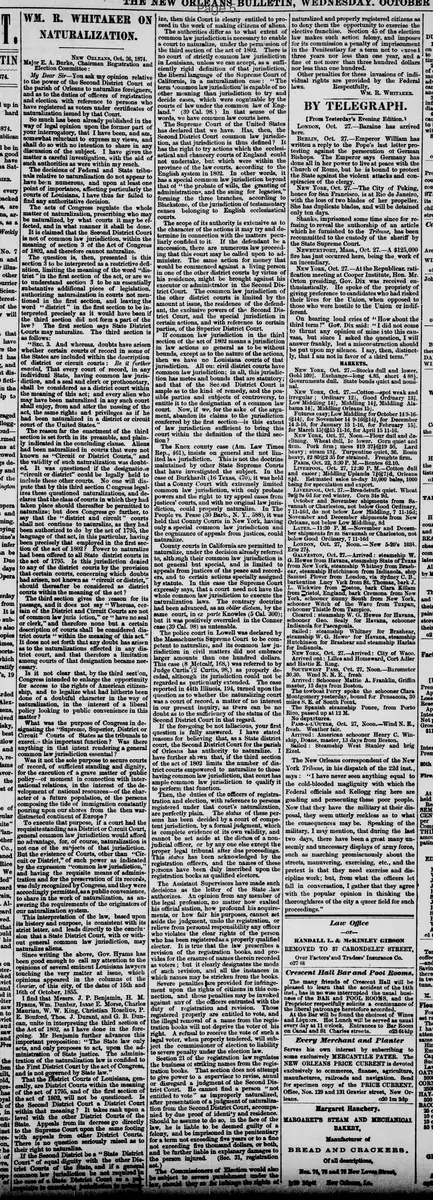
New Orleans, Oct. 26, 1874.
Major E. A. Burke, Chairman Registration and Election Committee:
My Dear Sir-You ask my opinion relative to the power of the Second District Court of the parish of Orleans to naturalize foreigners, and as to the duties of officers of registration and election with reference to persons who have registered as voters under certificates of naturalization issued by that Court.
So much has been already published in the way of legal opinion upon the former part of your interrogatory, that I have been, and am, somewhat reluctant to express my views, and shall do so with no intention to share in any discussion of the subject. I have given the matter a careful investigation, with the aid of such authorities as were within my reach.
The decisions of Federal and State tribunals relative to naturalization do not appear to have been numerous, and upon at least one point of importance, affecting particularly the courts of Louisiana, I have thus far failed to find any authoritative decision.
The acts of Congress regulate the whole matter of naturalization, prescribing who may be naturalized, by what courts it may be effected, and in what manner it shall be done. It is claimed that the Second District Court is not of common law jurisdiction, within the meaning of section 3 of the Act of Congress of 1802, and therefore cannot naturalize.
The question is, then, presented is this section 3 to be interpreted as a restrictive definition, limiting the meaning of the word "district" in the first section of the act, or are we to understand section 3 to be an essentially substantive additional piece of legislation, authorizing naturalization in courts not mentioned in the first section, and leaving the word "district" in the first section to be interpreted precisely as it would have been if the third section did not form a part of the law? The first section says State District Courts may naturalize. The third section is as follows:
"Sec. 3. And whereas, doubts have arisen whether certain courts of record in some of the States are included within the description of district or circuit courts: Be it further enacted, That every court of record, in any individual State, having common law jurisdiction, and a seal and clerk or prothonotary, shall be considered as a district court within the meaning of this act; and every alien who may have been naturalized in any such court shall enjoy, from and after the passing of the act, the same rights and privileges as if he had been naturalized in a district or circuit court of the United States."
The reason for the enactment of the third section is set forth in its preamble, and plainly indicated in the concluding clause. Aliens had been naturalized in courts that were not known as "Circuit or District Courts," and the validity of such naturalization was doubted. It was questioned if the designations "circuit or district" could be legally held to include these other courts. No one will dispute that by this third section Congress legalizes these questioned naturalizations, and declares that the class of courts in which they had taken place should thereafter be permitted to naturalize; but does Congress go further, to say that the "district and circuit" courts shall not continue to naturalize, as they had been authorized to do by the act of 1795, the language of that act, in this particular, having been precisely that employed in the first section of the act of 1802? Power to naturalize had been offered to all State district courts in the act of 1795. Is this jurisdiction denied to any of the district courts by the provision that certain courts, concerning which doubts had arisen, not known as "circuit or district," should thereafter be considered as district courts within the meaning of the act?
The third section gives the reason for its passage, and it does not say "Whereas, certain of the District and Circuit Courts are not of common law jurisdiction," or "have no seal or clerk," and therefore none but a certain description of courts shall be considered district courts "within the meaning of this act." It does not set forth that any doubt has arisen as to the naturalizations effected in any district court, and that therefore a limitation among courts of that designation became necessary.
Is it not clear that, by the third section, Congress intended to enlarge the opportunity for access to the rights of American citizenship, and to legalize what had hitherto been done of a doubtful character in the way of naturalization, in the interest of a liberal policy looking to public convenience in this matter?
What was the purpose of Congress in designating the "Supreme, Superior, District or Circuit" Courts of States as the tribunals to exercise this important function? Was there anything in that intent rendering a general common law jurisdiction essential?
Was it not the sole purpose to secure courts of record, of sufficient standing and dignity, for the execution of a grave matter of public policy-of moment in connection with international relations, in the interest of the development of national resources-of the character of a future population, of the persons composing the tide of immigration constantly pouring upon our shores from the then war-distracted continent of Europe?
To execute that purpose, if a court had the requisite standing as a District or Circuit Court, general common law jurisdiction would afford no advantage, for, of course, naturalization is not one of the subjects of that jurisdiction. But the existence of Courts, other than "Circuit or District," of such power as indicated by the expression "common law jurisdiction," and having the requisite means of administration and for the preservation of its records, was duly recognized by Congress, and they were accordingly permitted, as a public convenience, to share in the work of naturalization, as answering the requirements of the originators of our naturalization system.
This interpretation of the law, based upon its history and purpose, is consistent with its strict letter, and leads directly to the conclusion that a State District Court, with or without general common law jurisdiction, may naturalize aliens.
Since writing the above, Gov. Hyams has been good enough to call my attention to the opinions of several eminent Louisiana lawyers touching the very matter at issue, which opinions appeared in the columns of the Courier, of this city, of the dates of 15th and 16th of October, 1855.
I find that Messrs. J. P. Benjamin, H. M. Hyams, Wm. Dunbar, Isaac E. Morse, Charles Maurian, W. W. King, Christian Roselius, P. E. Bonford, Thos. J. Durant, and G. B. Duncan, unite in interpreting the third section of the Act of 1802, as I have done in the foregoing. Mr. Benjamin further advances this important proposition: "The State law only acts, and only proposes to act, upon the administration of State justice. The administration of the naturalization law is confided to the First District Court by the act of Congress, and is not governed by State law."
That the District Courts of Louisiana, generally, are District Courts within the meaning of the act of 1795, and of the first section of the act of 1802, will not be questioned. Is the Second District Court a District Court within that meaning? It takes rank upon a level with the other District Courts of the State. Appeals from its decrees go directly to the Supreme Court upon the same footing as appeals from other District Courts. There is no question seriously raised as to their right to naturalize.
If the Second District be a "State District Court" of equal dignity with the other District Courts of the State, and if a general common law jurisdiction be not required in the case of a State District Court as a pre-requisite to its power to naturalize, then this Court is clearly entitled to proceed in the work of making citizens of aliens.
The authorities differ as to what extent of common law jurisdiction is necessary to enable a court to naturalize, under the permission of the third section of the act of 1802. There is no court of strictly common law jurisdiction in Louisiana, unless we can accept, as a sufficiently rigid definition of that jurisdiction, the liberal language of the Supreme Court of California, in a naturalization case: The term "common law jurisdiction" is capable of no other meaning than jurisdiction to try and decide cases, which were cognizable by the courts of law under the common law of England. (39 Cal. 98.) In that sense of the words, we have common law courts here.
The Supreme Court of the United States has declared that we have. Has, then, the Second District Court common law jurisdiction, as that jurisdiction is thus defined? It has the right to try actions which the ecclesiastical and chancery courts of England could not undertake, but which were within the province of the law courts, according to the English system in 1802. In other words, it has a special common law jurisdiction beyond that of "the probate of wills, the granting of administrations, and the suing for legacies," forming the three branches, according to Blackstone, of the jurisdiction of testamentary causes belonging to English ecclesiastical courts.
The scope of its authority is extensive as to the character of the actions it may try and determine in connection with the matters peculiarly confided to it. If the defendant be a succession, there are numerous law proceedings that this court may be called upon to administer. The same action for money that would be commenced against a living person in one of the other district courts by virtue of his residence, might be brought against his executor or administrator in the Second District Court. The common law jurisdiction of the other district courts is limited by the amount at issue, the residence of the defendant, the exclusive powers of the Second District Court, and the special jurisdiction in certain actions, and with reference to certain parties, of the Superior District Court.
If common law jurisdiction in the third section of the act of 1802 means a jurisdiction in law actions so general as to be without bounds, except as to the nature of the actions, then we have no Louisiana courts of that jurisdiction. All our civil district courts have common law jurisdiction; in all, this jurisdiction has metes and bounds that are statutory; and that of the Second District Court is ample as to the kind of remedy, and the possible parties and subjects of controversy, to entitle it to the designation of a common law court. Now, if we, for the sake of the argument, abandon its claims to the jurisdiction conferred by the first section-is this extent of law jurisdiction sufficient to bring this court within the definition of the third section?
The Knox county case (Am. Law Times Rep., 461), insists on general and not limited law jurisdiction. This is not the doctrine maintained by other State Supreme Courts that have investigated the subject. In the case of Burkhardt (16 Texas, 470), it was held that a County Court with extremely limited common law jurisdiction, with only probate powers and the right to try appeal cases from justices' courts, and with no original law jurisdiction, could properly naturalize. In The People vs. Pease (30 Barb., N. Y., 588), it was held that County Courts in New York, having only a special common law jurisdiction and the cognizance of appeals from justices, could naturalize.
County courts in California are permitted to naturalize, under the decision already referred to, although their common law jurisdiction is not general but special, and is limited to appeals from justices of the peace and recorders, and to certain actions specially assigned by statute. In this case the Supreme Court expressly says, that a court need not have the whole common law jurisdiction to execute the naturalization laws. The contrary doctrine had been advanced, as an obiter dictum, by the same court, in ex parte Knowles (5 Cal. 300); but it was positively overruled in the Conner case (39 Cal. 98) as untenable.
The police court in Lowell was declared by the Massachusetts Supreme Court to be competent to naturalize, and its common law jurisdiction in civil matters did not embrace larger amounts than one hundred dollars. This case (8 Metcalf, 168,) was referred to by Judge Curtis (2 Curtis, 98,) as properly decided, although its jurisdiction could not be regarded as particularly extended. The case reported in 44th Illinois, 194, turned upon the question as to whether the naturalizing court was a court of record, a matter of no interest in our present inquiry, as there can be no doubt as to the sufficiency of the status of the Second District Court in that regard.
If the foregoing be not fallacious, your first question is fully answered. I have stated reasons for believing that, as a State district court, the Second District Court for the parish of Orleans has authority to naturalize. I have further shown that, if the third section of the act of 1802 limits the number of district courts empowered to naturalize to those having common law jurisdiction, that court has ample common law jurisdiction to qualify it to perform that function.
Then, the duties of the officers of registration and election, with reference to persons registered under that court's naturalization, are perfectly plain. The status of these persons has been decided by a court of competent jurisdiction, by a formal judgment, which is complete evidence of its own validity, and cannot be set aside at the dictum of a non-judicial officer, or by any one else except the proper legal tribunal after due proceedings.
This status has been acknowledged by the registration officers, and the names of these persons have been duly inscribed upon the registration books as qualified electors. The Assistant Supervisors have made such decisions as the letter of the State law authorizes. An opinion from any member of the legal profession, no matter how exalted his official station, how profound his acquirements, or how fair his purposes, cannot set aside the judgment, undo the registration, or relieve from personal responsibility any officer who violates the clear rights of the person who has been registered as a properly qualified elector.
It is true that the law prescribes a revision of the registration books, and provides for the erasure of names therein recorded as voters; but it clearly designates the mode of such revision, and all the instances in which names may be stricken from the books. Severe penalties are provided for infringement upon the rights of citizens in this connection, and those penalties may be invoked against any of the officers entrusted with the duty of registration and revision. Those registered properly are entitled to vote, and the illegal removal of a name from the registration books will not deprive the voter of his right. A refusal to receive the vote of such a legal voter, when properly tendered, will subject the commissioner of election to liability to severe penalty under the election law.
Section 21 of the registration law regulates the business of striking names from the registration books. That section does not attempt to give power to a supervisor to revise, annul or disregard a judgment of the Second District Court. He cannot find a person "not entitled to vote" as improperly naturalized, after presentation of a judgment of naturalization from the Second District Court, accompanied by due proof of identity and residence. Should he assume to do so, in the face of the law, he is liable to be deemed guilty of a felony, and be imprisoned in the penitentiary for a term not exceeding five years or to a fine not exceeding five thousand dollars, or both, and be further liable in exemplary damages to the person injured. (Sec. 31, registration act.)
The Commissioners of Election would also be subject to severe punishment under the law, should they so far interfere with the rights of naturalized and properly registered citizens as to deny them the opportunity to exercise the elective franchise. Section 45 of the election law makes such action felony, and imposes for its commission a penalty of imprisonment in the Penitentiary for a term not to exceed three years nor less than one year, and a fine of not more than three hundred dollars nor less than one hundred.
Other penalties for these invasions of individual rights are provided by the Federal laws.
Respectfully,
WM. R. WHITAKER.
What sub-type of article is it?
What themes does it cover?
What keywords are associated?
What entities or persons were involved?
Letter to Editor Details
Author
Wm. R. Whitaker
Recipient
Major E. A. Burke, Chairman Registration And Election Committee
Main Argument
the second district court of the parish of orleans has the power to naturalize foreigners under the act of congress of 1802, regardless of common law jurisdiction requirements, and officers of registration and election must recognize such naturalizations for voting purposes, facing severe penalties for denial.
Notable Details