Thank you for visiting SNEWPapers!
Sign up free
National Gazette
Philadelphia, Philadelphia County, Pennsylvania
What is this article about?
A Querist defends Thomas Jefferson against recent calumnies by 'Catullus' (1792), contrasting them with positive mentions by 'Publius' in the Federalist (1788). Questions any connection between the two writers and predicts the attacks will fail to sway American public opinion.
Clipping
OCR Quality
Full Text
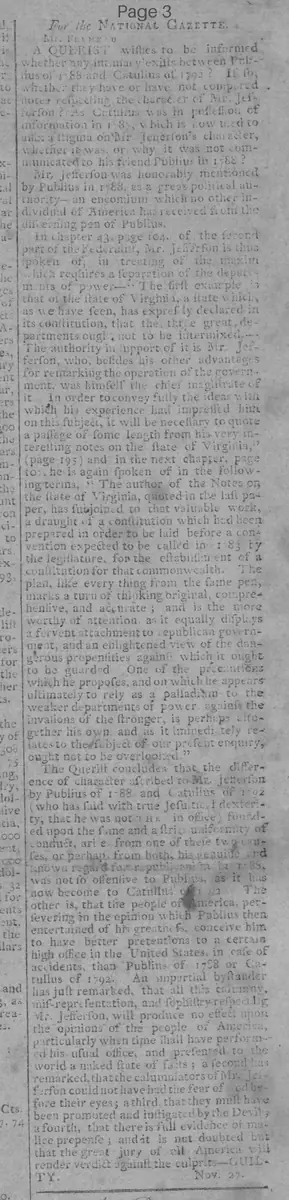
A Querist wishes to be informed whether any intimacy exists between Publius of 1788 and Catullus of 1792? If so, whether they have or have not compared notes respecting the character of Mr. Jefferson? If Catullus was in possession of information in 1788, which is now used to sully the stigma on Mr. Jefferson's character, whether it was, or why it was not communicated to his friend Publius in 1788?
Mr. Jefferson was honorably mentioned by Publius in 1788, as a great political authority—an encomium which no other individual of America has received from the discerning pen of Publius.
In chapter 43, page 104, of the second part of the Federalist, Mr. Jefferson is thus spoken of, in treating of the maxim 'which requires a separation of the departments of power—I. The first example is that of the state of Virginia, a state which, as we have seen, has expressly declared in its constitution, that the three great departments ought not to be intermingled—The authority in support of it is Mr. Jefferson, who, besides his other advantages for remarking the operation of the government, was himself the chief magistrate of it. In order to convey fully the ideas with which his experience had impressed him on this subject, it will be necessary to quote a passage of some length from his very interesting notes on the state of Virginia, (page 195) and in the next chapter, page 110, he is again spoken of in the following terms, 'The author of the Notes on the state of Virginia, quoted in the last paper, has subjoined to that valuable work, a draught of a constitution which he had been prepared in order to be laid before a convention expected to be called in 1782 by the legislature, on the establishment of a constitution for that commonwealth. The plan, like every thing from the same pen, marks a turn of thinking original, comprehensive, and accurate; and is the more worthy of attention as it equally displays a fervent attachment to republican government, and an enlightened view of the dangerous propensities against which it ought to be guarded. One of the precautions which he proposes, and on which he appears ultimately to rely as a palladium to the weaker departments of power against the invasions of the stronger, is perhaps altogether his own, and as it immediately relates to the subject of our present enquiry, ought not to be overlooked.'
The Querist concludes that the difference of character ascribed to Mr. Jefferson by Publius of 1788 and Catullus of 1792 (who has said with true Jesuitical dexterity, that he was not in office) sourced upon the fine and entire uniformity of conduct, arise from one of these two causes, or perhaps from both, his known regard for republicanism in 1788 was not so offensive to Publius, as it has now become to Catullus of 1792. The other is, that the people of America, persevering in the opinion which Publius then entertained of his greatness, conceive him to have better pretensions to a certain high office in the United States, in case of accidents, than Publius of 1788 or Catullus of 1792. An impartial bystander has just remarked, that all this calumny, misrepresentation, and sophistry respecting Mr. Jefferson, will produce no effect upon the opinions of the people of America, particularly when time shall have performed his usual office, and presented to the world a naked state of facts; a second has remarked, that the calumniators of Mr. Jefferson could not have had the fear of God before their eyes; a third, that they must have been prompted and instigated by the Devil, a fourth, that there is full evidence of malice prepense; and it is not doubted but that the grand jury of all America will render a verdict against the culprits—GUILTY.
Nov. 27.
What sub-type of article is it?
What themes does it cover?
What keywords are associated?
What entities or persons were involved?
Letter to Editor Details
Author
A Querist
Recipient
National Gazette
Main Argument
questions the connection between publius (1788) and catullus (1792) regarding their shifting views on jefferson's character, defends jefferson using federalist quotes, and asserts that calumnies against him will not influence american public opinion due to his republican virtues and potential for high office.
Notable Details