Thank you for visiting SNEWPapers!
Sign up free
Story
March 1, 1830
Phenix Gazette
Alexandria, Virginia
What is this article about?
In a U.S. Senate debate, Daniel Webster refutes Robert Hayne's doctrine of state nullification, defending the supremacy of the federal Constitution over state interference, emphasizing the government's origin from the people and rejecting states' rights to annul federal laws like the Tariff.
Clipping
OCR Quality
95%
Excellent
Full Text
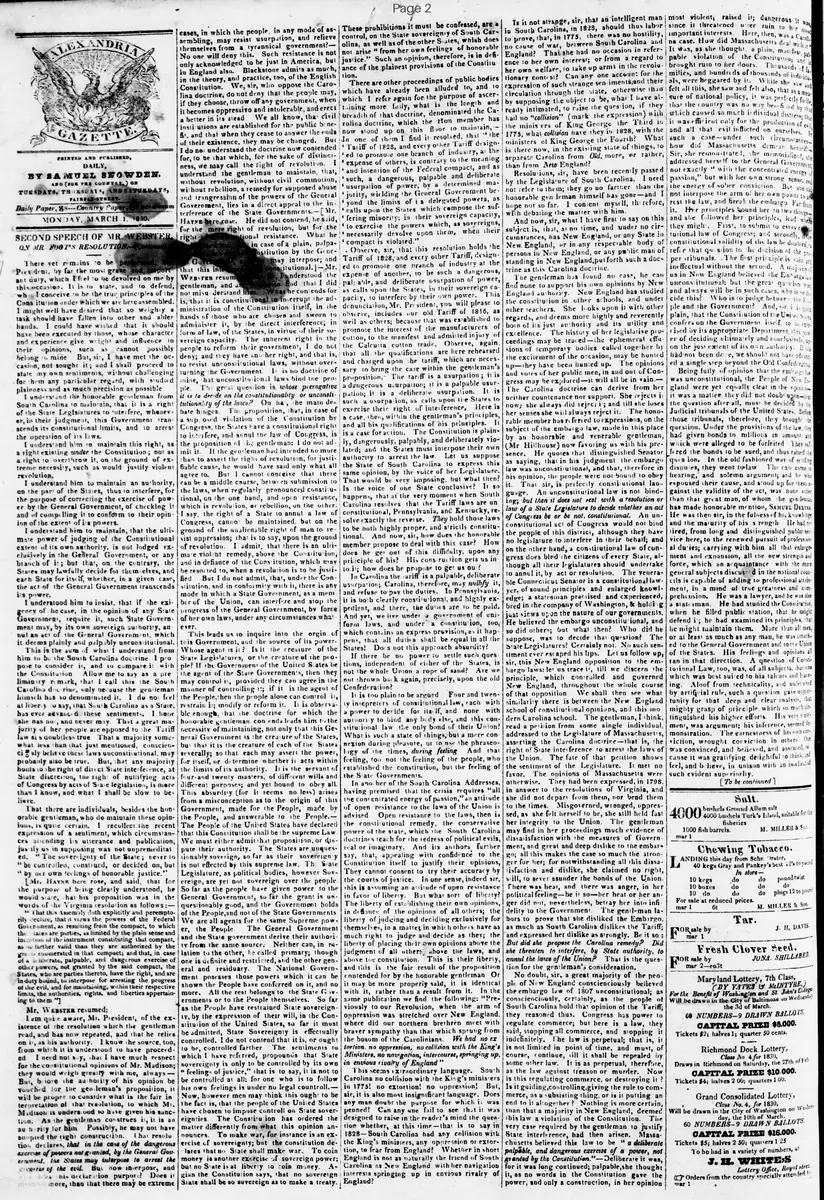
SECOND SPEECH OF MR WEBSTER
ON MR. HAYNE'S RESOLUTION
There yet remains to be discharged, by the President, by far the most grave and important duty, which I feel to be devolved on me by this occasion. It is to state, and to defend, what I conceive to be the true principles of the Constitution under which we are here assembled.
I might well have desired that so weighty a task should have fallen into other and abler hands. I could have wished that it should have been executed by those, whose character and experience give weight and influence to their opinions, such as cannot possibly belong to mine But, sir, I have met the occasion, not sought it; and I shall proceed to state my own sentiments, without challenging for them any particular regard, with studied plainness and as much precision as possible
I understand the honorable gentleman from South Carolina to maintain, that it is a right of the State Legislatures to interfere, whenever, in their judgment, this Government transcends its constitutional limits, and to arrest the operation of its laws.
I understand him to maintain this right, as a right existing under the Constitution; not as a right to overthrow it, on the ground of extreme necessity, such as would justify violent revolution.
I understand him to maintain an authority, on the part of the States, thus to interfere, for the purpose of correcting the exercise of power by the General Government, of checking it and of compelling it to conform to their opinion of the extent of its powers.
I understand him to maintain, that the ultimate power of judging of the Constitutional extent of its own authority, is not lodged exclusively in the General Government, or any branch of it; but that, on the contrary, the States may lawfully decide for themselves, and each State for itself, whether, in a given case, the act of the General Government transcends its power.
I understood him to insist, that if the exigency of the case, in the opinion of any State Government, require it, such State Government may, by its own sovereign authority, annul an act of the General Government, which it deems plainly and palpably unconstitutional.
This is the sum of what I understand from him to be the South Carolina doctrine I propose to consider it, and to compare it with the Constitution Allow me to say as a preliminary remark, that I call this the South Carolina doctrine, only because the gentleman himself has so denominated it. I do not feel at liberty to say, that South Carolina as a State, has ever advanced these sentiments. I hope she has not, and never may. That a great majority of her people are opposed to the Tariff law is doubtless true That a majority somewhat less than that just mentioned, conscientiously believe these laws unconstitutional, may probably also be true. But, that any majority holds to the right of direct State interference, at State discretion, the right of nullifying acts of Congress by acts of State legislation, is more than I know, and what I shall be slow to believe.
That there are individuals, besides the honorable gentleman, who do maintain these opinions, is quite certain. I recollect the recent expression of a sentiment, which circumstances attending its utterance and publication, justify us in supposing was not unpremeditated. "The sovereignty of the State; never to be controlled, construed, or decided on, but by our own feelings of honorable justice."
Mr. Hayne here rose, and said, that for the purpose of being clearly understood, he would state, that his proposition was in the words of the Virginia resolution as follows:-
"That this Assembly doth explicitly and peremptorily declare, that it views the powers of the Federal Government, as resulting from the compact, to which the states are parties, as limited by the plain sense and intention of the instrument constituting that compact, and as no farther valid than they are authorized by the grants enumerated in that compact; and that, in case of a deliberate, palpable, and dangerous exercise of other powers, not granted by the said compact, the States, who are parties thereto, have the right, and are in duty bound, to interpose for arresting the progress of the evil, and for maintaining, within their respective limits, the authorities, rights, and liberties appertaining to them."
Mr. WEBSTER resumed:
I am quite aware, Mr. President, of the existence of the resolution which the gentleman read, and has now repeated, and that he relies on it, as his authority. I know the source, too from which it is understood to have proceeded I need not say, that I have much respect for the constitutional opinions of Mr. Madison: they would weigh greatly with me, always- But, before the authority of his opinion be vouched for the gentleman's proposition, it will be proper to consider what is the fair interpretation of that resolution, to which Mr. Madison is understood to have given his sanction. As the gentleman construes it, it is an authority for him Possibly, he may not have adopted the right construction. That resolution declares, that in the case of the dangerous exercise of powers not granted, by the General Government, the States may interpose to arrest the progress of the evil. But how interpose? In what way? Does it mean that the States are to interpose by force? Does it mean that the States are to interpose by their own legislation? Does it mean more, than that there may be extreme cases, in which the people, in any mode of assembling, may resist usurpation, and relieve themselves from a tyrannical government?- No one will deny this. Such resistance is not only acknowledged to be just in America, but in England also. Blackstone admits as much, in the theory, and practice, too, of the English Constitution. We, sir, who oppose the Carolina doctrine, do not deny that the people may, if they choose, throw off any government, when it becomes oppressive and intolerable, and erect a better in its stead We all know, that civil institutions are established for the public benefit. and that when they cease to answer the ends of their existence. they may be changed. But I do not understand the doctrine now contended for, to be that which, for the sake of distinctness, we may call the right of revolution. I understand the gentleman to maintain, that, without revolution, without civil commotion, without rebellion, a remedy for supposed abuse and transgression of the powers of the General Government, lies in a direct appeal to the interference of the State Governments.-Mr. Hayne here rose. He did not contend, he said, for the mere right of revolution, but for the right of constitutional resistance. What he contended for was, that in case of a plain, palpable violation of the Constitution by the General Government, a State might interpose; and that this interposition was constitutional.- Mr. WEBSTER resumed- I understood the gentleman, and a God that I did not misunderstand him Where he contends for is, that it is constitutional to interrupt the administration of the Constitution itself, in the hands of those who are chosen and sworn to administer it, by the direct interference, in form of law, of the States, in virtue of their sovereign capacity. The inherent right in the people to reform their government, I do not deny; and they have another right, and that is, to resist unconstitutional laws, without overturning the Government. It is no doctrine of mine, that unconstitutional laws bind the people. The great question is whose prerogative it is to decide on the constitutionality or unconstitutionality of the laws? On that, the debate hinges. The proposition, that, in case of a supposed violation of the Constitution by Congress, the States have a constitutional right to interfere, and annul the law of Congress, is the proposition of the gentleman: I do not admit it. If the gentleman had intended no more than to assert the right of revolution, for justifiable cause, he would have said only what all agree to. But I cannot conceive that there can be a middle course, between submission to the laws, when regularly pronounced constitutional, on the one hand, and open resistance, which is revolution, or rebellion, on the other. I say, the right of a State to annul a law of Congress, cannot be maintained, but on the ground of the unalienable right of man to resist oppression; that is to say, upon the ground of revolution. I admit, that there is an ultimate violent remedy, above the Constitution and in defiance of the Constitution, which may be resorted to, when a revolution is to be justified But I do not admit, that, under the Constitution, and in conformity with it, there is any mode in which a State Government, as a member of the Union, can interfere and stop the progress of the General Government, by force of her own laws, under any circumstances whatever.
This leads us to inquire into the origin of this Government, and the source of its power. Whose agent is it? Is it the creature of the State Legislatures, or the creature of the people? If the Government of the United States be the agent of the State Governments, then they may control it, provided they can agree in the manner of controlling it; if it is the agent of the People, then the people alone can control it, restrain, modify or reform it. It is observable enough, that the doctrine for which the honorable gentleman contends leads him to the necessity of maintaining, not only that this General Government is the creature of the States, but that it is the creature of each of the States severally; so that each may assert the power, for itself, or determine whether it acts within the limits of its authority. It is the servant of four-and-twenty masters, of different wills and different purposes; and yet bound to obey all.
This absurdity (for it seems no less) arises from a misconception as to the origin of this Government, made for the People, made by the People, and answerable to the People.- The People of the United States have declared that this Constitution shall be the supreme Law We must either admit that proposition, or dispute their authority. The States are unquestionably sovereign, so far as their sovereignty is not affected by this supreme law. The State Legislature, as political bodies, however Sovereign, are yet not sovereign over the people So far as the people have given power to the General Government, so far the grant is unquestionably good, and the Government holds of the People, and not of the State Governments We are all agents for the same Supreme power, the People The General Government and the State government derive their authority from the same source: Neither can, in relation to the other, be called primary; though one is definite and restricted, and the other general and residuary. The National Government possesses those powers which it can be shown the People have conferred on it, and no more. All the rest belongs to the State Governments or to the People themselves. So far as the People have restrained State sovereignty, by the expression of their will, in the Constitution of the United States, so far it must be admitted, State Sovereignty is effectually controlled. I do not contend that it is, or ought to be, controlled farther The sentiments to which I have referred, propounds that State sovereignty is only to be controlled by its own "feelings of justice," that is to say, it is not to be controlled at all: for one who is to follow his own feelings is under no legal control.- Now, however men may think this ought to be the fact is, that the people of the United States have chosen to impose control on State sovereignties The Constitution has ordered the matter differently from what this opinion announces. To make war, for instance is an exercise of sovereignty: but the constitution declares that no State shall make war. To coin money is another exercise of sovereign power: but no State is at liberty to coin money. Again the Constitution says, that no sovereign State shall be so sovereign as to make a treaty.
These prohibitions, it must be confessed, are a control on the State sovereignty of South Carolina, as well as of the other States, which does not arise "from her own feelings of honorable justice." Such an opinion, therefore, is in defiance of the plainest provisions of the Constitution.
There are other proceedings of public bodies which have already been alluded to, and to which I refer again for the purpose of ascertaining more fully, what is the length and breadth of that doctrine, denominated the Carolina doctrine, which the Hon member has now stood up on this floor to maintain, -
In one of them I find it resolved, that "the Tariff of 1828, and every other Tariff designed to promote one branch of industry at the expense of others, is contrary to the meaning and intention of the Federal compact, and as such, a dangerous, palpable and deliberate usurpation of power, by a determined majority, wielding the General Government beyond the limits of its delegated powers, as calls upon the States which compose the suffering minority: in their sovereign capacity, to exercise the powers which, as sovereigns, necessarily devolve upon them, when their compact is violated."
Observe, sir, that this resolution holds the Tariff of 1828, and every other Tariff, designed to promote one branch of industry at the expense of another, to be such a dangerous, palpable, and deliberate usurpation of power, as calls upon the States, in their sovereign capacity, to interfere by their own power. This denunciation, Mr. President, you will please to observe, includes our old Tariff of 1816, as well as others; because that was established to promote the interest of the manufacturers of cotton, to the manifest and admitted injury of the Calcutta cotton trade. Observe, again, that all the qualifications are here rehearsed and charged upon the tariff, which are necessary to bring the case within the gentleman's proposition. The tariff is a usurpation; it is a dangerous usurpation; it is a palpable usurpation; it is a deliberate usurpation. It is such a usurpation, as calls upon the States to exercise their right of interference. Here is a case, then, within the gentleman's principles, and all his qualifications of his principles. It is a case for action. The Constitution is plainly, dangerously, palpably, and deliberately violated; and the States must interpose their own authority to arrest the law. Let us suppose the State of South Carolina to express this same opinion, by the voice of her Legislature. That would be very imposing. but what then? Is the voice of one State conclusive? It so happens, that at the very moment when South Carolina resolves that the Tariff laws are unconstitutional, Pennsylvania, and Kentucky, resolve exactly the reverse. They hold those laws to be both highly proper, and strictly constitutional. And now, sir, how does the honorable member propose to deal with this case? How does he get out of this difficulty, upon any principle of his? His construction gets us in to it; how does he propose to get us out? In Carolina the tariff is a palpable, deliberate usurpation; Carolina, therefore, may nullify it, and refuse to pay the duties. In Pennsylvania, it is both clearly constitutional, and highly expedient; and there, the duties are to be paid. And yet, we live under a government of uniform laws. and under a constitution, too, which contains an express provision, as it happens, that all duties shall be equal in all the States! Does not this approach absurdity? If there be no power to settle such questions, independent of either of the States, is not the whole Union a rope of sand? Are we not thrown back again, precisely, upon the old Confederation?
It is too plain to be argued Four and twenty interpreters of constitutional law, each with a power to decide for itself, and none with authority to bind any body else, and this constitutional law the only bond of their Union? What is such a state of things, but a mere connexion during pleasure, or to use the phraseology of the times, during feeling And that feeling, too not the feeling of the people, who established the constitution, but the feeling of the State Governments.
In another of the South Carolina Addresses, having premised that the crisis requires "all the concentrated energy of passion," an attitude of open resistance to the laws of the Union is advised Open resistance to the laws, then is the constitutional remedy. the conservative power of the state, which the South Carolina doctrines teach for the redress of political evils. real or imaginary. And its authors further say, that, appealing with confidence to the Constitution itself to justify their opinions. They cannot consent to try their accuracy by the courts of justice. In one sense, indeed sir. this is assuming an attitude of open resistance in favor of liberty. But what sort of liberty? The liberty of establishing their own opinions, in defiance of the opinions of all others; the liberty of judging and deciding exclusively for themselves, in a matter in which others have as much right to judge and decide as they; the liberty of placing their own opinions above the judgment of all others, above the laws, and above the constitution. This is their liberty, and this is the fair result of the proposition contended for by the honorable gentleman Or it may be more properly said, it is identical with it, rather than a result from it. In the same publication we find the following: "Previously to our Revolution, when the arm of oppression was stretched over New England. where did our northern brethren meet with braver sympathy than that which sprung from the bosom of the Carolinians. We had no extortion. no oppression. no collision with the King's Ministers, no navigation, intercourse, springing up, in envious rivalry of England "
This seems extraordinary language. South Carolina no collision with the King's ministers in 1775! no extortion! no oppression! But sir, it is also most insignificant language. Does any man doubt the purpose for which it was penned? Can any one fail to see that it was designed to raise in the reader's mind the question whether, at this time -that is to say in 1828-South Carolina had any collision with the King's ministers. any oppression or extortion, to fear from England? Whether in short England is not as naturally the friend of South Carolina as New England with her navigation interests springing up in envious rivalry of England?
Is it not strange, sir, that an intelligent man in South Carolina, in 1828, should thus labor to prove, that, in 1775, there was no hostility. no cause of war, between South Carolina and England? That she had no occasion in reference to her own interest; or from a regard to her own welfare, to take up arms in the revolutionary contest? Can any one account for the expression of such strange sentiments, and their circulation through the state, otherwise than by supposing the object to be, what I have already intimated, to raise the question, if they had no "collision" (mark the expression) with the ministers of King George the Third in 1775, what collision have they in 1828, with the ministers of King George the Fourth? What is there now, in the existing state of things, to separate Carolina from Old, more, or rather, than from New England?
Resolutions, sir, have been recently passed by the Legislature of South Carolina. I need not refer to them; they go no further than the honorable gentleman himself has gone-and I hope not so far. I content myself, therefore, with debating the matter with him.
And now, sir, what I have first to say on this subject is, that, at no time, and under no circumstances, has New England, or any State in New England, or in any respectable body of persons in New England, or any public man of standing in New England, put forth such a doctrine as this Carolina doctrine.
The gentleman has found no case, he can find none to support his own opinions by New England authority. New England has studied the constitution in other schools, and under other teachers. She looks upon it with other regards, and deems more highly and reverently born of its just authority and its utility and excellence. The history of her legislative proceedings may be traced-the ephemeral effusions of temporary bodies called together by the excitement of the occasion, may be hunted up-they have been hunted up. The opinions and votes of her public men, in and out of Congress may be explored-it will all be in vain.- The Carolina doctrine can derive from her neither countenance nor support. She rejects it now; she always did reject it; and till she loses her senses she will always reject it. The honorable member has referred to expressions, on the subject of the embargo law, made in this place by an honorable and venerable gentleman, (Mr Hillhouse) now favoring us with his presence. He quotes that distinguished Senator as saying, that in his judgment the embargo law was unconstitutional, and that, therefore in his opinion, the people were not bound to obey it. That sir, is perfectly constitutional language. An unconstitutional law is not binding; but then it does not rest with a resolution or law of a State Legislature to decide whether an act of Congress be or be not, constitutional. An unconstitutional act of Congress would not bind the people of this district, although they have no legislature to interfere in their behalf; and on the other hand, a constitutional law of congress does bind the citizens of every State, although all their Legislatures should undertake to annul it, by act or resolution. The venerable Connecticut Senator is a constitutional lawyer, yer, of sound principles and enlarged knowledge; a statesman practised and experienced, bred in the company of Washington, & holding just views upon the nature of our governments. He believed the embargo unconstitutional, and so did others; but what then? Who did he suppose, was to decide that question? The State Legislatures? Certainly not. No such sentiment ever escaped his lips. Let us follow up. sir, this New England opposition to the embargo laws: let us trace it, till we discern the principle, which controlled and governed New England, throughout the whole course of that opposition We shall then see what similarity there is between the New England school of constitutional opinions, and this modern Carolina school. The gentleman, I think. read a petition from some single individual, addressed to the Legislature of Massachusetts, asserting the Carolina doctrine-that is, the right of State interference to arrest the laws of the Union. The fate of that petition shows the sentiment of the Legislature. It met no favor. The opinions of Massachusetts were otherwise. They had been expressed, in 1798, in answer to the resolutions of Virginia, and she did not depart from them, nor bend them to the times. Misgoverned, wronged, oppressed, as she felt herself to be, she still held fast her integrity to the Union. The gentleman may find in her proceedings much evidence of dissatisfaction with the measures of Government, and great and deep dislike to the embargo; all this makes the case so much the stronger for her; for notwithstanding all this dissatisfaction and dislike, she claimed no right, still, to sever asunder the bonds of the Union. There was heat, and there was anger, in her political feeling--be it so-her heat or her anger did not, nevertheless, betray her into infidelity to the Government. The gentleman labors to prove that she disliked the Embargo. as much as South Carolina dislikes the Tariff; and expressed her dislike as strongly. Be it so : But did she propose the Carolina remedy? Did she threaten to interfere, by State authority, to annul the laws of the Union? That is the question for the gentleman's consideration.
No doubt, sir, a great majority of the people of New England conscientiously believed the embargo law of 1807 unconstitutional; as conscientiously, certainly, as the people of South Carolina hold that opinion of the Tariff; they reasoned thus. Congress has power to regulate commerce; but here is a law, they said, stopping all commerce, and stopping it indefinitely. The law is perpetual; that is, it is not limited in point of time, and must, of course, continue, till it shall be repealed by some other law. It is as perpetual, therefore, as the law against treason or murder. Now is this regulating commerce, or destroying it ? Is it guiding, controlling, giving the rule to commerce, as a subsisting thing. or is it putting an end to it altogether ? Nothing is more certain, than that a majority in New England, deemed this law a violation of the Constitution. The very case required by the gentleman to justify State interference, had then arisen. Massachusetts believed this law to be "a deliberate palpable, and dangerous exercise of a power, not granted by the Constitution."-Deliberate it was, for it was long continued; palpable, she thought it, as no words in the Constitution gave the power, and only a construction, in her opinion most violent) raised it; dangerous it was, since it threatened ruin to her most important interests Here then was a Carolina case How did Massachusetts deal with it?
It was, as she thought a plain manifest palpable brought violation of the Constitution and ruin to her doors of the Constitution and milies, and hundreds of thousands of individuals were beggared by it While she saw all this she saw and felt also that as a measure of national policy it was perfectly futile the country was no way benefited by it which caused so much individual distress; that it was efficient only for the production of evil and all that evil inflicted on ourselves
In such a case-under such circumstances- how did Massachusetts demean herself?
Sir she remonstrated she memorialized she addressed herself to the General Government not exactly with the concentrated energy of passion, but with her own strong sense. and the energy of sober conviction. But she did not interpose the arm of her own power to arrest the law, and break the embargo Far from it. Her principles found her to two things- and she followed her principles, lead where they might. First, to submit to every constitutional law of Congress; and secondly, if the constitutional validity of the law be doubted, to refer that question to the decision of the proper tribunals. The first principle is vain and ineffectual without the second. A majority of the people of New England believed the Embargo. unconstitutional: but the great question was and always will be in such cases, who is to decide this? Who is to judge between the People and the Government? And, sir it is quite plain, that the Constitution of the United States confers on the Government itself, to be exercised by its appropriate Department. this power of deciding ultimately and conclusively, upon the just extent of its own authority. If it had not been so, we should not have advanced a single step beyond the Old Confederation
Being fully of opinion that the embargo was unconstitutional, the People of New England were yet equally clear in the opinion- it was a matter they did not doubt upon-that the question after all, must be decided by the Judicial tribunals of the United States. Before those tribunals, therefore, they brought the question. Under the provisions of the law, they had given bonds to millions in amount. and which were alleged to be forfeited They suffered the bonds to be sued, and thus raised the question. In the old fashioned way of settling disputes, they went to law The case came to hearing, and solemn argument; and he who espoused their cause, and stood up for them against the validity of the act, was none other than that great man, of whom the gentleman has made honorable mention, Samuel Dexter
He was then sir, in the fulness of his knowledge and the maturity of his strength He had retired, from long and distinguished public service here, to the renewed pursuit of professional duties; carrying with him all that enlargement and expansion, all the new strength and force, which an acquaintance with the more general subjects discussed in the national councils is capable of adding to professional attainment, in a mind of true greatness and comprehension. He was a lawyer, and he was also a statesman. He had studied the Constitution when he filled public station, that he might defend it: he had examined its principles, that he might maintain them. More than all or at least as much as any man, he was attached to the General Government and to the Union of the States. His feelings and opinions all ran in that direction. A question of Constitutional Law, too, was, of all subjects, that which was best suited to his talents and learning. Aloof from technicality, and unembarrassed by artificial rule, such a question gave opportunity for that deep and clear analysis, that mighty grasp of principle, which so much distinguished his higher efforts. His very statement, was argument: his inference, seemed demonstration. The earnestness of his own conviction, wrought conviction in others One was convinced, and believed, and assented, because it was gratifying delightful to think, and feel, and believe, in unison with an intellect such evident superiority.
[To be continued]
ON MR. HAYNE'S RESOLUTION
There yet remains to be discharged, by the President, by far the most grave and important duty, which I feel to be devolved on me by this occasion. It is to state, and to defend, what I conceive to be the true principles of the Constitution under which we are here assembled.
I might well have desired that so weighty a task should have fallen into other and abler hands. I could have wished that it should have been executed by those, whose character and experience give weight and influence to their opinions, such as cannot possibly belong to mine But, sir, I have met the occasion, not sought it; and I shall proceed to state my own sentiments, without challenging for them any particular regard, with studied plainness and as much precision as possible
I understand the honorable gentleman from South Carolina to maintain, that it is a right of the State Legislatures to interfere, whenever, in their judgment, this Government transcends its constitutional limits, and to arrest the operation of its laws.
I understand him to maintain this right, as a right existing under the Constitution; not as a right to overthrow it, on the ground of extreme necessity, such as would justify violent revolution.
I understand him to maintain an authority, on the part of the States, thus to interfere, for the purpose of correcting the exercise of power by the General Government, of checking it and of compelling it to conform to their opinion of the extent of its powers.
I understand him to maintain, that the ultimate power of judging of the Constitutional extent of its own authority, is not lodged exclusively in the General Government, or any branch of it; but that, on the contrary, the States may lawfully decide for themselves, and each State for itself, whether, in a given case, the act of the General Government transcends its power.
I understood him to insist, that if the exigency of the case, in the opinion of any State Government, require it, such State Government may, by its own sovereign authority, annul an act of the General Government, which it deems plainly and palpably unconstitutional.
This is the sum of what I understand from him to be the South Carolina doctrine I propose to consider it, and to compare it with the Constitution Allow me to say as a preliminary remark, that I call this the South Carolina doctrine, only because the gentleman himself has so denominated it. I do not feel at liberty to say, that South Carolina as a State, has ever advanced these sentiments. I hope she has not, and never may. That a great majority of her people are opposed to the Tariff law is doubtless true That a majority somewhat less than that just mentioned, conscientiously believe these laws unconstitutional, may probably also be true. But, that any majority holds to the right of direct State interference, at State discretion, the right of nullifying acts of Congress by acts of State legislation, is more than I know, and what I shall be slow to believe.
That there are individuals, besides the honorable gentleman, who do maintain these opinions, is quite certain. I recollect the recent expression of a sentiment, which circumstances attending its utterance and publication, justify us in supposing was not unpremeditated. "The sovereignty of the State; never to be controlled, construed, or decided on, but by our own feelings of honorable justice."
Mr. Hayne here rose, and said, that for the purpose of being clearly understood, he would state, that his proposition was in the words of the Virginia resolution as follows:-
"That this Assembly doth explicitly and peremptorily declare, that it views the powers of the Federal Government, as resulting from the compact, to which the states are parties, as limited by the plain sense and intention of the instrument constituting that compact, and as no farther valid than they are authorized by the grants enumerated in that compact; and that, in case of a deliberate, palpable, and dangerous exercise of other powers, not granted by the said compact, the States, who are parties thereto, have the right, and are in duty bound, to interpose for arresting the progress of the evil, and for maintaining, within their respective limits, the authorities, rights, and liberties appertaining to them."
Mr. WEBSTER resumed:
I am quite aware, Mr. President, of the existence of the resolution which the gentleman read, and has now repeated, and that he relies on it, as his authority. I know the source, too from which it is understood to have proceeded I need not say, that I have much respect for the constitutional opinions of Mr. Madison: they would weigh greatly with me, always- But, before the authority of his opinion be vouched for the gentleman's proposition, it will be proper to consider what is the fair interpretation of that resolution, to which Mr. Madison is understood to have given his sanction. As the gentleman construes it, it is an authority for him Possibly, he may not have adopted the right construction. That resolution declares, that in the case of the dangerous exercise of powers not granted, by the General Government, the States may interpose to arrest the progress of the evil. But how interpose? In what way? Does it mean that the States are to interpose by force? Does it mean that the States are to interpose by their own legislation? Does it mean more, than that there may be extreme cases, in which the people, in any mode of assembling, may resist usurpation, and relieve themselves from a tyrannical government?- No one will deny this. Such resistance is not only acknowledged to be just in America, but in England also. Blackstone admits as much, in the theory, and practice, too, of the English Constitution. We, sir, who oppose the Carolina doctrine, do not deny that the people may, if they choose, throw off any government, when it becomes oppressive and intolerable, and erect a better in its stead We all know, that civil institutions are established for the public benefit. and that when they cease to answer the ends of their existence. they may be changed. But I do not understand the doctrine now contended for, to be that which, for the sake of distinctness, we may call the right of revolution. I understand the gentleman to maintain, that, without revolution, without civil commotion, without rebellion, a remedy for supposed abuse and transgression of the powers of the General Government, lies in a direct appeal to the interference of the State Governments.-Mr. Hayne here rose. He did not contend, he said, for the mere right of revolution, but for the right of constitutional resistance. What he contended for was, that in case of a plain, palpable violation of the Constitution by the General Government, a State might interpose; and that this interposition was constitutional.- Mr. WEBSTER resumed- I understood the gentleman, and a God that I did not misunderstand him Where he contends for is, that it is constitutional to interrupt the administration of the Constitution itself, in the hands of those who are chosen and sworn to administer it, by the direct interference, in form of law, of the States, in virtue of their sovereign capacity. The inherent right in the people to reform their government, I do not deny; and they have another right, and that is, to resist unconstitutional laws, without overturning the Government. It is no doctrine of mine, that unconstitutional laws bind the people. The great question is whose prerogative it is to decide on the constitutionality or unconstitutionality of the laws? On that, the debate hinges. The proposition, that, in case of a supposed violation of the Constitution by Congress, the States have a constitutional right to interfere, and annul the law of Congress, is the proposition of the gentleman: I do not admit it. If the gentleman had intended no more than to assert the right of revolution, for justifiable cause, he would have said only what all agree to. But I cannot conceive that there can be a middle course, between submission to the laws, when regularly pronounced constitutional, on the one hand, and open resistance, which is revolution, or rebellion, on the other. I say, the right of a State to annul a law of Congress, cannot be maintained, but on the ground of the unalienable right of man to resist oppression; that is to say, upon the ground of revolution. I admit, that there is an ultimate violent remedy, above the Constitution and in defiance of the Constitution, which may be resorted to, when a revolution is to be justified But I do not admit, that, under the Constitution, and in conformity with it, there is any mode in which a State Government, as a member of the Union, can interfere and stop the progress of the General Government, by force of her own laws, under any circumstances whatever.
This leads us to inquire into the origin of this Government, and the source of its power. Whose agent is it? Is it the creature of the State Legislatures, or the creature of the people? If the Government of the United States be the agent of the State Governments, then they may control it, provided they can agree in the manner of controlling it; if it is the agent of the People, then the people alone can control it, restrain, modify or reform it. It is observable enough, that the doctrine for which the honorable gentleman contends leads him to the necessity of maintaining, not only that this General Government is the creature of the States, but that it is the creature of each of the States severally; so that each may assert the power, for itself, or determine whether it acts within the limits of its authority. It is the servant of four-and-twenty masters, of different wills and different purposes; and yet bound to obey all.
This absurdity (for it seems no less) arises from a misconception as to the origin of this Government, made for the People, made by the People, and answerable to the People.- The People of the United States have declared that this Constitution shall be the supreme Law We must either admit that proposition, or dispute their authority. The States are unquestionably sovereign, so far as their sovereignty is not affected by this supreme law. The State Legislature, as political bodies, however Sovereign, are yet not sovereign over the people So far as the people have given power to the General Government, so far the grant is unquestionably good, and the Government holds of the People, and not of the State Governments We are all agents for the same Supreme power, the People The General Government and the State government derive their authority from the same source: Neither can, in relation to the other, be called primary; though one is definite and restricted, and the other general and residuary. The National Government possesses those powers which it can be shown the People have conferred on it, and no more. All the rest belongs to the State Governments or to the People themselves. So far as the People have restrained State sovereignty, by the expression of their will, in the Constitution of the United States, so far it must be admitted, State Sovereignty is effectually controlled. I do not contend that it is, or ought to be, controlled farther The sentiments to which I have referred, propounds that State sovereignty is only to be controlled by its own "feelings of justice," that is to say, it is not to be controlled at all: for one who is to follow his own feelings is under no legal control.- Now, however men may think this ought to be the fact is, that the people of the United States have chosen to impose control on State sovereignties The Constitution has ordered the matter differently from what this opinion announces. To make war, for instance is an exercise of sovereignty: but the constitution declares that no State shall make war. To coin money is another exercise of sovereign power: but no State is at liberty to coin money. Again the Constitution says, that no sovereign State shall be so sovereign as to make a treaty.
These prohibitions, it must be confessed, are a control on the State sovereignty of South Carolina, as well as of the other States, which does not arise "from her own feelings of honorable justice." Such an opinion, therefore, is in defiance of the plainest provisions of the Constitution.
There are other proceedings of public bodies which have already been alluded to, and to which I refer again for the purpose of ascertaining more fully, what is the length and breadth of that doctrine, denominated the Carolina doctrine, which the Hon member has now stood up on this floor to maintain, -
In one of them I find it resolved, that "the Tariff of 1828, and every other Tariff designed to promote one branch of industry at the expense of others, is contrary to the meaning and intention of the Federal compact, and as such, a dangerous, palpable and deliberate usurpation of power, by a determined majority, wielding the General Government beyond the limits of its delegated powers, as calls upon the States which compose the suffering minority: in their sovereign capacity, to exercise the powers which, as sovereigns, necessarily devolve upon them, when their compact is violated."
Observe, sir, that this resolution holds the Tariff of 1828, and every other Tariff, designed to promote one branch of industry at the expense of another, to be such a dangerous, palpable, and deliberate usurpation of power, as calls upon the States, in their sovereign capacity, to interfere by their own power. This denunciation, Mr. President, you will please to observe, includes our old Tariff of 1816, as well as others; because that was established to promote the interest of the manufacturers of cotton, to the manifest and admitted injury of the Calcutta cotton trade. Observe, again, that all the qualifications are here rehearsed and charged upon the tariff, which are necessary to bring the case within the gentleman's proposition. The tariff is a usurpation; it is a dangerous usurpation; it is a palpable usurpation; it is a deliberate usurpation. It is such a usurpation, as calls upon the States to exercise their right of interference. Here is a case, then, within the gentleman's principles, and all his qualifications of his principles. It is a case for action. The Constitution is plainly, dangerously, palpably, and deliberately violated; and the States must interpose their own authority to arrest the law. Let us suppose the State of South Carolina to express this same opinion, by the voice of her Legislature. That would be very imposing. but what then? Is the voice of one State conclusive? It so happens, that at the very moment when South Carolina resolves that the Tariff laws are unconstitutional, Pennsylvania, and Kentucky, resolve exactly the reverse. They hold those laws to be both highly proper, and strictly constitutional. And now, sir, how does the honorable member propose to deal with this case? How does he get out of this difficulty, upon any principle of his? His construction gets us in to it; how does he propose to get us out? In Carolina the tariff is a palpable, deliberate usurpation; Carolina, therefore, may nullify it, and refuse to pay the duties. In Pennsylvania, it is both clearly constitutional, and highly expedient; and there, the duties are to be paid. And yet, we live under a government of uniform laws. and under a constitution, too, which contains an express provision, as it happens, that all duties shall be equal in all the States! Does not this approach absurdity? If there be no power to settle such questions, independent of either of the States, is not the whole Union a rope of sand? Are we not thrown back again, precisely, upon the old Confederation?
It is too plain to be argued Four and twenty interpreters of constitutional law, each with a power to decide for itself, and none with authority to bind any body else, and this constitutional law the only bond of their Union? What is such a state of things, but a mere connexion during pleasure, or to use the phraseology of the times, during feeling And that feeling, too not the feeling of the people, who established the constitution, but the feeling of the State Governments.
In another of the South Carolina Addresses, having premised that the crisis requires "all the concentrated energy of passion," an attitude of open resistance to the laws of the Union is advised Open resistance to the laws, then is the constitutional remedy. the conservative power of the state, which the South Carolina doctrines teach for the redress of political evils. real or imaginary. And its authors further say, that, appealing with confidence to the Constitution itself to justify their opinions. They cannot consent to try their accuracy by the courts of justice. In one sense, indeed sir. this is assuming an attitude of open resistance in favor of liberty. But what sort of liberty? The liberty of establishing their own opinions, in defiance of the opinions of all others; the liberty of judging and deciding exclusively for themselves, in a matter in which others have as much right to judge and decide as they; the liberty of placing their own opinions above the judgment of all others, above the laws, and above the constitution. This is their liberty, and this is the fair result of the proposition contended for by the honorable gentleman Or it may be more properly said, it is identical with it, rather than a result from it. In the same publication we find the following: "Previously to our Revolution, when the arm of oppression was stretched over New England. where did our northern brethren meet with braver sympathy than that which sprung from the bosom of the Carolinians. We had no extortion. no oppression. no collision with the King's Ministers, no navigation, intercourse, springing up, in envious rivalry of England "
This seems extraordinary language. South Carolina no collision with the King's ministers in 1775! no extortion! no oppression! But sir, it is also most insignificant language. Does any man doubt the purpose for which it was penned? Can any one fail to see that it was designed to raise in the reader's mind the question whether, at this time -that is to say in 1828-South Carolina had any collision with the King's ministers. any oppression or extortion, to fear from England? Whether in short England is not as naturally the friend of South Carolina as New England with her navigation interests springing up in envious rivalry of England?
Is it not strange, sir, that an intelligent man in South Carolina, in 1828, should thus labor to prove, that, in 1775, there was no hostility. no cause of war, between South Carolina and England? That she had no occasion in reference to her own interest; or from a regard to her own welfare, to take up arms in the revolutionary contest? Can any one account for the expression of such strange sentiments, and their circulation through the state, otherwise than by supposing the object to be, what I have already intimated, to raise the question, if they had no "collision" (mark the expression) with the ministers of King George the Third in 1775, what collision have they in 1828, with the ministers of King George the Fourth? What is there now, in the existing state of things, to separate Carolina from Old, more, or rather, than from New England?
Resolutions, sir, have been recently passed by the Legislature of South Carolina. I need not refer to them; they go no further than the honorable gentleman himself has gone-and I hope not so far. I content myself, therefore, with debating the matter with him.
And now, sir, what I have first to say on this subject is, that, at no time, and under no circumstances, has New England, or any State in New England, or in any respectable body of persons in New England, or any public man of standing in New England, put forth such a doctrine as this Carolina doctrine.
The gentleman has found no case, he can find none to support his own opinions by New England authority. New England has studied the constitution in other schools, and under other teachers. She looks upon it with other regards, and deems more highly and reverently born of its just authority and its utility and excellence. The history of her legislative proceedings may be traced-the ephemeral effusions of temporary bodies called together by the excitement of the occasion, may be hunted up-they have been hunted up. The opinions and votes of her public men, in and out of Congress may be explored-it will all be in vain.- The Carolina doctrine can derive from her neither countenance nor support. She rejects it now; she always did reject it; and till she loses her senses she will always reject it. The honorable member has referred to expressions, on the subject of the embargo law, made in this place by an honorable and venerable gentleman, (Mr Hillhouse) now favoring us with his presence. He quotes that distinguished Senator as saying, that in his judgment the embargo law was unconstitutional, and that, therefore in his opinion, the people were not bound to obey it. That sir, is perfectly constitutional language. An unconstitutional law is not binding; but then it does not rest with a resolution or law of a State Legislature to decide whether an act of Congress be or be not, constitutional. An unconstitutional act of Congress would not bind the people of this district, although they have no legislature to interfere in their behalf; and on the other hand, a constitutional law of congress does bind the citizens of every State, although all their Legislatures should undertake to annul it, by act or resolution. The venerable Connecticut Senator is a constitutional lawyer, yer, of sound principles and enlarged knowledge; a statesman practised and experienced, bred in the company of Washington, & holding just views upon the nature of our governments. He believed the embargo unconstitutional, and so did others; but what then? Who did he suppose, was to decide that question? The State Legislatures? Certainly not. No such sentiment ever escaped his lips. Let us follow up. sir, this New England opposition to the embargo laws: let us trace it, till we discern the principle, which controlled and governed New England, throughout the whole course of that opposition We shall then see what similarity there is between the New England school of constitutional opinions, and this modern Carolina school. The gentleman, I think. read a petition from some single individual, addressed to the Legislature of Massachusetts, asserting the Carolina doctrine-that is, the right of State interference to arrest the laws of the Union. The fate of that petition shows the sentiment of the Legislature. It met no favor. The opinions of Massachusetts were otherwise. They had been expressed, in 1798, in answer to the resolutions of Virginia, and she did not depart from them, nor bend them to the times. Misgoverned, wronged, oppressed, as she felt herself to be, she still held fast her integrity to the Union. The gentleman may find in her proceedings much evidence of dissatisfaction with the measures of Government, and great and deep dislike to the embargo; all this makes the case so much the stronger for her; for notwithstanding all this dissatisfaction and dislike, she claimed no right, still, to sever asunder the bonds of the Union. There was heat, and there was anger, in her political feeling--be it so-her heat or her anger did not, nevertheless, betray her into infidelity to the Government. The gentleman labors to prove that she disliked the Embargo. as much as South Carolina dislikes the Tariff; and expressed her dislike as strongly. Be it so : But did she propose the Carolina remedy? Did she threaten to interfere, by State authority, to annul the laws of the Union? That is the question for the gentleman's consideration.
No doubt, sir, a great majority of the people of New England conscientiously believed the embargo law of 1807 unconstitutional; as conscientiously, certainly, as the people of South Carolina hold that opinion of the Tariff; they reasoned thus. Congress has power to regulate commerce; but here is a law, they said, stopping all commerce, and stopping it indefinitely. The law is perpetual; that is, it is not limited in point of time, and must, of course, continue, till it shall be repealed by some other law. It is as perpetual, therefore, as the law against treason or murder. Now is this regulating commerce, or destroying it ? Is it guiding, controlling, giving the rule to commerce, as a subsisting thing. or is it putting an end to it altogether ? Nothing is more certain, than that a majority in New England, deemed this law a violation of the Constitution. The very case required by the gentleman to justify State interference, had then arisen. Massachusetts believed this law to be "a deliberate palpable, and dangerous exercise of a power, not granted by the Constitution."-Deliberate it was, for it was long continued; palpable, she thought it, as no words in the Constitution gave the power, and only a construction, in her opinion most violent) raised it; dangerous it was, since it threatened ruin to her most important interests Here then was a Carolina case How did Massachusetts deal with it?
It was, as she thought a plain manifest palpable brought violation of the Constitution and ruin to her doors of the Constitution and milies, and hundreds of thousands of individuals were beggared by it While she saw all this she saw and felt also that as a measure of national policy it was perfectly futile the country was no way benefited by it which caused so much individual distress; that it was efficient only for the production of evil and all that evil inflicted on ourselves
In such a case-under such circumstances- how did Massachusetts demean herself?
Sir she remonstrated she memorialized she addressed herself to the General Government not exactly with the concentrated energy of passion, but with her own strong sense. and the energy of sober conviction. But she did not interpose the arm of her own power to arrest the law, and break the embargo Far from it. Her principles found her to two things- and she followed her principles, lead where they might. First, to submit to every constitutional law of Congress; and secondly, if the constitutional validity of the law be doubted, to refer that question to the decision of the proper tribunals. The first principle is vain and ineffectual without the second. A majority of the people of New England believed the Embargo. unconstitutional: but the great question was and always will be in such cases, who is to decide this? Who is to judge between the People and the Government? And, sir it is quite plain, that the Constitution of the United States confers on the Government itself, to be exercised by its appropriate Department. this power of deciding ultimately and conclusively, upon the just extent of its own authority. If it had not been so, we should not have advanced a single step beyond the Old Confederation
Being fully of opinion that the embargo was unconstitutional, the People of New England were yet equally clear in the opinion- it was a matter they did not doubt upon-that the question after all, must be decided by the Judicial tribunals of the United States. Before those tribunals, therefore, they brought the question. Under the provisions of the law, they had given bonds to millions in amount. and which were alleged to be forfeited They suffered the bonds to be sued, and thus raised the question. In the old fashioned way of settling disputes, they went to law The case came to hearing, and solemn argument; and he who espoused their cause, and stood up for them against the validity of the act, was none other than that great man, of whom the gentleman has made honorable mention, Samuel Dexter
He was then sir, in the fulness of his knowledge and the maturity of his strength He had retired, from long and distinguished public service here, to the renewed pursuit of professional duties; carrying with him all that enlargement and expansion, all the new strength and force, which an acquaintance with the more general subjects discussed in the national councils is capable of adding to professional attainment, in a mind of true greatness and comprehension. He was a lawyer, and he was also a statesman. He had studied the Constitution when he filled public station, that he might defend it: he had examined its principles, that he might maintain them. More than all or at least as much as any man, he was attached to the General Government and to the Union of the States. His feelings and opinions all ran in that direction. A question of Constitutional Law, too, was, of all subjects, that which was best suited to his talents and learning. Aloof from technicality, and unembarrassed by artificial rule, such a question gave opportunity for that deep and clear analysis, that mighty grasp of principle, which so much distinguished his higher efforts. His very statement, was argument: his inference, seemed demonstration. The earnestness of his own conviction, wrought conviction in others One was convinced, and believed, and assented, because it was gratifying delightful to think, and feel, and believe, in unison with an intellect such evident superiority.
[To be continued]
What sub-type of article is it?
Historical Event
What themes does it cover?
Justice
Moral Virtue
What keywords are associated?
Webster Hayne Debate
Nullification Doctrine
States Rights
Federal Constitution
Tariff Laws
Union Supremacy
Embargo Opposition
What entities or persons were involved?
Mr Webster
Mr Hayne
Mr Madison
Mr Hillhouse
Samuel Dexter
Where did it happen?
U.S. Senate
Story Details
Key Persons
Mr Webster
Mr Hayne
Mr Madison
Mr Hillhouse
Samuel Dexter
Location
U.S. Senate
Story Details
Daniel Webster delivers a speech refuting Robert Hayne's advocacy for state nullification of federal laws, arguing that the Constitution establishes federal supremacy derived from the people, not states, and that disputes over constitutionality belong to federal courts, not state legislatures.