Thank you for visiting SNEWPapers!
Sign up free
The Virginia Gazette
Williamsburg, Virginia
What is this article about?
Proprietors of East India Stock met in London to oppose parliamentary bills regulating the company and a loan offer, deeming them tyrannical. They rejected proposed clauses, appointed General Monckton as commander in chief in India over rivals, and resolved to petition Commons and Lords against the bills.
Clipping
OCR Quality
Full Text
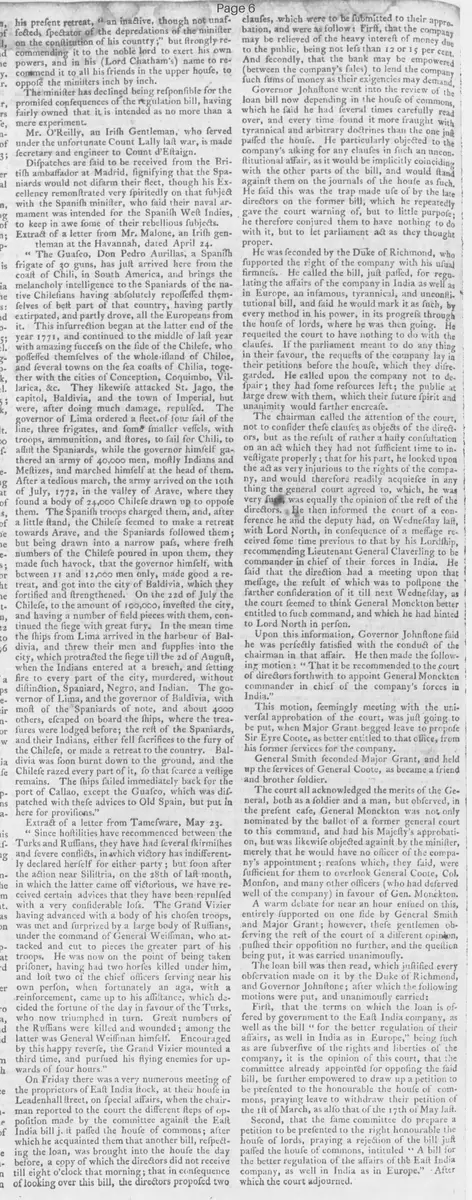
First, that the company may be relieved of the heavy interest of money due to the public, being not less than 12 or 15 per cent. And secondly that the bank may be empowered (between the company's sales) to lend the company such sums of money as their exigencies may demand.
Governor Johnstone went into the review of the loan bill now depending in the house of commons, which he said he had several times carefully read over, and every time found it more fraught with tyrannical and arbitrary doctrines than the one just passed the house. He particularly objected to the company's asking for any clauses in such an unconstitutional affair, as it would be implicitly coinciding with the other parts of the bill, and would stand against them on the journals of the house as such. He said this was the trap made use of by the late directors on the former bill, which he repeatedly gave the court warning of, but to little purpose; he therefore conjured them to have nothing to do with it, but to let parliament act as they thought proper.
He was seconded by the Duke of Richmond, who supported the right of the company with his usual firmness. He called the bill, just passed, for regulating the affairs of the company in India as well as in Europe, an infamous, tyrannical, and unconstitutional bill, and said he would mark it as such, by every method in his power, in its progress through the house of lords, where he was then going. He requested the court to have nothing to do with the clauses. If the parliament meant to do any thing in their favour, the requests of the company lay in their petitions before the house, which they disregarded. He called upon the company not to despair; they had some resources left; the public at large drew with them, which their future spirit and unanimity would farther increase.
The chairman called the attention of the court, not to consider these clauses as objects of the directors, but as the result of rather a hasty consultation on an act which they had not sufficient time to investigate properly; that for his part, he looked upon the act as very injurious to the rights of the company, and would therefore readily acquiesce in any thing the general court agreed to, which, he was very sure, was equally the opinion of the rest of the directors.
He then informed the court of a conference he and the deputy had, on Wednesday last, with Lord North, in consequence of a message received some time previous to that by his Lordship, recommending Lieutenant General Clavering to be commander in chief of their forces in India. He said that the direction had a meeting upon that message, the result of which was to postpone the farther consideration of it till next Wednesday, as the court seemed to think General Monckton better entitled to such command, and which he had hinted to Lord North in person.
Upon this information, Governor Johnstone said he was perfectly satisfied with the conduct of the chairman in that affair. He then made the following motion: "That it be recommended to the court of directors forthwith to appoint General Monckton commander in chief of the company's forces in India."
This motion, seemingly meeting with the universal approbation of the court, was just going to be put, when Major Grant begged leave to propose Sir Eyre Coote, as better entitled to that office, from his former services for the company. General Smith seconded Major Grant, and held up the services of General Coote, as became a friend and brother soldier. The court all acknowledged the merits of the General, both as a soldier and a man, but observed, in the present case, General Monckton was not only nominated by the ballot of a former general court to this command, and had his Majesty's approbation, but was likewise objected against by the minister merely that he would have no officer of the company's appointment; reasons which, they said, were sufficient for them to overlook General Coote, Col. Monson, and many other officers (who had deserved well of the company) in favour of Gen. Monckton.
A warm debate for near an hour ensued on this, entirely supported on one side by General Smith and Major Grant; however, these gentlemen observing the rest of the court of a different opinion, pushed their opposition no further, and the question being put, it was carried unanimously.
The loan bill was then read, which justified every observation made on it by the Duke of Richmond, and Governor Johnstone; after which the following motions were put, and unanimously carried:
First, that the terms on which the loan is offered by government to the East India company, as well as the bill "for the better regulation of their affairs, as well in India as in Europe," being such as are subversive of the rights and liberties of the company, it is the opinion of this court, that the committee already appointed for opposing the said bill, be further empowered to draw up a petition to be presented to the honourable the house of commons, praying leave to withdraw their petition of the 1st of March, as also that of the 17th of May last.
Second, that the same committee do prepare a petition to be presented to the right honourable the house of lords, praying a rejection of the bill just passed the house of commons, intituled "A bill for the better regulation of the affairs of the East India company, as well in India as in Europe."
After which the court adjourned.
What sub-type of article is it?
What keywords are associated?
What entities or persons were involved?
Where did it happen?
Foreign News Details
Primary Location
India
Event Date
On Friday
Key Persons
Outcome
motions carried unanimously: appointment of general monckton as commander in chief in india; committee empowered to draw petitions to commons to withdraw prior petitions and to lords to reject the regulation bill; rejection of proposed clauses on loan bill.
Event Details
Meeting of East India Company proprietors opposed East India regulation bill and loan bill as tyrannical; Governor Johnstone and Duke of Richmond urged no involvement in clauses; chairman reported conference with Lord North on command appointment; motion for General Monckton passed after debate over Sir Eyre Coote; resolutions for petitions against bills.