Thank you for visiting SNEWPapers!
Sign up free
The Daily Worker
Chicago, Cook County, Illinois
What is this article about?
Exposé on brutal chain gang system in Southern U.S., detailing murders of prisoners like John Donlan, inhumane conditions, torture, economic exploitation especially of Negro workers, as a tool to suppress labor organizing. Contrasts with Soviet prisons and advocates workers' dictatorship.
Clipping
OCR Quality
Full Text
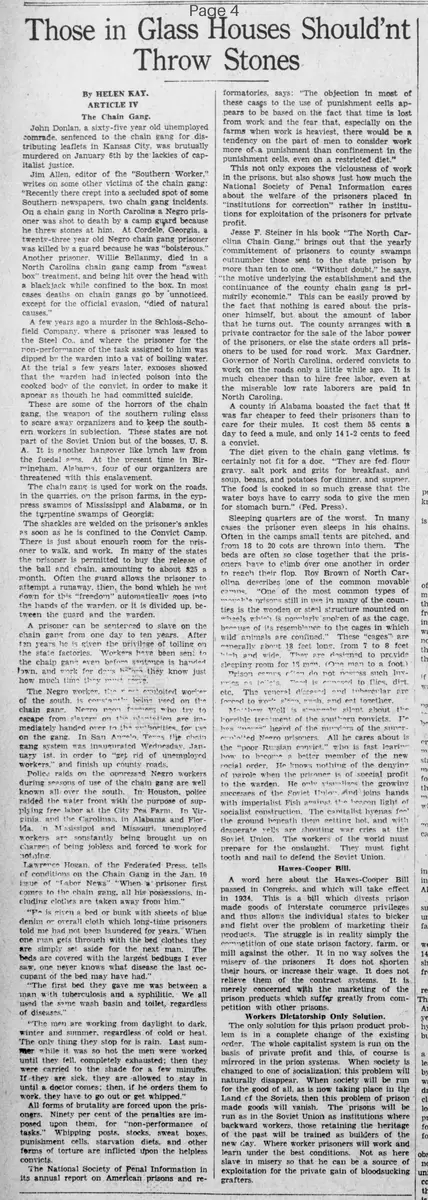
By HELEN KAY,
ARTICLE IV
The Chain Gang,
John Donlan, a sixty-five year old unemployed comrade, sentenced to the chain gang for distributing leaflets in Kansas City, was brutally murdered on January 6th by the lackeys of capitalist justice.
Jim Allen, editor of the "Southern Worker," writes on some other victims of the chain gang:
"Recently there crept into a secluded spot of some Southern newspapers, two chain gang incidents. On a chain gang in North Carolina a Negro prisoner was shot to death by a camp guard because he threw stones at him. At Cordele, Georgia, a twenty-three year old Negro chain gang prisoner was killed by a guard because he was "boisterous." Another prisoner, Willie Bellamy, died in a North Carolina chain gang camp from "sweat box" treatment, and being hit over the head with a blackjack while confined to the box. In most cases deaths on chain gangs go by unnoticed, except for the official evasion, "died of natural causes."
A few years ago a murder in the Schloss-Scho-field Company, where a prisoner was leased to the Steel Co., and where the prisoner for the non-performance of the task assigned to him was dipped by the warden into a vat of boiling water. At the trial a few years later, exposés showed that the warden had injected poison into the cooked body of the convict, in order to make it appear as though he had committed suicide.
These are some of the horrors of the chain gang, the weapon of the southern ruling class to scare away organizers and to keep the southern workers in subjection. These states are not part of the Soviet Union but of the bosses' U. S. A. It is another hangover like lynch law from the feudal ages. At the present time in Birmingham, Alabama, four of our organizers are threatened with this enslavement.
The chain gang is used for work on the roads, in the quarries, on the prison farms, in the cypress swamps of Mississippi and Alabama, or in the turpentine swamps of Georgia.
The shackles are welded on the prisoner's ankles as soon as he is confined to the Convict Camp. There is just about enough room for the prisoner to walk and work. In many of the states the prisoner is permitted to buy the release of the ball and chain, amounting to about $25 a month. Often the guard allows the prisoner to attempt a runaway, then, the bond which he put down for this "freedom" automatically goes into the hands of the warden, or it is divided up, between the guard and the warden.
A prisoner can be sentenced to slave on the chain gang from one day to ten years. After ten years he is given the privilege of toiling on the state factories. Workers have been sent to the chain gang even before sentence is handed down, and work for days hours they know just how much time they'll serve.
The Negro worker, the most cruelly exploited worker of the south, is constantly being used on the chain gang. Negro reformers who try to escape from slavery on the plantation are immediately handed over to the authorities, for use on the gang. In San Angelo, Texas the chain gang system was inaugurated Wednesday, January 1st, in order to "get rid of unemployed workers." and finish up county roads.
Police raids on the oppressed Negro workers during seasons of use of the chain gang are well known all over the south. In Houston, police raided the water front with the purpose of supplying free labor at the City Poor Farm. In Virginia, and the Carolinas, in Alabama and Florida, in Mississippi and Missouri, unemployed workers are constantly being brought up on charges of being jobless and forced to work for nothing.
Lawrence Hogan, of the Federated Press, tells of conditions on the Chain Gang in the Jan. 10 issue of "Labor News" "When a prisoner first comes to the chain gang, all his possessions, including clothes are taken away from him."
"He is given a bed or bunk with sheets of blue denim or overall cloth which long-time prisoners told me had not been laundered for years. When one man gets through with the bed clothes they are simply set aside for the next man. The beds are covered with the largest bedbugs I ever saw. one never knows what disease the last occupant of the bed may have had."
"The first bed they gave me was between a man with tuberculosis and a syphilitic. We all used the same wash basin and toilet, regardless of diseases."
"The men are working from daylight to dark, winter and summer, regardless of cold or heat. The only thing they stop for is rain. Last summer while it was so hot the men were worked until they fell, completely exhausted; then they were carried to the shade for a few minutes.
If they are sick, they are allowed to stay in until a doctor comes; then, if he orders them to work, they have to go out or get whipped."
All forms of brutality are forced upon the prisoners. Ninety per cent of the penalties are imposed upon them, for "non-performance of tasks." Whipping posts, stocks, sweat boxes, punishment cells, starvation diets, and other forms of torture are inflicted upon the helpless convicts.
The National Society of Penal Information in its annual report on American prisons and reformatories, says: "The objection in most of these cases to the use of punishment cells appears to be based on the fact that time is lost from work and the fear that, especially on the farms when work is heaviest, there would be a tendency on the part of men to consider work more of a punishment than confinement in the punishment cells, even on a restricted diet."
This not only exposes the viciousness of work in the prisons, but also shows just how much the National Society of Penal Information cares about the welfare of the prisoners placed in "institutions for correction" rather in institutions for exploitation of the prisoners for private profit.
Jesse F. Steiner in his book The North Carolina Chain Gang," brings out that the yearly commitment of prisoners to county camps outnumber those sent to the state prison by more than ten to one. "Without doubt," he says, "the motive underlying the establishment and the continuance of the county chain gang is primarily economic." This can be easily proved by the fact that nothing is cared about the prisoner himself, but about the amount of labor that he turns out. The county arranges with a private contractor for the sale of the labor power of the prisoners, or else the state orders all prisoners to be used for road work. Max Gardner, Governor of North Carolina, ordered convicts to work on the roads only a little while ago. It is much cheaper than to hire free labor, even at the miserable low rate laborers are paid in North Carolina.
A county in Alabama boasted the fact that It was far cheaper to feed their prisoners than to care for their mules. It cost them 55 cents a day to feed a mule, and only 14 1/2 cents to feed a convict.
The diet given to the chain gang victims. Is certainly not fit for a dog. "They are fed flour gravy, salt pork and grits for breakfast, and soup, beans, and potatoes for dinner. and supper. The food is cooked in so much grease that the water boys have to carry soda to give the men for stomach burn." (Fed. Press),
Sleeping quarters are of the worst. In many cases the prisoner even sleeps in his chains. Often in the camps small tents are pitched, and from 18 to 20 cots are thrown into them. The beds are often so close together that the prisoners have to climb over one another in order to reach their flop. Roy Brown of North Carolina describes one of the common movable camps. "One of the most common types of movable prisons still in use in many of the counties is the wooden or steel structure mounted on wheels which is popularly spoken of as the cage. because of its resemblance to the cages in which wild animals are confined." These "cages" are generally about 18 feet long. from 7 to 8 feet high and wide. They are designed to provide sleeping room for 13 men. (One man to a foot.) Prison cells do not possess such luxuries as toilets. room is exposed to flies. dirt. etc. The venereal diseased and tubercular are forced to work, sleep, and eat together.
Moscow is strangely silent about the horrible treatment of the southern convicts. He has "never" heard of the murders of the super-exploited Negro prisoners. All he cares about is the "poor Russian convict." who is fast learning how to become a better member of the new social order. He knows nothing of the denying of parole when the prisoner is of special profit to the warden. He only visualizes the growing successes of the Soviet Union. and joins hands with imperialist Fish against the beacon light of socialist construction. The capitalist hyenas feel the ground beneath them getting hot. and with desperate yells are shouting war cries at the Soviet Union. The workers of the world must prepare for the onslaught. They must fight tooth and nail to defend the Soviet Union.
Hawes-Cooper Bill.
A word here about the Hawes-Cooper Bill passed in Congress, and which will take effect in 1934. This is a bill which divests prison made goods of interstate commerce privileges and thus allows the individual states to bicker and fight over the problem of marketing their products. The struggle is in reality simply the competition of one state prison factory, farm, or mill against the other. It in no way solves the misery of the prisoners It does not shorten their hours. or increase their wage. It does not relieve them of the contract systems. It is merely concerned with the marketing of the prison products which suffer greatly from competition with other prisons.
Workers Dictatorship Only Solution.
The only solution for this prison product problem is in a complete change of the existing order. The whole capitalist system is run on the basis of private profit and this, of course is mirrored in the prison systems. When society is changed to one of socialization; this problem will naturally disappear, When society will be run for the good of all, as is now taking place in the Land of the Soviets, then this problem of prison made goods will vanish. The prisons will be run as in the Soviet Union as institutions where backward workers, those retaining the heritage of the past will be trained as builders of the new day. Where worker prisoners will work and learn under the best conditions. Not as here, slaves in misery so that he can be a source of exploitation for the private gain of bloodsucking grafters.
What sub-type of article is it?
What themes does it cover?
What keywords are associated?
What entities or persons were involved?
Where did it happen?
Story Details
Key Persons
Location
Southern United States (North Carolina, Georgia, Alabama, Mississippi, Texas, Etc.)
Event Date
January 6th; Recent Incidents In 1930s; Hawes Cooper Bill Effective 1934
Story Details
Article details murders and abuses in Southern chain gangs, including shooting of prisoners, sweat box torture, boiling water incident, poor food and sleeping conditions, economic motives, targeting of Negro and unemployed workers to suppress organizing; contrasts with Soviet system and calls for socialist change.