Thank you for visiting SNEWPapers!
Sign up free
The Key West Citizen
Key West, Monroe County, Florida
What is this article about?
Indian scientist Homi J. Bhabha opened the first International Atomic Energy Conference in Geneva, predicting controlled harnessing of hydrogen bomb energy for peaceful use within 20 years. The 72-nation parley, sponsored by the UN, features technical papers and exhibits on atomic energy's benefits for industry, agriculture, and medicine, continuing until Aug. 20.
Clipping
OCR Quality
Full Text
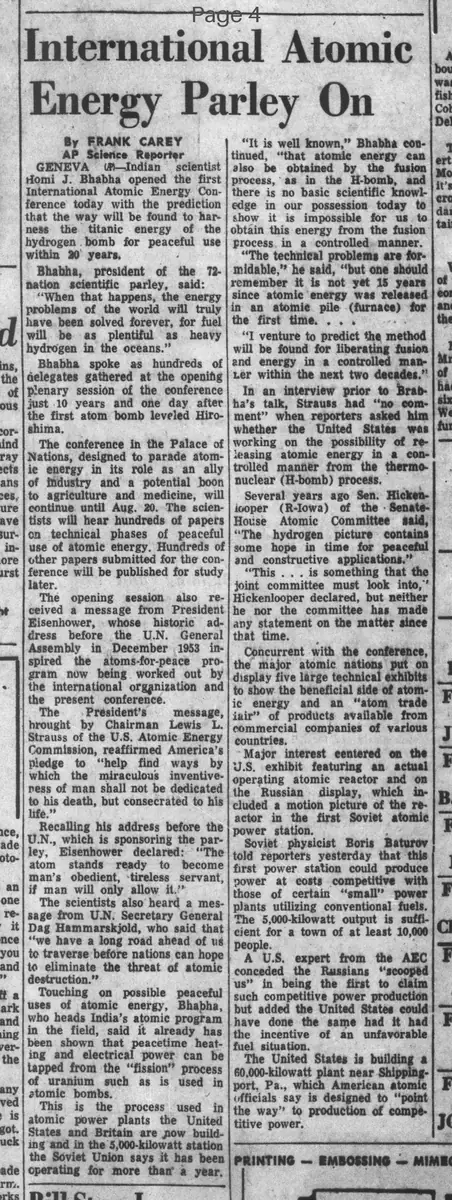
By FRANK CAREY AP Science Reporter
GENEVA (A)—Indian scientist Homi J. Bhabha opened the first International Atomic Energy Conference today with the prediction that the way will be found to harness the titanic energy of the hydrogen bomb for peaceful use within 20 years.
Bhabha, president of the 72-nation scientific parley, said:
"When that happens, the energy problems of the world will truly have been solved forever, for fuel will be as plentiful as heavy hydrogen in the oceans."
Bhabha spoke as hundreds of delegates gathered at the opening plenary session of the conference just 10 years and one day after the first atom bomb leveled Hiroshima.
The conference in the Palace of Nations, designed to parade atomic energy in its role as an ally of industry and a potential boon to agriculture and medicine, will continue until Aug. 20. The scientists will hear hundreds of papers on technical phases of peaceful use of atomic energy. Hundreds of other papers submitted for the conference will be published for study later.
The opening session also received a message from President Eisenhower, whose historic address before the U.N. General Assembly in December 1953 inspired the atoms-for-peace program now being worked out by the international organization and the present conference.
The President's message, brought by Chairman Lewis L. Strauss of the U.S. Atomic Energy Commission, reaffirmed America's pledge to "help find ways by which the miraculous inventiveness of man shall not be dedicated to his death, but consecrated to his life."
Recalling his address before the U.N., which is sponsoring the parley, Eisenhower declared: "The atom stands ready to become man's obedient, tireless servant, if man will only allow it."
The scientists also heard a message from U.N. Secretary General Dag Hammarskjold, who said that "we have a long road ahead of us to traverse before nations can hope to eliminate the threat of atomic destruction."
Touching on possible peaceful uses of atomic energy, Bhabha, who heads India's atomic program in the field, said it already has been shown that peacetime heating and electrical power can be tapped from the "fission" process of uranium such as is used in atomic bombs.
This is the process used in atomic power plants the United States and Britain are now building and in the 5,000-kilowatt station the Soviet Union says it has been operating for more than a year.
"It is well known," Bhabha continued, "that atomic energy can also be obtained by the fusion process, as in the H-bomb, and there is no basic scientific knowledge in our possession today to show it is impossible for us to obtain this energy from the fusion process in a controlled manner.
"The technical problems are formidable," he said, "but one should remember it is not yet 15 years since atomic energy was released in an atomic pile (furnace) for the first time..."
"I venture to predict the method will be found for liberating fusion energy in a controlled manner within the next two decades."
In an interview prior to Bhabha's talk, Strauss had "no comment" when reporters asked him whether the United States was working on the possibility of releasing atomic energy in a controlled manner from the thermonuclear (H-bomb) process.
Several years ago Sen. Hickenlooper (R-Iowa) of the Senate-House Atomic Committee said, "The hydrogen picture contains some hope in time for peaceful and constructive applications."
"This... is something that the joint committee must look into."
Hickenlooper declared, but neither he nor the committee has made any statement on the matter since that time.
Concurrent with the conference, the major atomic nations put on display five large technical exhibits to show the beneficial side of atomic energy and an "atom trade fair" of products available from commercial companies of various countries.
Major interest centered on the U.S. exhibit featuring an actual operating atomic reactor and on the Russian display, which included a motion picture of the reactor in the first Soviet atomic power station.
Soviet physicist Boris Baturov told reporters yesterday that this first power station could produce power at costs competitive with those of certain "small" power plants utilizing conventional fuels.
The 5,000-kilowatt output is sufficient for a town of at least 10,000 people.
A U.S. expert from the AEC conceded the Russians "scooped us" in being the first to claim such competitive power production but added the United States could have done the same had it had the incentive of an unfavorable fuel situation.
The United States is building a 60,000-kilowatt plant near Shippingport, Pa., which American atomic officials say is designed to "point the way" to production of competitive power.
What sub-type of article is it?
What keywords are associated?
What entities or persons were involved?
Where did it happen?
Foreign News Details
Primary Location
Geneva
Event Date
Opened Today, Continues Until Aug. 20
Key Persons
Outcome
prediction of controlled fusion energy within 20 years; ongoing discussions and exhibits on peaceful atomic applications; us building larger power plant.
Event Details
Homi J. Bhabha opened the 72-nation conference with a speech predicting harnessing of H-bomb energy for peace. Messages from Eisenhower and Hammarskjold emphasized peaceful uses. Conference features papers, exhibits including US reactor and Soviet power station film. Bhabha noted existing fission power plants in US, Britain, USSR.