Thank you for visiting SNEWPapers!
Sign up free
Editorial
July 17, 1810
The Enquirer
Richmond, Henrico County, Virginia
What is this article about?
Editorial analyzes July 4th Republican toasts as signs of national sentiments: guarding independence against maritime oppression, confidence in the Executive, contempt for recent Congresses, mistrust of the U.S. minister in London, praise for the minister in France, and French influence. Criticizes Federalists' pro-British attachment. Notes possible French envoy to U.S. and obsolescence of Rambouillet Decree.
Clipping
OCR Quality
95%
Excellent
Full Text
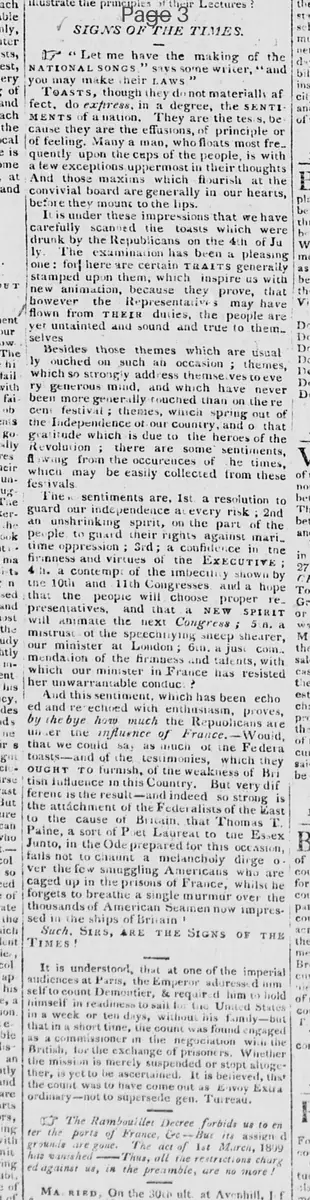
SIGNS OF THE TIMES.
"Let me have the making of the NATIONAL SONGS " says some writer, "and you may make their LAWS."
Toasts, though they do not materially affect, do express, in a degree, the SENTIMENTS of a nation. They are the test, because they are the effusions, of principle or of feeling. Many a man, who floats most frequently upon the caps of the people, is with a few exceptions uppermost in their thoughts. And those maxims which flourish at the convivial board are generally in our hearts, before they mount to the lips.
It is under these impressions that we have carefully scanned the toasts which were drunk by the Republicans on the 4th of July. The examination has been a pleasing one: for here are certain TRAITS generally stamped upon them, which inspire us with new animation, because they prove, that however the Representatives may have flown from THEIR duties, the people are yet untainted and sound and true to themselves.
Besides those themes which are usually touched on such an occasion; themes, which so strongly address themselves to every generous mind, and which have never been more generally touched than on the recent festival; themes, which spring out of the Independence of our Country, and of that gratitude which is due to the heroes of the Revolution; there are some sentiments, flying from the occurrences of the times, which may be easily collected from these festivals.
The sentiments are, 1st a resolution to guard our independence at every risk; 2nd an unshrinking spirit, on the part of the people to guard their rights against maritime oppression; 3rd; a confidence in the firmness and virtues of the Executive; 4th. a contempt of the imbecility shewn by the 10th and 11th Congresses and a hope that the people will choose proper representatives, and that a NEW SPIRIT will animate the next Congress; 5th. a mistrust of the speechifying sheep shearer, our minister at London; 6th. a just commendation of the firmness and talents, with which our minister in France has resisted her unwarrantable conduct.
And this sentiment, which has been echoed and re-echoed with enthusiasm, proves, by the bye how much the Republicans are under the influence of France. Would, that we could say as much of the Federal toasts--and of the testimonies, which they ought to furnish, of the weakness of British influence in this Country. But very different is the result--and indeed so strong is the attachment of the Federalists of the Last to the cause of Britain, that Thomas T. Paine, a sort of Poet Laureat to the Essex Junto, in the Ode prepared for this occasion, fails not to chaunt a melancholy dirge over the few smuggling Americans who are caged up in the prisons of France, whilst he forgets to breathe a single murmur over the thousands of American Seamen now impressed in the ships of Britain!
Such, SIRS, ARE THE SIGNS OF THE TIMES!
It is understood, that at one of the imperial audiences at Paris, the Emperor addressed himself to count Demoutier, & required him to hold himself in readiness to sail for the United States in a week or ten days, without his family--but that in a short time, the count was found engaged as a commissioner in the negociation with the British, for the exchange of prisoners. Whether the mission is merely suspended or stopt altogether, is yet to be ascertained. It is believed, that the count was to have come out as Envoy Extraordinary--not to supersede gen. Turreau.
The Rambouillet Decree forbids us to enter the ports of France, &c.--But its assigned grounds are gone. The act of 1st March, 1809 has vanished---Thus, all the restrictions charged against us, in the preamble, are no more!
"Let me have the making of the NATIONAL SONGS " says some writer, "and you may make their LAWS."
Toasts, though they do not materially affect, do express, in a degree, the SENTIMENTS of a nation. They are the test, because they are the effusions, of principle or of feeling. Many a man, who floats most frequently upon the caps of the people, is with a few exceptions uppermost in their thoughts. And those maxims which flourish at the convivial board are generally in our hearts, before they mount to the lips.
It is under these impressions that we have carefully scanned the toasts which were drunk by the Republicans on the 4th of July. The examination has been a pleasing one: for here are certain TRAITS generally stamped upon them, which inspire us with new animation, because they prove, that however the Representatives may have flown from THEIR duties, the people are yet untainted and sound and true to themselves.
Besides those themes which are usually touched on such an occasion; themes, which so strongly address themselves to every generous mind, and which have never been more generally touched than on the recent festival; themes, which spring out of the Independence of our Country, and of that gratitude which is due to the heroes of the Revolution; there are some sentiments, flying from the occurrences of the times, which may be easily collected from these festivals.
The sentiments are, 1st a resolution to guard our independence at every risk; 2nd an unshrinking spirit, on the part of the people to guard their rights against maritime oppression; 3rd; a confidence in the firmness and virtues of the Executive; 4th. a contempt of the imbecility shewn by the 10th and 11th Congresses and a hope that the people will choose proper representatives, and that a NEW SPIRIT will animate the next Congress; 5th. a mistrust of the speechifying sheep shearer, our minister at London; 6th. a just commendation of the firmness and talents, with which our minister in France has resisted her unwarrantable conduct.
And this sentiment, which has been echoed and re-echoed with enthusiasm, proves, by the bye how much the Republicans are under the influence of France. Would, that we could say as much of the Federal toasts--and of the testimonies, which they ought to furnish, of the weakness of British influence in this Country. But very different is the result--and indeed so strong is the attachment of the Federalists of the Last to the cause of Britain, that Thomas T. Paine, a sort of Poet Laureat to the Essex Junto, in the Ode prepared for this occasion, fails not to chaunt a melancholy dirge over the few smuggling Americans who are caged up in the prisons of France, whilst he forgets to breathe a single murmur over the thousands of American Seamen now impressed in the ships of Britain!
Such, SIRS, ARE THE SIGNS OF THE TIMES!
It is understood, that at one of the imperial audiences at Paris, the Emperor addressed himself to count Demoutier, & required him to hold himself in readiness to sail for the United States in a week or ten days, without his family--but that in a short time, the count was found engaged as a commissioner in the negociation with the British, for the exchange of prisoners. Whether the mission is merely suspended or stopt altogether, is yet to be ascertained. It is believed, that the count was to have come out as Envoy Extraordinary--not to supersede gen. Turreau.
The Rambouillet Decree forbids us to enter the ports of France, &c.--But its assigned grounds are gone. The act of 1st March, 1809 has vanished---Thus, all the restrictions charged against us, in the preamble, are no more!
What sub-type of article is it?
Partisan Politics
Foreign Affairs
War Or Peace
What keywords are associated?
July 4th Toasts
Republican Sentiments
Federalist Attachment
British Influence
French Relations
Maritime Oppression
Congress Criticism
Rambouillet Decree
What entities or persons were involved?
Republicans
Federalists
Executive
10th And 11th Congresses
Minister At London
Minister In France
Thomas T. Paine
Essex Junto
Emperor
Count Demoutier
Gen. Turreau
Editorial Details
Primary Topic
Analysis Of Republican July 4th Toasts As Signs Of Anti British And Pro French Sentiments
Stance / Tone
Pro Republican, Anti Federalist, Supportive Of Resistance To British Maritime Oppression
Key Figures
Republicans
Federalists
Executive
10th And 11th Congresses
Minister At London
Minister In France
Thomas T. Paine
Essex Junto
Emperor
Count Demoutier
Gen. Turreau
Key Arguments
Resolution To Guard Independence At Every Risk
Unshrinking Spirit To Guard Rights Against Maritime Oppression
Confidence In Firmness And Virtues Of The Executive
Contempt Of Imbecility Shown By 10th And 11th Congresses And Hope For New Spirit In Next
Mistrust Of Speechifying Sheep Shearer As Minister At London
Commendation Of Firmness And Talents Of Minister In France
Republicans Under Influence Of France
Strong Attachment Of Federalists To Britain
Possible Suspension Of French Envoy Mission To U.S.
Rambouillet Decree Grounds No Longer Valid Due To Vanished Act Of 1st March 1809