Thank you for visiting SNEWPapers!
Sign up free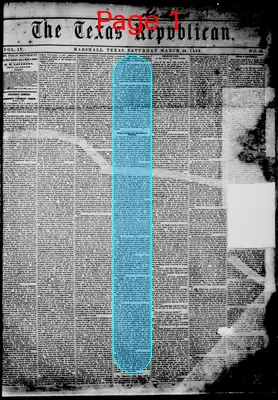
Story
March 26, 1853
The Texas Republican
Marshall, Harrison County, Texas
What is this article about?
Mr. Green delivers a lecture in Annapolis to legislators and officials, demonstrating card manipulation techniques used by professional gamblers to expose their deceptive skills and advocate against gambling.
Clipping

OCR Quality
95%
Excellent
Full Text
Green's Lectures and Exposition of Gambling
It may be interesting to your readers to have a sketch of one of Green's lectures before the members of the legislature, the public officers of the State, &c., in Annapolis. Mr. Green commenced by exhibiting about twenty different packs of cards in common use, including those having white backs, and pointed out the various marks upon the backs of each, by which the professed gambler could tell them as readily as by the face. The manufacture of cards, he observed, was exclusively in the hands of gamblers and their agents.
Mr. Green next remarked that the public generally had no adequate conception of the degree of skill which is attainable by the professed gambler, and that if he could only succeed in acquainting the public upon this subject, he had no fears that any individual well informed in the matter, would be so simple minded as ever to attempt an encounter with the professed gambler. This great degree of skill on the part of professed gamblers was the result of some amount of science, strong powers of memory acquired by cultivation, an astonishing sleight of hand obtained by constant practice, all aided by the marked cards in general use by which they were read as easily as if played with the face upwards.
To convince gentlemen of the utter folly of attempting to play cards with professed gamblers however amusing might be their private games with each other, he would show them how completely he could control the cards of the entire pack. The game of whist was called for: the cards shuffled by those around him, when he immediately dealt himself and his partner all the strong cards in the pack. He then explained to them that, knowing each card by the back he could deal any second, third or even the fourth card from the top as well as the first, and this he did again with a rapidity that defied the closest scrutiny to detect it, and with as much apparent ease as if he was dealing from the top of the pack.
"High, low, jack and the game" was next called for, the cards thoroughly shuffled. He immediately dealt himself the ace, deuce, and ten of clubs and turned the jack, and gave his opponent the king, queen and tray, beneath a score of watchful eyes around the table, none of which could detect the cheat or account for the result, until explained by Mr. G.
"Euchre" was next called for. the cards shuffled, &c., Mr. G. dealt himself the ace, king, jack of clubs, jack of spades and ten of hearts, and turned the queen of clubs for trumps; discharging the ten, he insured himself all the tricks. This he accomplished by making several changes in the relative position of the cards, which is done, and could only be done, by thorough-bred gamblers.
"Bragg" was next introduced—the cards shuffled and cut; a partner selected, to whom Mr. G. said he would give a large hand. He dealt him "two bullets and a braggor," and the third man the same hand in size—thus showing that the gambler could, in his knowledge of cards by marks, deal just such cards as he chose to deal.
"Bluff" was next called for, and Mr. G. showed conclusively that he could deal the cards from the top, bottom, or middle of the pack, with so much dexterity as defied detection.
The "Faro bank" was next called for. This Mr. G. said, might be considered the national game, and was supposed by the public to be the most equal and fair game played with cards. But his exposition of the many modes of cheating by marked cards, false shuffling, bending the cards as they were about to be placed in the box, stocking them when gamblers "show" the cards, (a peculiar shuffle)—the "gaff" played on the finger to push out two, (which cheat, he said, is played a great deal by Baltimore gamblers) "strippers" or cut cards, and the manner in which cards could be shuffled and put up to lose, all was starting information to all present, some of whom candidly confessed that they had lost their thousands at this game, but declared they would never play again, and would advocate the passage of a law to punish those who had been instrumental in robbing them, and to prohibit the continuance of gambling houses.
A great variety of tricks with cards was next presented, showing the extraordinary slight of hand and powers of memory that could be attained by those who make gambling their study, and exhibiting the utter folly of the attempt to play cards with gamblers, who can rob their victims at their will, to any extent. Mr. Green's audience left the room much wiser than when they entered.—Baltimore.
It may be interesting to your readers to have a sketch of one of Green's lectures before the members of the legislature, the public officers of the State, &c., in Annapolis. Mr. Green commenced by exhibiting about twenty different packs of cards in common use, including those having white backs, and pointed out the various marks upon the backs of each, by which the professed gambler could tell them as readily as by the face. The manufacture of cards, he observed, was exclusively in the hands of gamblers and their agents.
Mr. Green next remarked that the public generally had no adequate conception of the degree of skill which is attainable by the professed gambler, and that if he could only succeed in acquainting the public upon this subject, he had no fears that any individual well informed in the matter, would be so simple minded as ever to attempt an encounter with the professed gambler. This great degree of skill on the part of professed gamblers was the result of some amount of science, strong powers of memory acquired by cultivation, an astonishing sleight of hand obtained by constant practice, all aided by the marked cards in general use by which they were read as easily as if played with the face upwards.
To convince gentlemen of the utter folly of attempting to play cards with professed gamblers however amusing might be their private games with each other, he would show them how completely he could control the cards of the entire pack. The game of whist was called for: the cards shuffled by those around him, when he immediately dealt himself and his partner all the strong cards in the pack. He then explained to them that, knowing each card by the back he could deal any second, third or even the fourth card from the top as well as the first, and this he did again with a rapidity that defied the closest scrutiny to detect it, and with as much apparent ease as if he was dealing from the top of the pack.
"High, low, jack and the game" was next called for, the cards thoroughly shuffled. He immediately dealt himself the ace, deuce, and ten of clubs and turned the jack, and gave his opponent the king, queen and tray, beneath a score of watchful eyes around the table, none of which could detect the cheat or account for the result, until explained by Mr. G.
"Euchre" was next called for. the cards shuffled, &c., Mr. G. dealt himself the ace, king, jack of clubs, jack of spades and ten of hearts, and turned the queen of clubs for trumps; discharging the ten, he insured himself all the tricks. This he accomplished by making several changes in the relative position of the cards, which is done, and could only be done, by thorough-bred gamblers.
"Bragg" was next introduced—the cards shuffled and cut; a partner selected, to whom Mr. G. said he would give a large hand. He dealt him "two bullets and a braggor," and the third man the same hand in size—thus showing that the gambler could, in his knowledge of cards by marks, deal just such cards as he chose to deal.
"Bluff" was next called for, and Mr. G. showed conclusively that he could deal the cards from the top, bottom, or middle of the pack, with so much dexterity as defied detection.
The "Faro bank" was next called for. This Mr. G. said, might be considered the national game, and was supposed by the public to be the most equal and fair game played with cards. But his exposition of the many modes of cheating by marked cards, false shuffling, bending the cards as they were about to be placed in the box, stocking them when gamblers "show" the cards, (a peculiar shuffle)—the "gaff" played on the finger to push out two, (which cheat, he said, is played a great deal by Baltimore gamblers) "strippers" or cut cards, and the manner in which cards could be shuffled and put up to lose, all was starting information to all present, some of whom candidly confessed that they had lost their thousands at this game, but declared they would never play again, and would advocate the passage of a law to punish those who had been instrumental in robbing them, and to prohibit the continuance of gambling houses.
A great variety of tricks with cards was next presented, showing the extraordinary slight of hand and powers of memory that could be attained by those who make gambling their study, and exhibiting the utter folly of the attempt to play cards with gamblers, who can rob their victims at their will, to any extent. Mr. Green's audience left the room much wiser than when they entered.—Baltimore.
What sub-type of article is it?
Deception Fraud
Curiosity
What themes does it cover?
Deception
Crime Punishment
Moral Virtue
What keywords are associated?
Gambling Lecture
Card Cheating
Marked Cards
Sleight Of Hand
Faro Bank
Annapolis Exposition
What entities or persons were involved?
Mr. Green
Where did it happen?
Annapolis
Story Details
Key Persons
Mr. Green
Location
Annapolis
Story Details
Mr. Green lectures on gambling by demonstrating marked cards, sleight of hand, and cheating techniques in games like whist, euchre, faro, convincing the audience of the folly of playing with professional gamblers and advocating anti-gambling laws.