Thank you for visiting SNEWPapers!
Sign up free
The National Intelligencer And Washington Advertiser
Washington, District Of Columbia
What is this article about?
This editorial, signed 'A FARMER,' praises James Madison's pivotal role in forming and adopting the U.S. Constitution, contrasting it with the weaknesses of the Articles of Confederation, and argues for his election to the presidency based on his wisdom, patriotism, and contributions like the Federalist Papers and Bill of Rights.
Merged-components note: This is a single opinion piece 'A FARMER—No. VI' advocating for James Madison's presidency by detailing his role in the Constitution; relabeled from 'story' to 'editorial' as it is partisan and opinionated, and merged as sequential continuation on the same topic.
Clippings
1 of 2
OCR Quality
Full Text
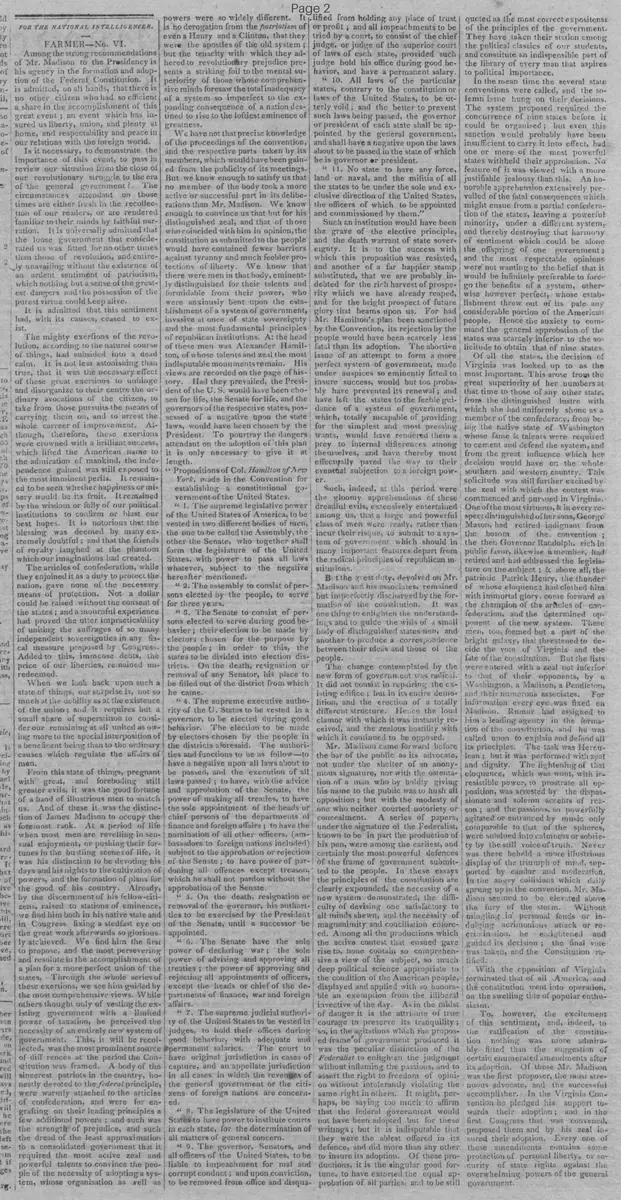
A FARMER—No. VI.
Among the strong recommendations of Mr. Madison to the Presidency is his agency in the formation and adoption of the Federal Constitution. It is admitted, on all hands, that there is no other citizen who had so efficient a share in the accomplishment of this great event; an event which has insured us liberty, union, and plenty at home, and respectability and peace in our relations with the foreign world.
Is it necessary, to demonstrate the importance of this event, to pass in review our situation from the close of our revolutionary struggle to the era of the general government? The circumstances attendant on those times are either fresh in the recollection of our readers, or are rendered familiar to their minds by faithful narration. It is universally admitted that the loose government that confederated us was fitted for no other times than those of revolution, and entirely unavailing without the existence of an ardent sentiment of patriotism, which nothing but a sense of the greatest dangers and the possession of the purest virtue could keep alive.
It is admitted that this sentiment had, with its causes, ceased to exist.
The mighty exertions of the revolution, according to the natural course of things, had subsided into a dead calm. It is not less astonishing than true, that it was the necessary effect of these great exertions to unhinge and disorganize to their centre the ordinary avocations of the citizen, to take from those pursuits the means of carrying them on, and to arrest the whole career of improvement. Although, therefore, these exertions were crowned with a brilliant success, which lifted the American name to the admiration of mankind, the independence gained was still exposed to the most imminent perils. It remained to be seen whether happiness or misery would be its fruit. It remained by the wisdom or folly of our political institutions to confirm or blast our best hopes. It is notorious that the blessing was deemed by many extremely doubtful; and that the friends of royalty laughed at the phantom which our imaginations had created.
The articles of confederation, while they enjoined it as a duty to protect the nation, gave none of the necessary means of protection. Not a dollar could be raised without the consent of the states; and a mournful experience had proved the utter impracticability of uniting the suffrages of so many independent sovereignties in any fiscal measure proposed by Congress. Added to this, immense debts, the price of our liberties, remained unredeemed.
When we look back upon such a state of things, our surprise is, not so much at the debility as at the existence of the union; and it requires but a small share of superstition to consider our remaining at all united as owing more to the special interposition of a beneficent being than to the ordinary causes which regulate the affairs of men.
From this state of things, pregnant with great, and foreboding still greater evils, it was the good fortune of a band of illustrious men to snatch us. And of these it was the distinction of James Madison to occupy the foremost rank. At a period of life when most men are revelling in sensual enjoyment, or pushing their fortunes in the bustling scenes of life, it was his distinction to be devoting his days and his nights to the cultivation of powers, and the formation of plans for the good of his country. Already, by the discernment of his fellow-citizens, raised to stations of eminence, we find him both in his native state and in Congress fixing a stedfast eye on the great work afterwards so gloriously achieved. We find him the first to propose, and the most persevering and resolute in the accomplishment of a plan for a more perfect union of the states. Through the whole series of these exertions, we see him guided by the most comprehensive views. While others thought only of vesting the existing government with a limited power of taxation, he perceived the necessity of an entirely new system of government. This, it will be recollected, was the most prominent source of differences at the period the Constitution was framed. A body of the sincerest patriots in the country, honestly devoted to the federal principle, were warmly attached to the articles of confederation, and were for engrafting on their leading principles a few additional powers; and such was the strength of prejudice, and such the dread of the least approximation to a consolidated government that it required the most active zeal and powerful talents to convince the people of the necessity of adopting a system, whose organisation as well as powers were so widely different. It is no derogation from the patriotism of even a Henry and a Clinton, that they were the apostles of the old system; but the tenacity with which they adhered to revolutionary prejudice presents a striking foil to the mental superiority of those whose comprehensive minds foresaw the total inadequacy of a system so imperfect to the expanding consequence of a nation destined to rise to the loftiest eminence of greatness.
We have not that precise knowledge of the proceedings of the convention, and the respective parts taken by its members, which would have been gained from the publicity of its meetings. But we know enough to satisfy us that no member of the body took a more active or successful part in its deliberations than Mr. Madison. We know enough to convince us that but for his distinguished zeal, and that of those who coincided with him in opinion, the constitution as submitted to the people would have contained fewer barriers against tyranny and much feebler protections of liberty. We know that there were men in that body, eminently distinguished for their talents and formidable from their power, who were anxiously bent upon the establishment of a system of government, invasive at once of state sovereignty and the most fundamental principles of republican institutions. At the head of these men was Alexander Hamilton, of whose talents and zeal the most indisputable monuments remain. His views are recorded on the page of history. Had they prevailed, the President of the U. S. would have been chosen for life, the Senate for life, and the governors of the respective states, possessed of a negative upon the state laws, would have been chosen by the President. To pourtray the dangers attendant on the adoption of this plan it is only necessary to give it at length.
"Propositions of Col. Hamilton of New York, made in the Convention for establishing a constitutional government of the United States.
"I. The supreme legislative power of the United States of America, to be vested in two different bodies of men, the one to be called the Assembly, the other the Senate, who together shall form the legislature of the United States, with power to pass all laws whatever, subject to the negative hereafter mentioned.
"2. The assembly to consist of persons elected by the people, to serve for three years.
"3. The Senate to consist of persons elected to serve during good behavior; their election to be made by electors chosen for the purpose by the people; in order to this, the states to be divided into election districts. On the death, resignation or removal of any Senator, his place to be filled out of the district from which he came.
"4. The supreme executive authority of the U. States to be vested in a governor, to be elected during good behavior. The election to be made by electors chosen by the people in the districts aforesaid. The authorities and functions to be as follow—to have a negative upon all laws about to be passed, and the execution of all laws passed; to have, with the advice and approbation of the Senate, the power of making all treaties, to have the sole appointment of the heads or chief persons of the departments of finance and foreign affairs; to have the nomination of all other officers, (ambassadors to foreign nations included) subject to the approbation or rejection of the Senate; to have power of pardoning all offences except treason, which he shall not pardon without the approbation of the Senate.
"5. On the death, resignation or removal of the governor, his authorities to be exercised by the President of the Senate, until a successor be appointed.
"6. The Senate have the sole power of declaring war; the sole power of advising and approving all treaties; the power of approving and rejecting all appointments of officers, except the heads or chief of the departments of finance, War and foreign affairs.
"7. The supreme judicial authority of the United States to be vested in judges, to hold their offices during good behavior, with adequate and permanent salaries. The court to have original jurisdiction in cases of capture, and an appellate jurisdiction in all cases in which the revenues of the general government or the citizens of foreign nations are concerned.
"8. The legislature of the United States to have power to institute courts in each state, for the determination of all matters of general concern.
"9. The governor, Senators, and all officers of the United States, to be liable to impeachment for mal and corrupt conduct; and upon conviction, to be removed from office and disqualified from holding any place of trust or profit; and all impeachments to be tried by a court, to consist of the chief judge, or judge of the superior court of laws of each state, provided such judge hold his office during good behavior, and have a permanent salary.
"10. All laws of the particular states, contrary to the constitution or laws of the United States, to be utterly void; and the better to prevent such laws being passed, the governor or president of each state shall be appointed by the general government, and shall have a negative upon the laws about to be passed in the state of which he is governor or president.
"11. No state to have any force, land or naval, and the militia of all the states to be under the sole and exclusive direction of the United States, the officers of which to be appointed and commissioned by them."
Such an institution would have been the grave of the elective principle, and the death warrant of state sovereignty. It is to the success with which this proposition was resisted, and another of a far happier stamp substituted, that we are probably indebted for the rich harvest of prosperity which we have already reaped, and for the bright prospect of future glory that beams upon us. For had Mr. Hamilton's plan been sanctioned by the Convention, its rejection by the people would have been scarcely less fatal than its adoption. The abortive issue of an attempt to form a more perfect system of government, made under auspices so eminently fitted to insure success, would but too probably have prevented its renewal; and have left the states to the feeble guidance of a system of government, which, totally incapable of providing for the simplest and most pressing wants, would have rendered them a prey to internal differences among themselves, and have thereby most effectually paved the way to their eventual subjection to a foreign power.
Such, indeed, at this period were the gloomy apprehensions of these dreadful evils, extensively entertained among us, that a large and powerful class of men were ready, rather than incur their risque, to submit to a system of government which should in many important features depart from the radical principles of republican institutions.
But the great duty, devolved on Mr. Madison and his associates, remained but imperfectly discharged by the formation of the constitution. It was one thing to enlighten the understandings and to guide the wills of a small body of distinguished statesmen, and another to produce a correspondence between their ideas and those of the people.
The change contemplated by the new form of government was radical. It did not consist in repairing the existing edifice; but in its entire demolition, and the erection of a totally different structure. Hence the loud clamor with which it was instantly received, and the zealous hostility with which it continued to be opposed.
Mr. Madison came forward before the bar of the public as its advocate, not under the shelter of an anonymous signature, nor with the ostentation of a man who by boldly giving his name to the public was to hush all opposition; but with the modesty of one who neither courted notoriety nor concealment. A series of papers, under the signature of the Federalist, known to be in part the production of his pen, were among the earliest, and certainly the most powerful defences of the frame of government submitted to the people. In these essays the principles of the constitution are clearly expounded, the necessity of a new system demonstrated, the difficulty of devising one satisfactory to all minds shewn, and the necessity of magnanimity and conciliation enforced. Among all the productions which the active contest that ensued gave rise to, none contain so comprehensive a view of the subject, so much deep political science appropriate to the condition of the American people, displayed and applied with so honorable an exemption from the illiberal invective of the day. As in the midst of danger it is the attribute of true courage to preserve its tranquility; so, in the agitations which the proposed frame of government produced it was the peculiar distinction of the Federalist to enlighten the judgment without inflaming the passions, and to assert the right to freedom of opinion without intolerantly violating the same right in others. It might, perhaps, be saying too much to affirm that the federal government would not have been adopted but for these writings; but it is indisputable that they were the ablest offered in its defence, and did more than any other to insure its adoption. Of these productions, it is the singular good fortune, to have extorted the equal approbation of all parties, and to be still quoted as the most correct expositions of the principles of the government. They have taken their station among the political classics of our students, and constitute an indispensable part of the library of every man that aspires to political importance.
In the mean time the several state conventions were called, and the solemn issue hung on their decisions. The system proposed required the concurrence of nine states before it could be organised; but even this sanction would probably have been insufficient to carry it into effect, had one or more of the most powerful states withheld their approbation. No feature of it was viewed with a more justifiable jealousy than this. An honorable apprehension extensively prevailed of the fatal consequences which might ensue from a partial confederation of the states, leaving a powerful minority, under a different system, and thereby destroying that harmony of sentiment which could be alone the offspring of one government; and the most respectable opinions were not wanting to the belief that it would be infinitely preferable to forego the benefits of a system, otherwise however perfect, whose establishment threw out of its pale any considerable portion of the American people. Hence the anxiety to command the general approbation of the states was scarcely inferior to the solicitude to obtain that of nine states.
Of all the states, the decision of Virginia was looked up to as the most important. This arose from the great superiority of her numbers at that time to those of any other state, from the distinguished lustre with which she had uniformly shone as a member of the confederacy, from being the native state of Washington whose name & talents were required to cement and defend the system, and from the great influence which her decision would have on the whole southern and western country. This solicitude was still further excited by the zeal with which the contest was commenced and pursued in Virginia. One of the most virtuous, & in every respect distinguished of her sons, George Mason, had retired indignant from the bosom of the convention; the then Governor Randolph, rich in public favor, likewise a member, had retired and had addressed the legislature on the subject; & above all, the patriotic Patrick Henry, the thunder of whose eloquence had clothed him with immortal glory, come forward as the champion of the articles of confederation, and the determined opponent of the new system. These men, too, formed but a part of the bright galaxy, that threatened to decide the vote of Virginia and the fate of the constitution. But the lists were entered with a zeal not inferior to that of their opponents, by a Washington, a Madison, a Pendleton, and their numerous associates. For information every eye was fixed on Madison. Rumor had assigned to him a leading agency in the formation of the constitution, and he was called upon to explain and defend all its principles. The task was Herculean; but it was performed with zeal and dignity. The lightening of that eloquence, which was wont, with irresistible power, to prostrate all opposition, was arrested by the dispassionate and solemn accents of reason; and the passions, so powerfully agitated or entranced by music only comparable to that of the spheres, were subdued into calmness or sobriety by the still voice of truth. Never was there beheld a more illustrious display of the triumph of mind, supported by candor and moderation.
In the angry collisions which daily sprung up in the convention, Mr. Madison seemed to be elevated above the fury of the storm. Without mingling in personal feuds or indulging acrimonious attack or recrimination, he enlightened and guided its decision; the final vote was taken, and the Constitution ratified.
With the opposition of Virginia terminated that of all America, and the constitution went into operation, on the swelling tide of popular enthusiasm.
To, however, the excitement of this sentiment, and, indeed, to the ratification of the constitution nothing was more admirably fitted than the suggestion of certain enumerated amendments after its adoption. Of these Mr. Madison was the first proposer, the most strenuous advocate, and the successful accomplisher. In the Virginia Convention he pledged his support towards their adoption; and in the first Congress that was convened, proposed them and by his zeal insured their adoption. Every one of these amendments contains some protection of personal liberty, or security of state rights against the overwhelming powers of the general government.
Such then is the system of government under which we are now united: in a great measure the work of his hand; the object of his devoted ambition; the child of his patriotism. Carried into operation, he watched over it with parental solicitude, and for several years led the popular branch of the government and shared the confidence of Washington. When the federal government became the fortress of moderate error; when those within, of his mode of thinking, found themselves incapable of arresting its progress, he retired--but for what? To restore, through the influence of the states, the republican tone it had lost. How well he succeeded in this let his incomparable report on the Alien and Sedition laws, and the consequent revolution of 1800 tell! Let any dispassionate man, who has attended to this brief review of events, say, whether there is any citizen among us from whom we have a right to expect a more enlightened and faithful discharge of the duties of the Chief Magistracy, than James Madison. These duties consist in an honest application of the powers of the general government to the existing state of affairs. Who can have a higher ambition to make this application than the man who had such a leading agency in the formation and adoption of the constitution? Whose greatest fame, in future times, is to be rescued from the eventual success of this great experiment in securing the liberty and prosperity of the new world. The page of history glows with the achievements of the hero who has fought the battles of his country, and with the labors of the legislator who has passed wise and just laws; but its brightest effulgence beams around the individual, who ranks as the founder of the fundamental system, which adjusts for ages the limits of power and its application to the varied and complicated wants of man. How powerful, then, will be the inducements of such a man faithfully to administer a form of government, on whose eventual purity so large a share of his reputation will depend? Who, so able to give us a practical commentary on its true meaning and powers? And who so irresistibly called upon, by the strongest motives that can influence the human heart, to pursue the straight line of honest policy, without being led astray by the false lights of a sinister ambition?
In such hands the system will be secure. Vigilance, virtue and wisdom will guard it from pollution. It will equally defy violence without, or corruption within. Its friends will be inspired with new confidence, and its enemies cease to cherish the faintest hope of its subversion.
A FARMER.
What sub-type of article is it?
What keywords are associated?
What entities or persons were involved?
Editorial Details
Primary Topic
James Madison's Role In Forming The U.S. Constitution And Suitability For Presidency
Stance / Tone
Strongly Supportive Of James Madison
Key Figures
Key Arguments