Thank you for visiting SNEWPapers!
Sign up free
Richmond Enquirer
Richmond, Richmond County, Virginia
What is this article about?
Proceedings of the U.S. 28th Congress, 2d Session on January 6, 1845: Senate handles communications, Texas annexation resolutions and anti-slavery memorials, postage and revenue bills; House debates Texas annexation, reports appropriation bills, and receives state resolutions.
Merged-components note: The first three are embedded financial tables within the continuous internal improvements report; the last is a short related news item on the topic.
Clipping
OCR Quality
Full Text
| At the commencement of the year, the amount of scrip afloat was 204,999 54 |
| The scrip taken in during the year for tolls, debts due the company, and in exchange for guaranteed bonds, was as follows: |
| Post notes, 123,560 00 |
| Certificates receivable, 33,829 73 |
| Certificates convertible into guaranteed bonds, 2,854 59 |
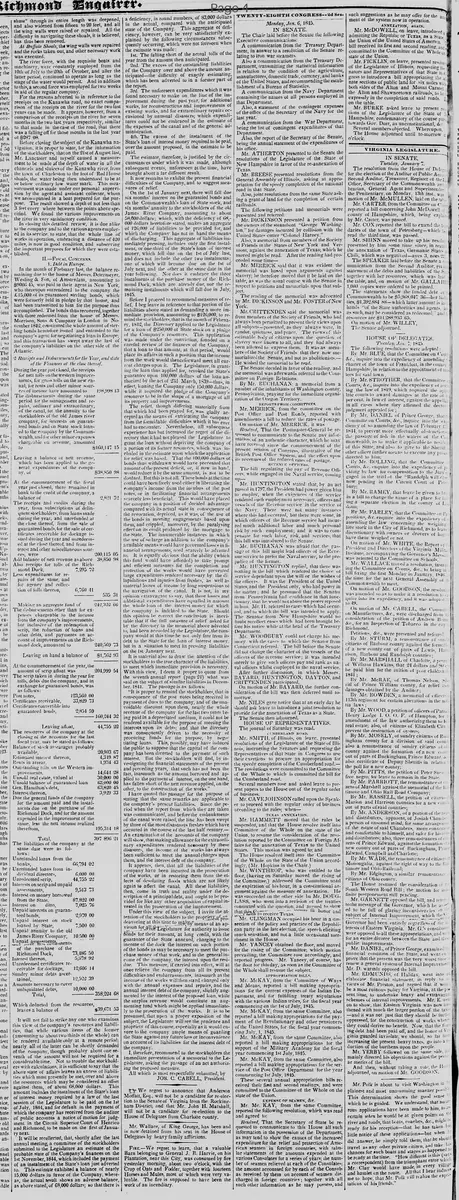
TWENTY-EIGHTH CONGRESS--2d Sess:
Monday, Jan. 6, 1845.
IN SENATE.
The Chair laid before the Senate the following
Executive communications:
A communication from the Treasury Department, in answer to a resolution of the Senate relating to iron war steamers.
Also a communication from the Treasury Department, transmitting the statistical information in relation to the condition of the agriculture, manufactures, domestic trade, currency, and banks of the United States, and recommending the establishment of a Bureau of Statistics.
A communication from the Navy Department containing the names of all persons employed in that Department.
Also, a statement of the contingent expenses of the office of the Secretary of the Navy for the last year.
A communication from the War Department being the list of contingent expenditures of that Department.
Also, the report of the Secretary of the Senate, being the annual statement of the expenditures of his office.
Mr. ATHERTON presented to the Senate the resolutions of the Legislature of the State of New Hampshire in favor of the re-annexation of Texas.
Mr. BREESE presented resolutions from the General Assembly of Illinois, asking an appropriation for the speedy completion of the national road in that State.
Also, joint resolutions from the same State asking a grant of land for the completion of certain railroads.
The following petitions and memorials were presented and referred:
Mr. DICKINSON presented a petition from the owners of the steamboat "George Washington," for damages incurred by collision with the United States cutter "Colonel Harney."
Also, a memorial from members of the Society of Friends in the States of New York and Vermont, against the annexation of Texas; which he moved might be read. After the reading had proceeded some time-
Mr. MERRICK said that it was evident the memorial was based upon arguments against slavery; he therefore moved that it be laid on the table, as was the usual course with the Senate in respect to petitions and memorials upon that subject.
The reading of the memorial was advocated by Mr. DICKINSON and Mr. FOSTER of New York.
Mr. CRITTENDEN said the memorial was from members of the Society of Friends, who had always been permitted to present their views upon all subjects-presented, as they always were, in candor, quietness, and peace. The views of this estimable body of citizens upon the question of slavery were known to all, and they had always been allowed to express them. It was as members of the Society of Friends that they now memorialized the Senate, and not as abolitionists. He wished the memorial to be read.
The Senate decided in favor of the reading, and the memorial was afterwards referred to the Committee on Foreign Relations.
By Mr. BUCHANAN: a memorial from a number of the inhabitants of Washington county, Pennsylvania, praying for the immediate organization of the Oregon Territory.
REPORTS FROM COMMITTEES.
Mr. MERRICK, from the committee on the Post Office and Post Roads, reported with amendments a bill to reduce the rates of postage. On motion of Mr. MERRICK, it was
Resolved, That the Postmaster-General be requested to communicate to the Senate any information, of an authentic character, which he may have received since the commencement of the present session of Congress, illustrative of the British Post Office System, and the effect upon its revenues of the reduced rates of postage.
REVENUE OFFICERS.
The bill regulating the pay of Revenue Officers, while engaged in the Naval service, coming up-
Mr. HUNTINGTON stated that, by an act passed in 1797, the President had power given him to employ, when the exigencies of the service rendered such employment necessary, officers and vessels of the Revenue service in the service of the Navy. There were not many instances where this had occurred, but there were some, in which officers of the Revenue service had incurred much additional labor and much personal risk by such employment: and it was to compensate for such labor, risk, and services, that this bill was introduced to the Senate.
Mr. BUCHANAN was afraid that the passage of this bill might lead officers of the Revenue service to prefer the Naval service, to the prejudice of the former.
Mr. HUNTINGTON replied, that there was nothing in the bill which rendered the choice of service dependent upon the will or the wishes of the officers. It was the President of the United States, and the President only, who had power in the matter: and he presumed that the Senator from Pennsylvania had confidence in that functionary, that he would not abuse the power reposed in him. Mr. H. referred to cases which had occurred, and to which the bill was intended to apply. The Senator from New Hampshire would no doubt recollect cases which had been brought before his notice while at the head of the Treasury Department.
Mr. WOODBURY could not charge his memory with the cases to which the Senator from Connecticut referred. The bill before the Senate did not change the character of the vessels or the officers of the revenue service: it was intended merely to give such officers pay and rank as naval officers whilst employed in the naval service.
After further discussion, in which Messrs. BAYARD, HUNTINGTON, DAYTON, and CRITTENDEN participated,
On motion of Mr. BAYARD, the further consideration of the bill was then deferred until tomorrow.
Mr. NILES gave notice that at an early day he should ask leave to introduce a joint resolution to provide for the annexation of Texas as a State.
The Senate then adjourned.
HOUSE OF REPRESENTATIVES
The journal of Saturday was read.
CUMBERLAND ROAD.
Mr. SMITH, of Illinois, on leave, presented resolutions of the Legislature of the State of Illinois, instructing the Senators and requesting the Representatives of that State in Congress to use their exertions to procure an appropriation for the speedy completion of the Cumberland road. The resolutions were committed to the Committee of the Whole to which is committed the bill for the Cumberland road.
Several members rose and asked leave to present papers to the House out of the regular order of business.
Mr. CAVE JOHNSON called upon the Speaker to proceed with the regular order of business according to the rules; when-
TEXAS ANNEXATION.
Mr. HAMMETT moved that the rules be suspended, and that the House resolve itself into Committee of the Whole on the state of the Union, to resume the consideration of the resolution reported by the Committee on Foreign Affairs for the annexation of Texas to the United States. This motion was agreed to; and
The House resolved itself into the Committee of the Whole on the State of the Union accordingly. (Mr. Hopkins in the Chair.)
Mr. WINTHROP, who was entitled to the floor, (having on Saturday moved the rising of the Committee,) addressed the Committee until the expiration of his hour, in a constitutional argument against the measure of annexation. He was succeeded on the other side by Mr. DOUGLASS, who went into a revision of the treaties connected with the question, and argued to show that they receive Texas.
Mr. CLINGMAN occupied his hour in a discussion in honor and section of the policy and practice of the Republican party in the late election, the speech eliciting much sensation, and not a little occasional merriment in the House.
Mr. YANCEY obtained the floor, and moved for the rising of the Committee; which motion prevailing, the Committee rose accordingly, and reported progress, Mr. Yancey, of course, has the floor for this day, as soon as the Committee of the Whole shall resume the subject.
APPROPRIATION BILLS.
Mr. McKAY, from the Committee of Ways and Means, reported a bill making appropriations for the current expenses of the Indian Department, and for fulfilling treaty stipulations with the various Indian tribes, for the fiscal year commencing on the 1st of July, 1845.
Mr. McKAY, from the same Committee, also reported a bill making appropriations for the payment of the Revolutionary and other pensioners of the United States, for the fiscal year commencing July 1, 1845.
Mr. McKAY, from the same Committee, also reported a bill making appropriations for the support of the Military Academy for the fiscal year commencing 1st July, 1845.
Mr. McKAY, from the same Committee, also reported a bill making appropriations for the service of the Post Office Department for the year commencing 1st July, 1845.
These several annual appropriation bills received their first and second readings, and were committed to the Committee of the Whole on the state of the Union.
EXPENSE OF SEAMEN, &C.
Mr. McKAY, from the same Committee reported the following resolution, which was read and agreed to:
Resolved, That the Secretary of State be requested to communicate to this House all such information in the possession of the Department as may tend to show the causes of the increased expenditure for the relief and protection of American seamen in foreign countries, with tabular statements of the amounts expended at the various Consulates for a series of years: the number of seamen relieved at each of the Consulates; the amount accounted for by each of the Consuls as received by them on account of seamen discharged in foreign countries; together with all such other information as he may possess, and such suggestions as he may offer for the amendment of the system now in operation.
ANNEXATION, AGAIN.
Mr. McDOWELL, on leave, introduced a bill admitting the Republic of Texas, as a State into the Union of the United States of America.
The bill received its first and second reading, and committed to the Committee of the Whole on state of the Union.
Mr. FICKLIN, on leave, presented resolutions of the Legislature of Illinois, requesting the Senators and Representatives of that State in Congress to introduce a bill appropriating the alternate sections of public land for six miles wide on both sides of the Alton and Mount Carmel and the Alton and Shawneetown railroads, to be applied expressly in the completion of said roads. Laid on the table.
Mr. BURKE asked leave to present resolutions of the Legislature of the State of New Hampshire, condemnatory of the course pursued towards Gov. Dorr, as unconstitutional, &c. Several members objected. Whereupon,
The House adjourned until to-morrow at two o'clock.
Mr. Polk is about to visit Washington in the plainest and most unassuming manner possible. This determination shows the good sense by which he is guided. We understand, that numerous applications have been made to him, to ascertain when he would be at given points on the river and roads, that boats, coaches, &c., might be ready at the time. He has taken but little notice of these applications--but when ready for his reception--that he has taken but little notice of these applications--but when ready for his reception--he did answer, he simply told them, that he should travel as any other private citizen, and take his chances for such boats and stages as happened to be ready at the time. "How different is this (says a correspondent) from the triumphant entries which were made at every town and hamlet on the route. All that I hear induces me to hope, that Mr. Polk will realize the expectations of his friends."
What sub-type of article is it?
What themes does it cover?
What keywords are associated?
What entities or persons were involved?
Where did it happen?
Story Details
Key Persons
Location
Washington, D.C.
Event Date
Monday, Jan. 6, 1845
Story Details
The Senate received executive communications on various departmental matters, presented state resolutions favoring Texas re-annexation and infrastructure funding, debated and referred a Quaker memorial against Texas annexation due to slavery concerns, reported bills to reduce postage rates and regulate revenue officers' naval pay, and adjourned. The House read the journal, presented Illinois resolutions on the Cumberland Road, suspended rules to debate Texas annexation with speeches by Winthrop, Douglas, Clingman, and Yancey, reported multiple appropriation bills for Indian affairs, pensions, military academy, and post office, passed a resolution on seamen expenses, introduced a Texas admission bill, and received additional state resolutions before adjourning. A note describes President-elect Polk's modest travel to Washington.