Thank you for visiting SNEWPapers!
Sign up free
Gazette Of The United States
Philadelphia, Philadelphia County, Pennsylvania
What is this article about?
In this installment (No. III), 'Harrington' critiques inconsistencies in arguments favoring the Senate's superiority over the House of Representatives, emphasizing the Constitution's preference for the House in originating money bills and the essential independence of both legislative branches for public safety.
Clipping
OCR Quality
Full Text
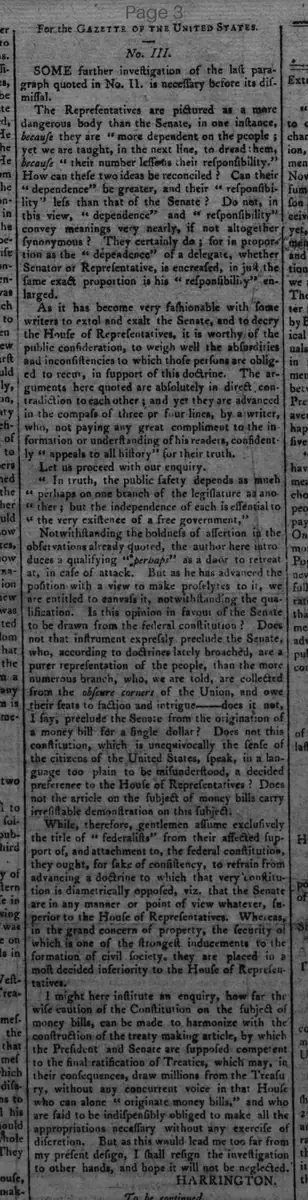
No. III.
SOME further investigation of the last paragraph quoted in No. II. is necessary before its dismissal.
The Representatives are pictured as a more dangerous body than the Senate, in one instance, because they are "more dependent on the people; yet we are taught, in the next line, to dread them, because "their number lessens their responsibility." How can these two ideas be reconciled? Can their "dependence" be greater, and their "responsibility" less than that of the Senate? Do not, in this view, "dependence" and "responsibility" convey meanings very nearly, if not altogether synonymous? They certainly do; for in proportion as the "dependence" of a delegate, whether Senator or Representative, is increased, in just the same exact proportion is his "responsibility" enlarged.
As it has become very fashionable with some writers to extol and exalt the Senate, and to decry the House of Representatives, it is worthy of the public consideration, to weigh well the absurdities and inconsistencies to which those persons are obliged to recur, in support of this doctrine. The arguments here quoted are absolutely in direct contradiction to each other; and yet they are advanced in the compass of three or four lines, by a writer, who, not paying any great compliment to the information or understanding of his readers, confidently "appeals to all history" for their truth.
Let us proceed with our enquiry.
"In truth, the public safety depends as much perhaps on one branch of the legislature as another; but the independence of each is essential to the very existence of a free government,"
Notwithstanding the boldness of assertion in the observations already quoted, the author here introduces a qualifying "perhaps" as a door to retreat at, in case of attack. But as he has advanced the position with a view to make proselytes to it, we are entitled to canvass it, notwithstanding the qualification. Is this opinion in favour of the Senate to be drawn from the federal constitution? Does not that instrument expressly preclude the Senate, who, according to doctrines lately broached, are a purer representation of the people, than the more numerous branch, who, we are told, are collected from the obscure corners of the Union, and owe their seats to faction and intrigue—does it not, I say, preclude the Senate from the origination of a money bill for a single dollar? Does not this constitution, which is unequivocally the work of the citizens of the United States, speak, in a language too plain to be misunderstood, a decided preference to the House of Representatives? Does not the article on the subject of money bills carry irresistible demonstration on this subject.
While, therefore, gentlemen assume exclusively the title of "federalists" from their affected support of, and attachment to, the federal constitution, they ought, for sake of consistency, to refrain from advancing a doctrine to which that very "constitution is diametrically opposed, viz. that the Senate are in any manner or point of view whatever, superior to the House of Representatives. Whereas, in the grand concern of property, the security of which is one of the strongest inducements to the formation of civil society, they are placed in a most decided inferiority to the House of Representatives.
I might here institute an enquiry, how far the wise caution of the Constitution on the subject of money bills, can be made to harmonize with the construction of the treaty making article, by which the President and Senate are supposed competent to the final ratification of Treaties, which may, in their consequences, draw millions from the Treasury, without any concurrent voice in that House who can alone "originate money bills," and who are said to be indispensibly obliged to make all the appropriations necessary without any exercise of discretion. But as this would lead me too far from my present design, I shall resign the investigation to other hands, and hope it will not be neglected.
HARRINGTON
What sub-type of article is it?
What themes does it cover?
What keywords are associated?
What entities or persons were involved?
Letter to Editor Details
Author
Harrington
Recipient
Gazette Of The United States
Main Argument
the letter exposes contradictions in arguments elevating the senate over the house of representatives, arguing that the federal constitution demonstrates a clear preference for the house, particularly in originating money bills, and that both branches' independence is vital for free government.
Notable Details