Thank you for visiting SNEWPapers!
Sign up free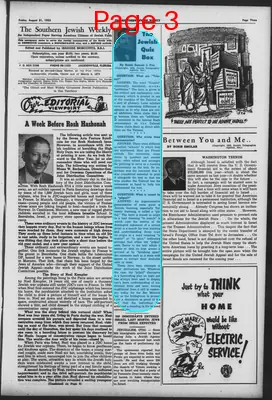
Literary
August 21, 1953
The Southern Jewish Weekly
Jacksonville, Duval County, Florida
What is this article about?
Educational article by Rabbi Samuel J. Fox explaining 'Tosafot' as marginal additions to Talmud commentary, attributed to French schools, and 'pilpul' as logical argumentation in Jewish learning, used in rituals like Bar Mitzvah.
Clipping

OCR Quality
98%
Excellent
Full Text
The Jewish Quiz Box
By Rabbi Samuel J. Fox
(Copyright, 1953, Jewish Telegraphic Agency, Inc.)
QUESTION: What are "Tosafot?"
ANSWER: The word "Tosafot" technically translated, means "additions." The term is given to the critical and explanatory commentary which is printed in one of the margins of the Talmud as a sort of glossary. Later scholars have an interesting difference of opinion as to why these are called additions. Some claim this is so because these are "additions" of comment to the famous Rashi commentary on the Talmud. Others claim them as direct additions on the Talmud.
QUESTION: Who wrote these commentaries?
ANSWER: There were different so-called "schools" to which they are attributed. Most are French schools. The comments, many times in question and answer form, were edited and arranged for printing to serve as a running commentary on the text. So important was the comment that it was considered essential to print it alongside the text so that one who studies the Talmud has the comments at hand to help him understand the text.
QUESTION: What is meant by a "pilpul?"
ANSWER: An argumentative presentation of some point of Jewish learning, especially Talmudic learning, is called a "pilpul." The term is traced in origin to a root meaning "to search" in which case the motive of the developed argument of a certain point is a search for true learning and understanding. Some trace its origin to a word meaning "to season" or "to spice," indicating perhaps that either the "pilpul" adds flavor to the text which it treats or that its true aroma is arrived at by "breaking apart" the elements such as is done with spices to extract their desirable odor or taste.
There have been attempts at other derivations too. Whatever the case, the "pilpul" discussion is a fascinating play on logic and has always been used to display one's keen understanding of traditional texts and laws. Among traditional Jews it still is customary today for the Bar Mitzvah boy or the bridegroom to present such a discussion as proof of the fact that the individual has achieved a standing in the learned community.
By Rabbi Samuel J. Fox
(Copyright, 1953, Jewish Telegraphic Agency, Inc.)
QUESTION: What are "Tosafot?"
ANSWER: The word "Tosafot" technically translated, means "additions." The term is given to the critical and explanatory commentary which is printed in one of the margins of the Talmud as a sort of glossary. Later scholars have an interesting difference of opinion as to why these are called additions. Some claim this is so because these are "additions" of comment to the famous Rashi commentary on the Talmud. Others claim them as direct additions on the Talmud.
QUESTION: Who wrote these commentaries?
ANSWER: There were different so-called "schools" to which they are attributed. Most are French schools. The comments, many times in question and answer form, were edited and arranged for printing to serve as a running commentary on the text. So important was the comment that it was considered essential to print it alongside the text so that one who studies the Talmud has the comments at hand to help him understand the text.
QUESTION: What is meant by a "pilpul?"
ANSWER: An argumentative presentation of some point of Jewish learning, especially Talmudic learning, is called a "pilpul." The term is traced in origin to a root meaning "to search" in which case the motive of the developed argument of a certain point is a search for true learning and understanding. Some trace its origin to a word meaning "to season" or "to spice," indicating perhaps that either the "pilpul" adds flavor to the text which it treats or that its true aroma is arrived at by "breaking apart" the elements such as is done with spices to extract their desirable odor or taste.
There have been attempts at other derivations too. Whatever the case, the "pilpul" discussion is a fascinating play on logic and has always been used to display one's keen understanding of traditional texts and laws. Among traditional Jews it still is customary today for the Bar Mitzvah boy or the bridegroom to present such a discussion as proof of the fact that the individual has achieved a standing in the learned community.
What sub-type of article is it?
Essay
What themes does it cover?
Religious
Moral Virtue
What keywords are associated?
Tosafot
Pilpul
Talmud
Jewish Scholarship
Rabbinic Commentary
What entities or persons were involved?
By Rabbi Samuel J. Fox
Literary Details
Title
The Jewish Quiz Box
Author
By Rabbi Samuel J. Fox
Form / Style
Question And Answer Commentary
Key Lines
The Word "Tosafot" Technically Translated, Means "Additions."
An Argumentative Presentation Of Some Point Of Jewish Learning, Especially Talmudic Learning, Is Called A "Pilpul."