Thank you for visiting SNEWPapers!
Sign up free
Gazette Of The United States And Daily Evening Advertiser
Philadelphia, Philadelphia County, Pennsylvania
What is this article about?
Proceedings of the French National Convention on August 2-3, 1794, including denunciations of Joseph Lebon as a Robespierre agent, debates on his arrest, military updates from the Army of the North capturing Cadzand, financial revelations of conspirators' hoarding, and decrees on exclusions, requisitions, and commercial regulations.
Clipping
OCR Quality
Full Text
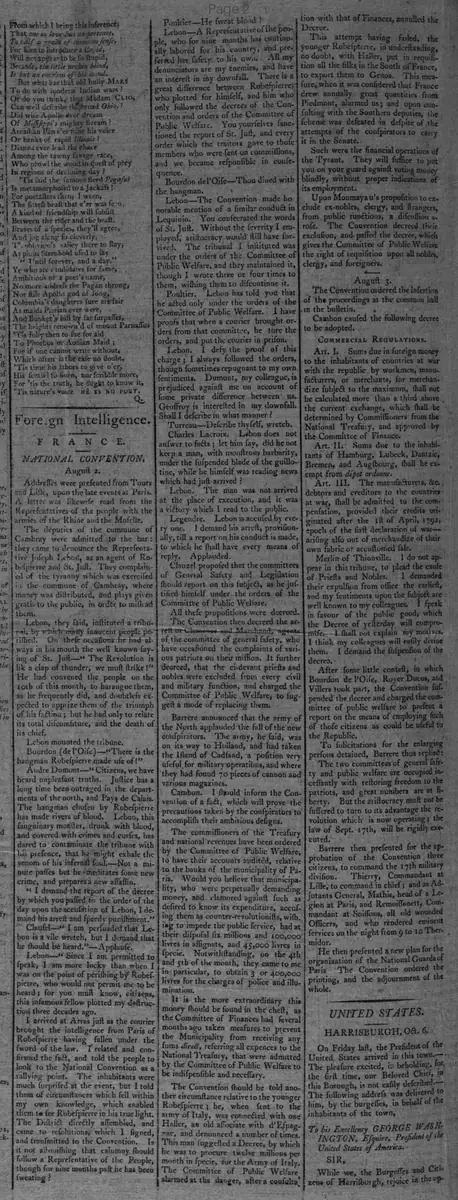
FRANCE.
NATIONAL CONVENTION,
August 2.
Addresses were presented from Tours and Lisle, upon the late events at Paris.
A letter was likewise read from the Representatives of the people with the armies of the Rhine and the Meuse.
The deputies of the commune of Cambray were admitted to the bar: they came to denounce the Representative Joseph Lebon, as an agent of Robespierre and St. Just. They complained of the tyranny which was exercised in the commune of Cambray, where money was distributed, and plays given gratis to the public, in order to mislead them.
Lebon, they said, instituted a tribunal, by which many innocent people perished. On these occasions he had always in his mouth the well known saying of St. Just—"The Revolution is like a clap of thunder, we must strike!"
He had convened the people on the 10th of this month, to harangue them, as he frequently did, and doubtless expected to apprise them of the triumph of his faction; but he had only to relate its total discomfiture, and the death of its chief.
Lebon mounted the tribune.
Bourdon (de l'Oise)—"There is the hangman Robespierre made use of!"
Andre Dumont—"Citizens, we have heard unpleasant truths. Justice has a long time been outraged in the departments of the north, and Pays de Calais. The hangman chosen by Robespierre has made rivers of blood. Lebon, this sanguinary monster, drunk with blood, and covered with crimes and outrages, has dared to contaminate the tribune with his presence, that he might exhale the venom of his infernal soul. Not a minute passes but he meditates some new crime, and prepares a new assassin."
"I demand the report of the decree by which you passed to the order of the day upon the accusation of Lebon, I demand his arrest and speedy punishment."
Clauzel "I am persuaded that Lebon is a vile wretch, but I demand that he should be heard." Applause.
Lebon—"Since I am permitted to speak, I am more lucky than when I was on the point of perishing by Robespierre, who would not permit me to be heard; for you must know, citizens, this infamous fellow plotted my destruction three decades ago.
I arrived at Arras just as the courier brought the intelligence from Paris of Robespierre having fallen under the sword of the law. I related and confirmed the fact, and told the people to look to the National Convention as a rallying point. The inhabitants were much surprised at the event, but I told them of circumstances which fell within my own knowledge, which enabled them to see Robespierre in his true light.
The District directly assembled, and came to resolutions, which I signed, and transmitted to the Convention. Is it not astonishing that calumny should follow a Representative of the People, though for nine months past he has been sweating?"
Poultier—He sweats blood!
Lebon—A Representative of the people, who for nine months has continually labored for his country, and preferred her safety to his own. All my denunciators are my enemies, and have an interest in my downfall. There is a great difference between Robespierre; who plotted for himself, and him who only followed the decrees of the Convention and orders of the Committee of Public Welfare. You yourselves sanctioned the report of St. Just, and every order which the traitors gave to those members who were sent on commissions, and we became responsible in consequence.
Bourdon de l'Oise—Thou dined with the hangman.
Lebon—The Convention made honorable mention of a similar conduct in Lequinio. You consecrated the words of St. Just. Without the severity I employed, aristocracy would still have survived. The tribunal I instituted was under the orders of the Committee of Public Welfare, and they maintained it, though I wrote three or four times to them, wishing them to discontinue it.
Poultier. Lebon has told you that he acted only under the orders of the Committee of Public Welfare. I have proofs that when a courier brought orders from that committee, he tore the orders, and put the courier in prison.
Lebon. I defy the proof of this charge; I always followed the orders, though sometimes repugnant to my own sentiments. Dumont, my colleague, is prejudiced against me on account of some private difference between us. Geoffroy is interested in my downfall. Shall I describe in what manner?
Turreau—Describe thyself, wretch.
Charles Lacroix. Lebon does not answer to facts; let him say, did he not keep a man, with monstrous barbarity, under the suspended blade of the guillotine, while he himself was reading news which had just arrived?
Lebon. The man was not arrived at the place of execution, and it was a victory which I read to the public.
Legendre. Lebon is accused by every one. I demand his arrest, provisionally, till a report on his conduct is made, to which he shall have every means of reply. Applauded.
Clauzel proposed that the committees of General Safety and Legislation should report on this subject, as he justified himself under the orders of the Committee of Public Welfare.
All these propositions were decreed.
The Convention then decreed the arrest of Clemence and Marchand, agents of the committee of general safety, who have occasioned the complaints of various patriots on their mission. It further decreed, that the ci-devant priests and nobles were excluded from every civil and military function, and charged the Committee of Public Welfare, to suggest a mode of replacing them.
Barrere announced that the army of the North applauded the fall of the new conspirators. The army, he said, was on its way to Holland, and had taken the Island of Cadzand, a position very useful for military operations, and where they had found 70 pieces of cannon and various magazines.
Cambon. I should inform the Convention of a fact, which will prove the precautions taken by the conspirators to accomplish their ambitious designs.
The commissioners of the Treasury and national revenues have been ordered by the Committee of Public Welfare, to have their accounts audited, relative to the banks of the municipality of Paris. Would you believe that municipality, who were perpetually demanding money, and clamored against such as desired to know its expenditure, accusing them as counter-revolutionists, wishing to impede the public service, had at their disposal six millions 100,000 livres in assignats, and 45,000 livres in specie. Notwithstanding, on the 4th and 5th of the month, they came to me in particular, to obtain 300,000 or 400,000 livres for the charges of police and illumination.
It is the more extraordinary this money should be found in the chest, as the Committee of Finances had several months ago taken measures to prevent the Municipality from receiving any sums direct, referring all expenses to the National Treasury, that were admitted by the Committee of Public Welfare to be indispensable and necessary.
The Convention should be told another circumstance relative to the younger Robespierre; he, when sent to the army of Italy, was connected with one Haller, an old associate with d'Epagny, and denounced a number of times. This man suggested a Decree, by which he was to procure twelve millions per month in specie, for the Army of Italy.
The Committee of Public Welfare alarmed at the danger, after a consultation with that of Finances, annulled the Decree.
This attempt having failed, the younger Robespierre, in understanding, no doubt, with Haller, put in requisition all the silks in the South of France, to export them to Genoa. This measure, when it was considered that France drew annually great quantities from Piedmont, alarmed us; and upon consulting with the Southern deputies, the scheme was defeated in despite of the attempts of the conspirators to carry it in the Senate: —
Such were the financial operations of the Tyrant. They will suffice to put you on your guard against voting money blindly, without proper indications of its employment.
Upon Monmoyer's proposition to exclude ex-nobles, clergy, and strangers, from public functions, a discussion arose. The Convention decreed their exclusion, and passed the decree, which gives the Committee of Public Welfare the right of requisition upon all nobles, clergy, and foreigners.
August 3.
The Convention ordered the insertion of the proceedings at the common hall in the bulletin.
Cambon caused the following decree to be adopted.
Commercial Regulations.
Art. I. Sums due in foreign money to the inhabitants of countries at war with the republic by workmen, manufacturers, or merchants, for merchandise subject to the maximum, shall not be calculated more than a third above the current exchange, which shall be determined by Commissioners from the National Treasury, and approved by the Committee of Finance.
Art. II. Sums due to the inhabitants of Hamburg, Lubeck, Dantzic, Bremen, and Augbourg, shall be exempt from dépot ordonne.
Art. III. The manufacturers, &c. debtors and creditors to the countries at war, shall be admitted to the compensation, provided their credits originated after the 1st of April, 1792, epoch of the first declaration of war—arising also out of merchandise of their own fabric or accustomed sale.
Merlin of Thionville. I do not appear in this tribune, to plead the cause of Priests and Nobles. I demanded their expulsion from office the earliest, and my sentiments upon the subject are well known to my colleagues. I speak in favour of the public good, which the Decree of yesterday will compromise. I shall not explain my motives. I think my colleagues will easily divine them. I demand the suspension of the decree.
After some little contest, in which Bourdon de l'Oise, Royer (Ducos), and Villers took part, the Convention suspended the decree and charged the committee of public welfare to present a report on the means of employing such of those citizens as could be useful to the Republic.
To solicitations for the enlarging persons detained, Barrere thus replied:
The two committees of general safety and public welfare are occupied incessantly with restoring freedom to the patriots, and great numbers are at liberty. But the aristocracy must not be suffered to turn to its advantage the revolution which is now operating; the law of Sept. 17th, will be rigidly executed.
Barrere then presented for the approbation of the Convention three citizens, to command the 17th military division. Thierry, Commandant at Lille, to command in chief; and as Adjutants General, Mathis, head of a Legion at Paris, and Remoissenet, Commandant at Soissons, all old wounded Officers, and who rendered eminent services on the night from 9 to 10 Thermidor.
He then presented a new plan for the organization of the National Guards of Paris The Convention ordered the printing, and the adjournment of the whole.
What sub-type of article is it?
What keywords are associated?
What entities or persons were involved?
Where did it happen?
Foreign News Details
Primary Location
France
Event Date
August 2 And 3
Key Persons
Outcome
provisional arrest of lebon; arrests of clemence and marchand; exclusion of ci-devant priests and nobles from functions; army of the north takes island of cadzand with 70 cannon; discovery of municipality's hidden funds; suspension of decree on employing nobles and clergy; commercial regulations adopted limiting foreign payments.
Event Details
The National Convention received addresses from Tours and Lisle on Paris events and a letter from Rhine and Meuse armies. Deputies from Cambray denounced Joseph Lebon for tyranny, executions, and Robespierre ties. Debates ensued with accusations of bloodthirstiness and defenses citing obedience to Convention decrees. Arrests decreed for Lebon provisionally, Clemence, and Marchand. Exclusions for priests and nobles enacted, with Committee of Public Welfare to suggest replacements. Barrere reported Army of the North's advance to Holland and capture of Cadzand. Cambon revealed conspirators' financial manipulations, including hidden millions and failed schemes for Army of Italy. Decrees passed on excluding nobles/clergy/strangers, requisitions, and commercial rules on war debts and exchanges. On August 3, decree suspension debated and approved for useful citizens; Barrere addressed detentions and presented military commanders.