Thank you for visiting SNEWPapers!
Sign up free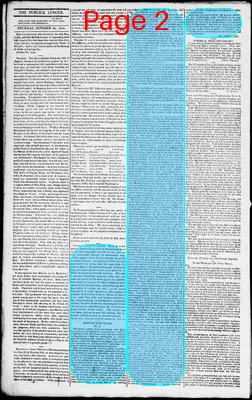
Norfolk Gazette And Publick Ledger
Norfolk, Virginia
What is this article about?
Editorial from the United States' Gazette (Oct. 5) argues against war with Spain, criticizing the Jefferson administration's unpreparedness, lack of navy and army, potential European entanglements, and risks to commerce and western settlements.
Clipping
OCR Quality
Full Text
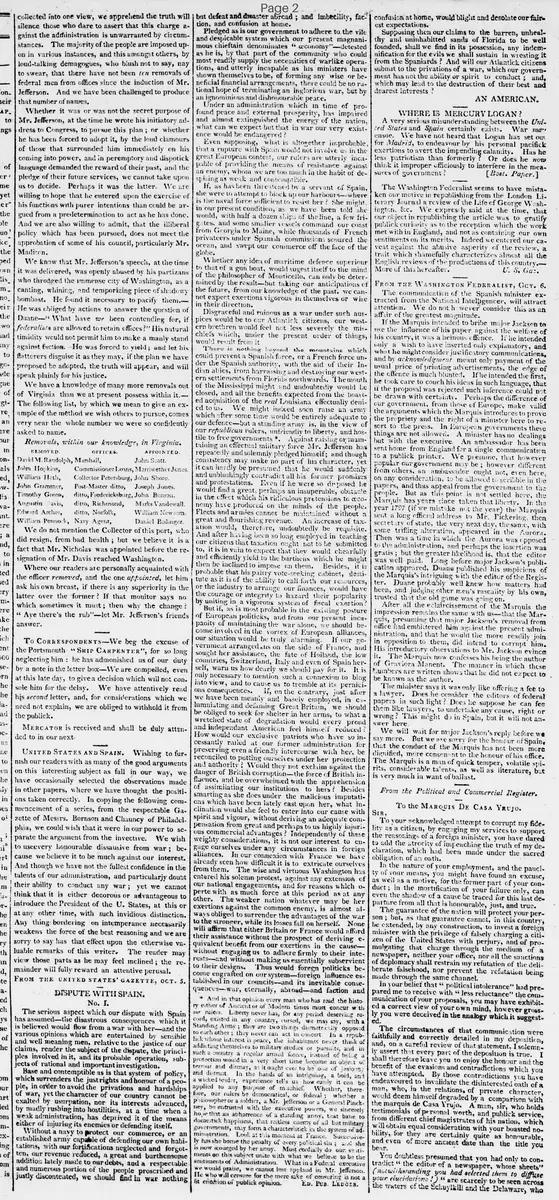
FROM THE UNITED STATES' GAZETTE, OCT. 5.
DISPUTE WITH SPAIN.
No. I.
The serious aspect which our dispute with Spain has assumed—the disastrous consequences which it is believed would flow from a war with her—and the various opinions which are entertained by sensible and well meaning men, relative to the justice of our claims, render the subject of the dispute, the principles involved in it, and its probable operation, subjects of rational and important investigation.
Base and contemptible as is that system of policy, which surrenders the just rights and honour of a people, in order to avoid the privations and hardships of war, yet the character of our country cannot be exalted by usurpation, nor its interests advanced, by madly rushing into hostilities, at a time when a weak administration, has deprived it of the means either of injuring its enemies or defending itself.
Without a navy to protect our commerce, or an established army capable of defending our own habitations, with our fortifications neglected and forgotten, our revenue reduced, a great and burthensome addition lately made to our debts, and a respectable and numerous portion of the people proscribed and justly discontented, we should find in war nothing but defeat and disaster abroad; and imbecility, faction, and confusion at home.
Pledged as is our government to adhere to the vile and despicable system which our present magnanimous chieftain denominates "economy"—detested as he is, by that part of the community who could most readily supply the necessities of warlike operations, and utterly incapable as his ministers have shewn themselves to be, of forming any wise or beneficial financial arrangements, there could be no rational hope of terminating an inglorious war, but by an ignominious and dishonourable peace.
Under an administration which in time of profound peace and external prosperity, has impaired and almost extinguished the energy of the nation, what can we expect but that in war our very existence would be endangered?
Even supposing, what is altogether improbable, that a rupture with Spain would not involve us in the great European contest, our rulers are utterly incapable of providing the means of resistance against an enemy, whom we are too much in the habit of despising as weak and contemptible.
If, as has been threatened by a servant of Spain, she were to attempt to block up our harbours—where is the naval force sufficient to resist her? She might, in our present condition, as we have been told she would, with half a dozen ships of the line, a few frigates, and some smaller vessels command our coast from Georgia to Maine, while thousands of French privateers under Spanish commissions scoured the ocean, and swept our commerce of the face of the globe.
Whether any idea of maritime defence superior to that of a gun boat, would suggest itself to the mind of the philosopher of Monticello, can only be determined by the result—but taking our anticipations of the future, from our knowledge of the past, we cannot expect exertions vigorous in themselves or wise in their direction.
Disgraceful and ruinous as a war under such auspices would be to our Atlantic citizens, our western brethren would feel not less severely the mischiefs which, under the present order of things, would result from it.
There is nothing beyond the mountains which could prevent a Spanish force, or a French force under the Spanish authority, with the aid of their Indian allies, from harrassing and destroying our western settlements from Florida northwards. The mouth of the Mississippi might and undoubtedly would be closed, and all the benefits expected from the boasted acquisition of the real Louisiana effectually denied to us. We might indeed soon raise an army which after some time would be entirely adequate to our defence—but a standing army is, in the view of our republican rulers, unfriendly to liberty, and hostile to free governments*.
Against raising or maintaining an effectual military force Mr. Jefferson has repeatedly and solemnly pledged himself; and though consistency may make no part of his character, yet it can hardly be presumed that he would suddenly and unblushingly contradict all his former promises and protestations. Even if he were so disposed he would find a great, perhaps an insuperable, obstacle in the effect which his ridiculous pretensions to economy have produced on the minds of the people.
Fleets and armies cannot be maintained without a great and flourishing revenue. An increase of taxation would, therefore, undoubtedly be requisite. And after having been so long employed in teaching our citizens that taxation ought not to be submitted to, it is in vain to expect that they would cheerfully and efficiently yield to the burthens which he might then be inclined to impose on them. Besides, it is probable that his paltry vote-seeking cabinet, destitute as it is of the ability to call forth our resources, or the industry to arrange our finances, would have the courage or integrity to hazard their popularity by uniting in a vigorous system of fiscal exertion?
But if, as is most probable in the existing posture of European politicks, and from our present incapacity of maintaining the war alone, we should become involved in the vortex of European alliances, our situation would be truly alarming. If our government arranged us on the side of France, and sought her assistance, the fate of Holland, the low countries, Switzerland, Italy and even of Spain herself, warn us how dearly we should pay for it. It is only necessary to mention such a connexion to bring into view, and to cause us to tremble at its pernicious consequences. If, on the contrary, just after we have been meanly and basely employed, in calumniating and defaming Great Britain, we should be obliged to seek for shelter in her arms, to what a wretched state of degradation would every proud and independent American feel himself reduced?
How would our exclusive patriots who have so incessantly railed at our former administration for preserving even a friendly intercourse with her, be reconciled to putting ourselves under her protection and authority? Would they not exclaim against the danger of British corruption—the force of British influence, and be overwhelmed with the apprehension of assimilating our institutions to hers? Besides smarting as she does under the malicious imputations which have been lately cast upon her, what inclination would she feel to enter into our cause with spirit and vigour, without deriving an adequate compensation from great and perhaps to us highly injurious commercial advantages?
Independently of these weighty considerations, it is not our interest to engage ourselves under any circumstances in foreign alliances. In our connexion with France we have already seen how difficult it is to extricate ourselves from them. The wise and virtuous Washington has entered his solemn protest, against any extension of our national engagements, and for reasons which operate with as much force at this period as at any other. The weaker nation whatever may be her exertions against the common enemy, is almost always obliged to surrender the advantages of the war to the stronger, while its losses fall on herself. None will affirm that either Britain or France would afford their assistance without the prospect of deriving equivalent benefit from our exertions in the cause—without engaging us to adhere firmly to their interests—and without making us essentially subservient to their designs. Thus would foreign politicks become engrafted on our system—foreign influence established in our councils—and its inevitable consequences—war, eternally, abroad—and faction and confusion at home, would blight and desolate our fairest expectations.
Supposing then our claims to the barren, unheathy and uninhabited sands of Florida to be well founded, shall we find in its possession, any indemnification for the evils we shall sustain in wresting it from the Spaniards? And will our Atlantic citizens submit to the privations of a war, which our government has not the ability or spirit to conduct; and, which may lead to the destruction of their best and dearest interests?
AN AMERICAN.
* And in that opinion every man who has read the history either of Ancient or of Modern times must concur with our rulers. Liberty never has, for any period deserving record, existed in any country, cursed, we may say, with a Standing Army; they are two things diametrically opposed to each other; they never can act in concert. In a republic whose interest is peace, the inhabitants never think of addicting themselves to military studies or pursuits, and in such a country a regular armed force, instead of being a protection would in a very short time become an object of terrour and dismay, as it ought ever to be one of jealousy and distrust. In the hands of an intriguing, a bold, and a wicked leader, experience tells us how easily it can be applied to any purpose of mischief. Whether, therefore, our rulers be democratical, or federal; whether a philosopher or a soldier, a Mr. Jefferson or a General Pinckney, be entrusted with the executive powers, we sincerely hope that an abhorrence of a standing army, that bane to domestick happiness, that restless enemy of all but military governments, may form a characteristick in the system of administration. Look at this moment at France. Successively has she borne the penalty of every political sin; and she is now scourged by her army. Most cordially do our sentiments on this subject unite with what we believe to be the sentiments of Administration. What in a Federal executive we would praise, we cannot less applaud in Mr. Jefferson. He who will censure for the mere sake of censuring is not a fit criterion of publick opinion.
ED. PUB. LEDGER.
What sub-type of article is it?
What keywords are associated?
What entities or persons were involved?
Where did it happen?
Foreign News Details
Primary Location
Spain
Event Date
Oct. 5
Key Persons
Outcome
hypothetical disastrous consequences including defeat, disaster, ignominious peace, and potential involvement in european alliances leading to loss of independence.
Event Details
Editorial argues against pursuing war with Spain over territorial claims like Florida, highlighting U.S. military unpreparedness, lack of navy and army, financial weaknesses under Jefferson's economy policy, risks to commerce and western settlements, and dangers of European entanglements with France or Britain.