Thank you for visiting SNEWPapers!
Sign up free
Domestic News
September 8, 1795
The New Hampshire Gazette
Portsmouth, Rockingham County, New Hampshire
What is this article about?
President George Washington writes to Thomas Russell of the Boston Chamber of Commerce, acknowledging dissent from some citizens against town votes on the US-Great Britain treaty of amity, commerce, and navigation, while noting general commercial support for it.
Clipping
OCR Quality
98%
Excellent
Full Text
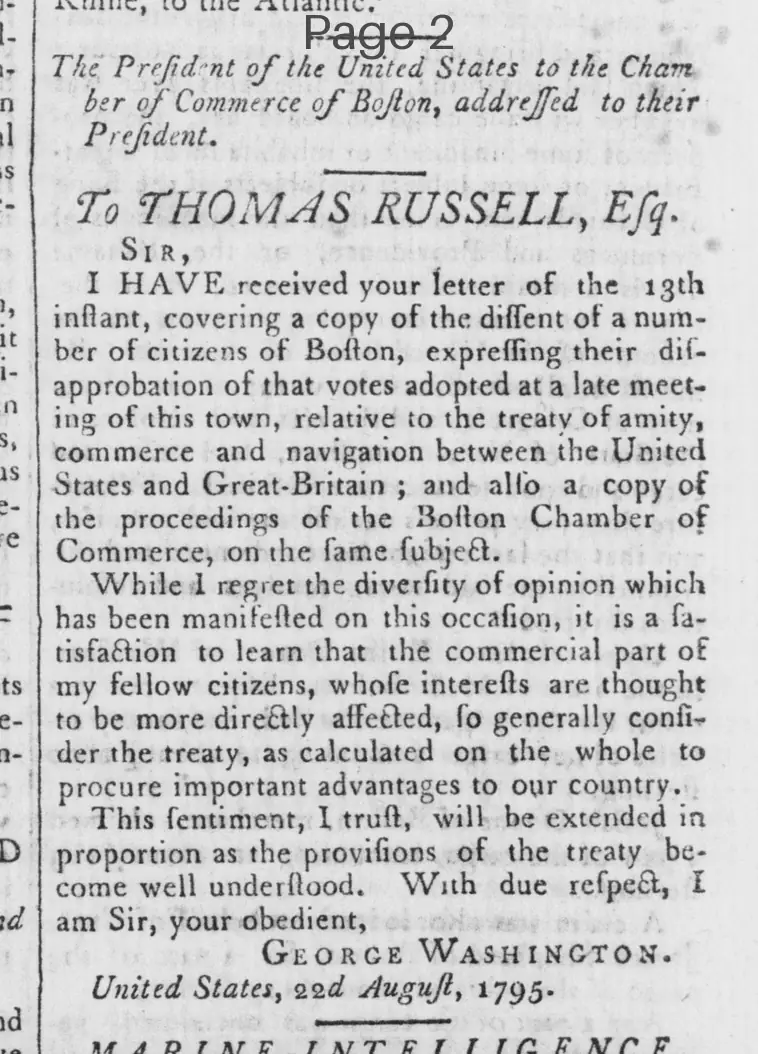
The President of the United States to the Chamber of Commerce of Boston, addressed to their President.
To THOMAS RUSSELL, Esq.
SIR,
I HAVE received your letter of the 13th instant, covering a copy of the dissent of a number of citizens of Boston, expressing their disapprobation of those votes adopted at a late meeting of this town, relative to the treaty of amity, commerce and navigation between the United States and Great-Britain; and also a copy of the proceedings of the Boston Chamber of Commerce, on the same subject.
While I regret the diversity of opinion which has been manifested on this occasion, it is a satisfaction to learn that the commercial part of my fellow citizens, whose interests are thought to be more directly affected, so generally consider the treaty, as calculated on the whole to procure important advantages to our country.
This sentiment, I trust, will be extended in proportion as the provisions of the treaty become well understood. With due respect, I am Sir, your obedient,
George Washington.
United States, 22d August, 1795
To THOMAS RUSSELL, Esq.
SIR,
I HAVE received your letter of the 13th instant, covering a copy of the dissent of a number of citizens of Boston, expressing their disapprobation of those votes adopted at a late meeting of this town, relative to the treaty of amity, commerce and navigation between the United States and Great-Britain; and also a copy of the proceedings of the Boston Chamber of Commerce, on the same subject.
While I regret the diversity of opinion which has been manifested on this occasion, it is a satisfaction to learn that the commercial part of my fellow citizens, whose interests are thought to be more directly affected, so generally consider the treaty, as calculated on the whole to procure important advantages to our country.
This sentiment, I trust, will be extended in proportion as the provisions of the treaty become well understood. With due respect, I am Sir, your obedient,
George Washington.
United States, 22d August, 1795
What sub-type of article is it?
Politics
What keywords are associated?
Washington Letter
Boston Dissent
Us Britain Treaty
Chamber Of Commerce
What entities or persons were involved?
George Washington
Thomas Russell
Where did it happen?
Boston
Domestic News Details
Primary Location
Boston
Event Date
22d August, 1795
Key Persons
George Washington
Thomas Russell
Event Details
Washington receives letter from Russell enclosing Boston citizens' dissent against town votes on the US-Great Britain treaty and Chamber of Commerce proceedings; he regrets differing opinions but is pleased with commercial support for the treaty's advantages.