Thank you for visiting SNEWPapers!
Sign up free
Literary
January 31, 1930
The Butler County Press
Hamilton, Butler County, Ohio
What is this article about?
Essay by Leonard A. Barrett discusses experiments by scientists Steinbach, Voronoff, and Tushnoff on prolonging life through gland operations and chemical elimination of poisons, potentially extending human life to 150 years. Questions desirability of such longevity.
Clipping
OCR Quality
92%
Excellent
Full Text
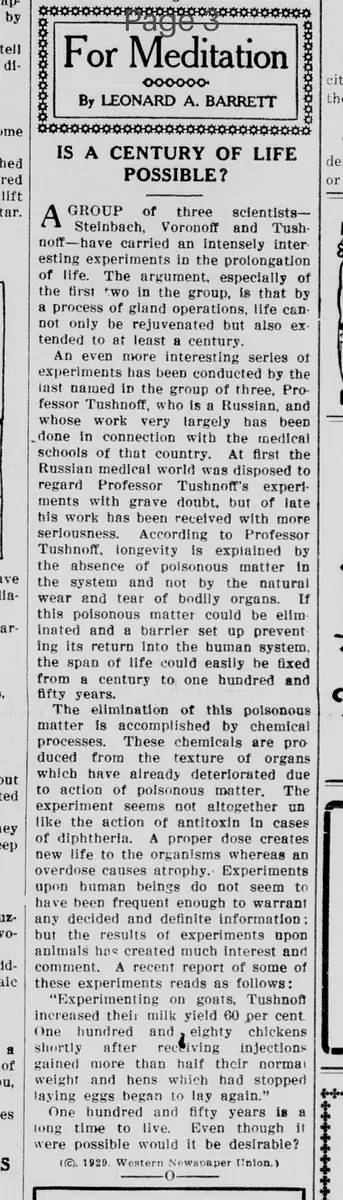
For Meditation
By LEONARD A. BARRETT
IS A CENTURY OF LIFE POSSIBLE?
A group of three scientists- Steinbach, Voronoff and Tushnoff- have carried on intensely interesting experiments in the prolongation of life. The argument, especially of the first two in the group, is that by a process of gland operations, life can not only be rejuvenated but also extended to at least a century.
An even more interesting series of experiments has been conducted by the last named in the group of three. Professor Tushnoff, who is a Russian, and whose work very largely has been done in connection with the medical schools of that country. At first the Russian medical world was disposed to regard Professor Tushnoff's experiments with grave doubt, but of late his work has been received with more seriousness.
According to Professor Tushnoff, longevity is explained by the absence of poisonous matter in the system and not by the natural wear and tear of bodily organs. If this poisonous matter could be eliminated and a barrier set up preventing its return into the human system the span of life could easily be fixed from a century to one hundred and fifty years.
The elimination of this poisonous matter is accomplished by chemical processes. These chemicals are produced from the texture of organs which have already deteriorated due to action of poisonous matter. The experiment seems not altogether unlike the action of antitoxin in cases of diphtheria. A proper dose creates new life to the organisms whereas an overdose causes atrophy. Experiments upon human beings do not seem to have been frequent enough to warrant any decided and definite information; but the results of experiments upon animals has created much interest and comment. A recent report of some of these experiments reads as follows:
"Experimenting on goats, Tushnoff increased their milk yield 60 per cent. One hundred and eighty chickens shortly after receiving injections gained more than half their normal weight and hens which had stopped laying eggs began to lay again."
One hundred and fifty years is a long time to live. Even though it were possible would it be desirable?
(©). 1929. Western Newspaper Union.
By LEONARD A. BARRETT
IS A CENTURY OF LIFE POSSIBLE?
A group of three scientists- Steinbach, Voronoff and Tushnoff- have carried on intensely interesting experiments in the prolongation of life. The argument, especially of the first two in the group, is that by a process of gland operations, life can not only be rejuvenated but also extended to at least a century.
An even more interesting series of experiments has been conducted by the last named in the group of three. Professor Tushnoff, who is a Russian, and whose work very largely has been done in connection with the medical schools of that country. At first the Russian medical world was disposed to regard Professor Tushnoff's experiments with grave doubt, but of late his work has been received with more seriousness.
According to Professor Tushnoff, longevity is explained by the absence of poisonous matter in the system and not by the natural wear and tear of bodily organs. If this poisonous matter could be eliminated and a barrier set up preventing its return into the human system the span of life could easily be fixed from a century to one hundred and fifty years.
The elimination of this poisonous matter is accomplished by chemical processes. These chemicals are produced from the texture of organs which have already deteriorated due to action of poisonous matter. The experiment seems not altogether unlike the action of antitoxin in cases of diphtheria. A proper dose creates new life to the organisms whereas an overdose causes atrophy. Experiments upon human beings do not seem to have been frequent enough to warrant any decided and definite information; but the results of experiments upon animals has created much interest and comment. A recent report of some of these experiments reads as follows:
"Experimenting on goats, Tushnoff increased their milk yield 60 per cent. One hundred and eighty chickens shortly after receiving injections gained more than half their normal weight and hens which had stopped laying eggs began to lay again."
One hundred and fifty years is a long time to live. Even though it were possible would it be desirable?
(©). 1929. Western Newspaper Union.
What sub-type of article is it?
Essay
What themes does it cover?
Death Mortality
What keywords are associated?
Life Prolongation
Gland Operations
Tushnoff Experiments
Longevity
Medical Rejuvenation
What entities or persons were involved?
By Leonard A. Barrett
Literary Details
Title
Is A Century Of Life Possible?
Author
By Leonard A. Barrett
Subject
On Experiments In Prolongation Of Life
Key Lines
"Experimenting On Goats, Tushnoff Increased Their Milk Yield 60 Per Cent. One Hundred And Eighty Chickens Shortly After Receiving Injections Gained More Than Half Their Normal Weight And Hens Which Had Stopped Laying Eggs Began To Lay Again."
One Hundred And Fifty Years Is A Long Time To Live. Even Though It Were Possible Would It Be Desirable?