Thank you for visiting SNEWPapers!
Sign up free
Editorial
August 30, 1803
The New Hampshire Gazette
Portsmouth, Rockingham County, New Hampshire
What is this article about?
The 'Rural Loiterer' critiques contemporary baptism controversies, arguing that practices allowing baptism for children of those making insincere 'credible professions' of faith result in a worldly, national church in New England, comparable to ancient Jewish circumcision, with examples of widespread baptisms.
Clipping
OCR Quality
95%
Excellent
Full Text
RURAL LOITERER.
For the New-Hampshire Gazette.
THOUGHTS on the modern warm Controversy respecting BAPTISM.
[No. IV.]
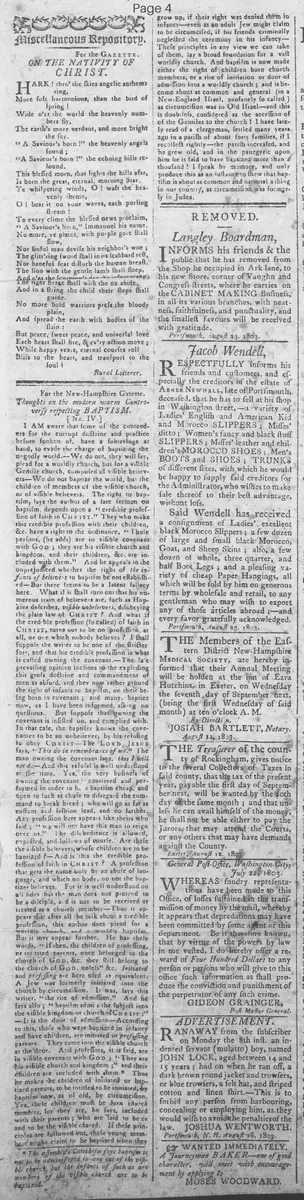
I AM aware that some of the contenders for the corrupt doctrine and practice before spoken of, have a subterfuge at hand, to evade the charge of baptizing the ungodly world.--We do not, they will say, plead for a worldly church, but for a visible church, composed of visible believers. We do not baptize the world, but the children of members of the visible church, or of visible believers. The right to baptize, says the author of a late sermon on baptism, depends upon a "credible profession of faith in CHRIST." They who make this credible profession with their children, &c. have a right to the ordinance, "Those persons, (he adds) are in visible covenant with God: they are his visible church and kingdom, and their children, &c. are included with them." And he appeals to the unprejudiced whether the right of the infants of believers to baptism be not established.--But there seems to be a latent fallacy here. What if it shall turn out that his numerous train of believers are, such as Hopkins describes, visible unbelievers, disobeying the plain law of Christ? And what if the credible profession (so called) of faith in Christ, turns out to be no profession at all, or one which nobody believes? I shall suppose the writer to be one of the stricter sort, and that his credible profession is what is called owning the covenant.--The late prevailing opinion inclines to the exploding this gross doctrine and commandment of men as absurd, and they now rather ground the right of infants to baptism, on their being born in covenant: and many, baptize now, as I have been informed, asking no questions. But suppose that owning the covenant is insisted on, and complied with. In that case, the baptizer knows the covenanter to be an unbeliever, by his refusing to obey Christ--The Lord Jesus says, "This do in remembrance of me." The man owning the covenant says. "this I will not do."--And his refusal is well understood at the time. Yea, the very business of owning the covenant;--contrived and performed in order to have baptism cheap, and open to such as choose to disregard the command to break bread; who will go as far as custom and fashion lead, and no farther. Any profession here appears like theirs who said; "we will not have this man to reign over us." The disobedience is allowed, expressed, and follows of course. Are these the visible believers, whose children are to be baptized?--And is this the credible profession of faith in Christ? A profession that gets the name only by an abuse of language, and which nobody, no not the baptizer believes. For it is well understood on all sides that the man does not pretend to be a disciple, and is not to be received or treated as a church member--Thus it appears that after all the talk about a credible profession, this author does plead for a worldly church, and worldly baptism. But it may appear further. He has these words, "If then, the children of professing, or initiated parents, once belonged to the church of God, &c. they still belong to the church of God, unless" &c. Initiated and professing are here used as equivalent. A Jew was formerly initiated into the church by circumcision. It was, says this writer. "the rite of admission." And he says also; "baptism admits the subject into the visible kingdom or church of CHRIST:"--It is the door of admission--According to this, those who were baptized in infancy and have children, are initiated or professing parents. They came into the visible church at the door. And professors, it is said, are in visible covenant with God; "They are his visible church and kingdom;" and their children are included with them.* Thus he makes the children of initiated or baptized parents, to be entitled to be initiated, by baptism now, as of old, by circumcision. Yea, these children must be born church members, for they are, he says. included with their parents; who are said to be in and to be the visible church. If these principles are followed out, these young members might claim to be baptized when they
*The assembly's Catechism says baptism is not to be administered to any out of the visible church, but the infants of such as are members of the visible church are to be baptized.
grow up, if their right was denied them in infancy--even as an adult Jew might claim to be circumcised, if his friends criminally neglected the ceremony in his infancy-- These principles in any view we can take of them, lay a broad foundation for a vast worldly church. And baptism is now made either the right of children born church members, or a rite of initiation or door of admission into a worldly church: and is become about as common and general (in a New-England Israel, profanely so called.) as circumcision was in Old Israel--and this is doubtless, considered as the accession of the Gentiles to the church! I have lately read of a clergyman, entitled many years ago in a parish of about forty families, if I recollect rightly--the parish increased, and he grew old, and in the panegyric upon him he is said to have baptized more than a thousand! I speak by memory. and only produce this as an instance to shew that baptism is about as common and national a thing in our country, as circumcision was formerly in Judea.
For the New-Hampshire Gazette.
THOUGHTS on the modern warm Controversy respecting BAPTISM.
[No. IV.]
I AM aware that some of the contenders for the corrupt doctrine and practice before spoken of, have a subterfuge at hand, to evade the charge of baptizing the ungodly world.--We do not, they will say, plead for a worldly church, but for a visible church, composed of visible believers. We do not baptize the world, but the children of members of the visible church, or of visible believers. The right to baptize, says the author of a late sermon on baptism, depends upon a "credible profession of faith in CHRIST." They who make this credible profession with their children, &c. have a right to the ordinance, "Those persons, (he adds) are in visible covenant with God: they are his visible church and kingdom, and their children, &c. are included with them." And he appeals to the unprejudiced whether the right of the infants of believers to baptism be not established.--But there seems to be a latent fallacy here. What if it shall turn out that his numerous train of believers are, such as Hopkins describes, visible unbelievers, disobeying the plain law of Christ? And what if the credible profession (so called) of faith in Christ, turns out to be no profession at all, or one which nobody believes? I shall suppose the writer to be one of the stricter sort, and that his credible profession is what is called owning the covenant.--The late prevailing opinion inclines to the exploding this gross doctrine and commandment of men as absurd, and they now rather ground the right of infants to baptism, on their being born in covenant: and many, baptize now, as I have been informed, asking no questions. But suppose that owning the covenant is insisted on, and complied with. In that case, the baptizer knows the covenanter to be an unbeliever, by his refusing to obey Christ--The Lord Jesus says, "This do in remembrance of me." The man owning the covenant says. "this I will not do."--And his refusal is well understood at the time. Yea, the very business of owning the covenant;--contrived and performed in order to have baptism cheap, and open to such as choose to disregard the command to break bread; who will go as far as custom and fashion lead, and no farther. Any profession here appears like theirs who said; "we will not have this man to reign over us." The disobedience is allowed, expressed, and follows of course. Are these the visible believers, whose children are to be baptized?--And is this the credible profession of faith in Christ? A profession that gets the name only by an abuse of language, and which nobody, no not the baptizer believes. For it is well understood on all sides that the man does not pretend to be a disciple, and is not to be received or treated as a church member--Thus it appears that after all the talk about a credible profession, this author does plead for a worldly church, and worldly baptism. But it may appear further. He has these words, "If then, the children of professing, or initiated parents, once belonged to the church of God, &c. they still belong to the church of God, unless" &c. Initiated and professing are here used as equivalent. A Jew was formerly initiated into the church by circumcision. It was, says this writer. "the rite of admission." And he says also; "baptism admits the subject into the visible kingdom or church of CHRIST:"--It is the door of admission--According to this, those who were baptized in infancy and have children, are initiated or professing parents. They came into the visible church at the door. And professors, it is said, are in visible covenant with God; "They are his visible church and kingdom;" and their children are included with them.* Thus he makes the children of initiated or baptized parents, to be entitled to be initiated, by baptism now, as of old, by circumcision. Yea, these children must be born church members, for they are, he says. included with their parents; who are said to be in and to be the visible church. If these principles are followed out, these young members might claim to be baptized when they
*The assembly's Catechism says baptism is not to be administered to any out of the visible church, but the infants of such as are members of the visible church are to be baptized.
grow up, if their right was denied them in infancy--even as an adult Jew might claim to be circumcised, if his friends criminally neglected the ceremony in his infancy-- These principles in any view we can take of them, lay a broad foundation for a vast worldly church. And baptism is now made either the right of children born church members, or a rite of initiation or door of admission into a worldly church: and is become about as common and general (in a New-England Israel, profanely so called.) as circumcision was in Old Israel--and this is doubtless, considered as the accession of the Gentiles to the church! I have lately read of a clergyman, entitled many years ago in a parish of about forty families, if I recollect rightly--the parish increased, and he grew old, and in the panegyric upon him he is said to have baptized more than a thousand! I speak by memory. and only produce this as an instance to shew that baptism is about as common and national a thing in our country, as circumcision was formerly in Judea.
What sub-type of article is it?
Moral Or Religious
What keywords are associated?
Baptism Controversy
Infant Baptism
Visible Church
Credible Profession
Worldly Church
Owning Covenant
New England Religion
What entities or persons were involved?
Hopkins
Author Of A Late Sermon On Baptism
Lord Jesus
Assembly's Catechism
Editorial Details
Primary Topic
Critique Of Worldly Baptism Practices
Stance / Tone
Critical Of Insincere Professions And Infant Baptism
Key Figures
Hopkins
Author Of A Late Sermon On Baptism
Lord Jesus
Assembly's Catechism
Key Arguments
Credible Profession Of Faith Often Masks Unbelief And Disobedience To Christ.
Owning The Covenant Allows Baptism For Non Disciples, Creating A Worldly Church.
Baptism As Initiation Parallels Circumcision, Leading To National, Meaningless Practice.
Children Of Baptized Parents Are Entitled To Baptism, Perpetuating A Vast Worldly Church.
Example Of A Clergyman Baptizing Over A Thousand In A Small Parish Shows Commonality.