Thank you for visiting SNEWPapers!
Sign up free
Editorial
September 17, 1869
Gold Hill Daily News
Gold Hill, Storey County, Nevada
What is this article about?
An editorial from the Sacramento Union critiques Democratic leaders' claims that the Fourteenth and Fifteenth Amendments are invalid without unanimous state consent, arguing this view voids the Thirteenth Amendment abolishing slavery, as Kentucky and Delaware opposed it, and labels it secessionist doctrine threatening Union, credit, and liberty.
Clipping
OCR Quality
98%
Excellent
Full Text
IS THE THIRTEENTH AMENDMENT VOID?
[From the Sacramento Union of yesterday.]
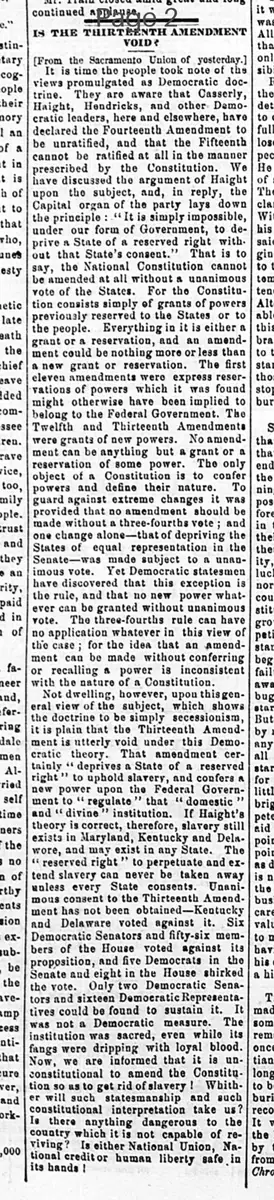
It is time the people took note of the views promulgated as Democratic doctrine. They are aware that Casserly, Haight, Hendricks, and other Democratic leaders, here and elsewhere, have declared the Fourteenth Amendment to be unratified, and that the Fifteenth cannot be ratified at all in the manner prescribed by the Constitution. We have discussed the argument of Haight upon the subject, and, in reply, the Capital organ of the party lays down the principle: "It is simply impossible, under our form of Government, to deprive a State of a reserved right without that State's consent." That is to say, the National Constitution cannot be amended at all without a unanimous vote of the States. For the Constitution consists simply of grants of powers previously reserved to the States or to the people. Everything in it is either a grant or a reservation, and an amendment could be nothing more or less than a new grant or reservation. The first eleven amendments were express reservations of powers which it was found might otherwise have been implied to belong to the Federal Government. The Twelfth and Thirteenth Amendments were grants of new powers. No amendment can be anything but a grant or reservation of some power. The only object of a Constitution is to confer powers and define their nature. To guard against extreme changes it was provided that no amendment should be made without a three-fourths vote; and one change alone—that of depriving the States of equal representation in the Senate—was made subject to a unanimous vote. Yet Democratic statesmen have discovered that this exception is the rule, and that no new power whatever can be granted without unanimous vote. The three-fourths rule can have no application whatever in this view of the case; for the idea that an amendment can be made without conferring or recalling a power is inconsistent with the nature of a Constitution. Not dwelling, however, upon this general view of the subject, which shows the doctrine to be simply secessionism, it is plain that the Thirteenth Amendment is utterly void under this Democratic theory. That amendment certainly "deprives a State of a reserved right" to uphold slavery, and confers new power upon the Federal Government to "regulate" that "domestic" and "divine" institution. If Haight's theory is correct, therefore, slavery still exists in Maryland, Kentucky and Delaware, and may exist in any State. The "reserved right" to perpetuate and extend slavery can never be taken away unless every State consents. Unanimous consent to the Thirteenth Amendment has not been obtained—Kentucky and Delaware voted against it. Six Democratic Senators and fifty-six members of the House voted against its proposition, and five Democrats in the Senate and eight in the House shirked the vote. Only two Democratic Senators and sixteen Democratic Representatives could be found to sustain it. It was not a Democratic measure. The institution was sacred, even while its fangs were dripping with loyal blood. Now, we are informed that it is unconstitutional to amend the Constitution so as to get rid of slavery! Whither will such statesmanship and such constitutional interpretation take us? Is there anything dangerous to the country which it is not capable of reviving? Is either National Union, National credit or human liberty safe in its hands!
[From the Sacramento Union of yesterday.]
It is time the people took note of the views promulgated as Democratic doctrine. They are aware that Casserly, Haight, Hendricks, and other Democratic leaders, here and elsewhere, have declared the Fourteenth Amendment to be unratified, and that the Fifteenth cannot be ratified at all in the manner prescribed by the Constitution. We have discussed the argument of Haight upon the subject, and, in reply, the Capital organ of the party lays down the principle: "It is simply impossible, under our form of Government, to deprive a State of a reserved right without that State's consent." That is to say, the National Constitution cannot be amended at all without a unanimous vote of the States. For the Constitution consists simply of grants of powers previously reserved to the States or to the people. Everything in it is either a grant or a reservation, and an amendment could be nothing more or less than a new grant or reservation. The first eleven amendments were express reservations of powers which it was found might otherwise have been implied to belong to the Federal Government. The Twelfth and Thirteenth Amendments were grants of new powers. No amendment can be anything but a grant or reservation of some power. The only object of a Constitution is to confer powers and define their nature. To guard against extreme changes it was provided that no amendment should be made without a three-fourths vote; and one change alone—that of depriving the States of equal representation in the Senate—was made subject to a unanimous vote. Yet Democratic statesmen have discovered that this exception is the rule, and that no new power whatever can be granted without unanimous vote. The three-fourths rule can have no application whatever in this view of the case; for the idea that an amendment can be made without conferring or recalling a power is inconsistent with the nature of a Constitution. Not dwelling, however, upon this general view of the subject, which shows the doctrine to be simply secessionism, it is plain that the Thirteenth Amendment is utterly void under this Democratic theory. That amendment certainly "deprives a State of a reserved right" to uphold slavery, and confers new power upon the Federal Government to "regulate" that "domestic" and "divine" institution. If Haight's theory is correct, therefore, slavery still exists in Maryland, Kentucky and Delaware, and may exist in any State. The "reserved right" to perpetuate and extend slavery can never be taken away unless every State consents. Unanimous consent to the Thirteenth Amendment has not been obtained—Kentucky and Delaware voted against it. Six Democratic Senators and fifty-six members of the House voted against its proposition, and five Democrats in the Senate and eight in the House shirked the vote. Only two Democratic Senators and sixteen Democratic Representatives could be found to sustain it. It was not a Democratic measure. The institution was sacred, even while its fangs were dripping with loyal blood. Now, we are informed that it is unconstitutional to amend the Constitution so as to get rid of slavery! Whither will such statesmanship and such constitutional interpretation take us? Is there anything dangerous to the country which it is not capable of reviving? Is either National Union, National credit or human liberty safe in its hands!
What sub-type of article is it?
Constitutional
Slavery Abolition
Partisan Politics
What keywords are associated?
Thirteenth Amendment
Democratic Doctrine
Constitutional Amendments
Slavery Abolition
State Consent
Secessionism
Reconstruction
Ratification
What entities or persons were involved?
Casserly
Haight
Hendricks
Democratic Leaders
Sacramento Union
Kentucky
Delaware
Maryland
Democratic Senators
Democratic Representatives
Editorial Details
Primary Topic
Validity Of The Thirteenth Amendment Under Democratic Theory
Stance / Tone
Strongly Critical Of Democratic Constitutional Doctrine As Secessionist And Threatening To Abolition
Key Figures
Casserly
Haight
Hendricks
Democratic Leaders
Sacramento Union
Kentucky
Delaware
Maryland
Democratic Senators
Democratic Representatives
Key Arguments
Democratic Doctrine Requires Unanimous State Consent For Amendments Depriving Reserved Rights
This View Makes The Thirteenth Amendment Void Since Kentucky And Delaware Opposed It
Such Theory Equates To Secessionism By Undermining The Three Fourths Ratification Rule
Amendments Are Grants Or Reservations Of Power, Not Possible Without Unanimity Per Democrats
Slavery Persists In Opposing States Like Maryland, Kentucky, Delaware Under This Theory
Few Democrats Supported The Thirteenth Amendment In Congress
This Interpretation Endangers National Union, Credit, And Human Liberty