Thank you for visiting SNEWPapers!
Sign up free
Story
February 14, 1879
The Charlotte Democrat
Charlotte, Mecklenburg County, North Carolina
What is this article about?
Article urges farmers to manage land as capital like merchants or bankers, by clearing unproductive areas like bushes and swamps, removing obstacles, controlling weeds, and using land intensively for multiple crops and livestock to maximize profits and avoid waste.
Clipping
OCR Quality
98%
Excellent
Full Text
AGRICULTURAL.
The Farmer's Use of His Capital.
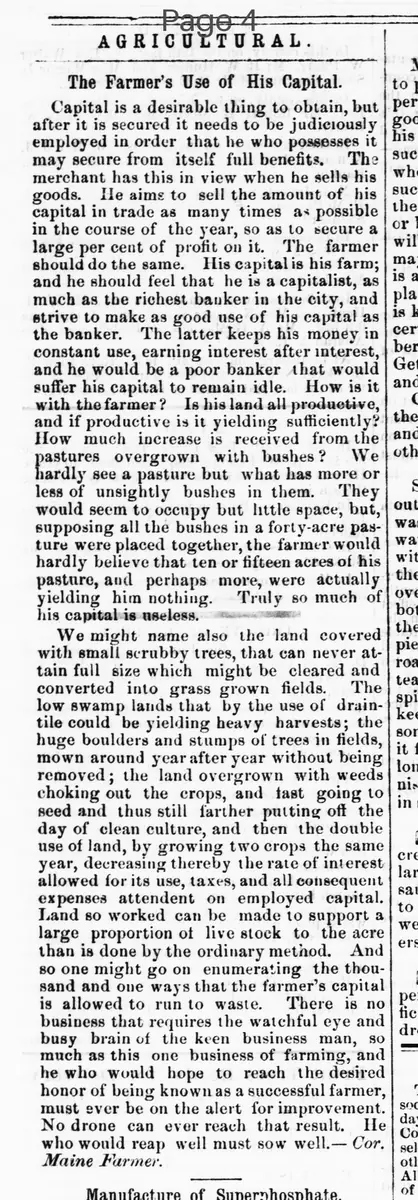
Capital is a desirable thing to obtain, but after it is secured it needs to be judiciously employed in order that he who possesses it may secure from it full benefits. The merchant has this in view when he sells his goods. He aims to sell the amount of his capital in trade as many times as possible in the course of the year, so as to secure a large per cent of profit on it. The farmer should do the same. His capital is his farm; and he should feel that he is a capitalist, as much as the richest banker in the city, and strive to make as good use of his capital as the banker. The latter keeps his money in constant use, earning interest after interest, and he would be a poor banker that would suffer his capital to remain idle. How is it with the farmer? Is his land all productive, and if productive is it yielding sufficiently? How much increase is received from the pastures overgrown with bushes? We hardly see a pasture but what has more or less of unsightly bushes in them. They would seem to occupy but little space, but, supposing all the bushes in a forty-acre pasture were placed together, the farmer would hardly believe that ten or fifteen acres of his pasture, and perhaps more, were actually yielding him nothing. Truly so much of his capital is useless.
We might name also the land covered with small scrubby trees, that can never attain full size which might be cleared and converted into grass grown fields. The low swamp lands that by the use of drain tile could be yielding heavy harvests; the huge boulders and stumps of trees in fields, mown around year after year without being removed; the land overgrown with weeds choking out the crops, and fast going to seed and thus still farther putting off the day of clean culture, and then the double use of land, by growing two crops the same year, decreasing thereby the rate of interest allowed for its use, taxes, and all consequent expenses attendant on employed capital. Land so worked can be made to support a large proportion of live stock to the acre than is done by the ordinary method. And so one might go on enumerating the thousand and one ways that the farmer's capital is allowed to run to waste.
There is no business that requires the watchful eye and busy brain of the keen business man, so much as this one business of farming, and he who would hope to reach the desired honor of being known as a successful farmer, must ever be on the alert for improvement. No drone can ever reach that result. He who would reap well must sow well. - Cor. Maine Farmer.
The Farmer's Use of His Capital.
Capital is a desirable thing to obtain, but after it is secured it needs to be judiciously employed in order that he who possesses it may secure from it full benefits. The merchant has this in view when he sells his goods. He aims to sell the amount of his capital in trade as many times as possible in the course of the year, so as to secure a large per cent of profit on it. The farmer should do the same. His capital is his farm; and he should feel that he is a capitalist, as much as the richest banker in the city, and strive to make as good use of his capital as the banker. The latter keeps his money in constant use, earning interest after interest, and he would be a poor banker that would suffer his capital to remain idle. How is it with the farmer? Is his land all productive, and if productive is it yielding sufficiently? How much increase is received from the pastures overgrown with bushes? We hardly see a pasture but what has more or less of unsightly bushes in them. They would seem to occupy but little space, but, supposing all the bushes in a forty-acre pasture were placed together, the farmer would hardly believe that ten or fifteen acres of his pasture, and perhaps more, were actually yielding him nothing. Truly so much of his capital is useless.
We might name also the land covered with small scrubby trees, that can never attain full size which might be cleared and converted into grass grown fields. The low swamp lands that by the use of drain tile could be yielding heavy harvests; the huge boulders and stumps of trees in fields, mown around year after year without being removed; the land overgrown with weeds choking out the crops, and fast going to seed and thus still farther putting off the day of clean culture, and then the double use of land, by growing two crops the same year, decreasing thereby the rate of interest allowed for its use, taxes, and all consequent expenses attendant on employed capital. Land so worked can be made to support a large proportion of live stock to the acre than is done by the ordinary method. And so one might go on enumerating the thousand and one ways that the farmer's capital is allowed to run to waste.
There is no business that requires the watchful eye and busy brain of the keen business man, so much as this one business of farming, and he who would hope to reach the desired honor of being known as a successful farmer, must ever be on the alert for improvement. No drone can ever reach that result. He who would reap well must sow well. - Cor. Maine Farmer.
What sub-type of article is it?
Agricultural Advice
Essay
What themes does it cover?
Moral Virtue
Triumph
What keywords are associated?
Farming Capital
Land Productivity
Agricultural Improvement
Waste Reduction
Successful Farming
Story Details
Story Details
Advice to farmers on treating land as capital, maximizing productivity by clearing bushes, scrubby trees, draining swamps, removing boulders and stumps, controlling weeds, and growing multiple crops to increase yields and support more livestock, emphasizing constant vigilance and improvement for success.