Thank you for visiting SNEWPapers!
Sign up free
The National Intelligencer And Washington Advertiser
Washington, District Of Columbia
What is this article about?
This continued editorial argues for the advantages of union in the United States, examining geographical features like swamps, deserts, and mountains as non-obstacles to intercourse. It highlights the value of swamps for timber and future meadows, absence of true deserts, navigable plains for manufactures, and economic complementarity among northern, middle, southern, and western states' productions, emphasizing internal trade over foreign dependence.
Merged-components note: Seamless continuation of the editorial essay on the advantages of union across pages; original label of second component changed from story to editorial.
Clippings
1 of 2
OCR Quality
Full Text
(CONTINUED)
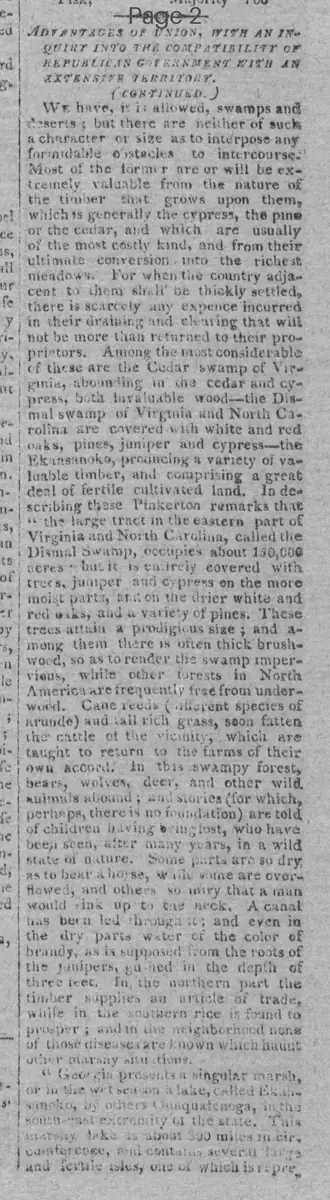
We have, it is allowed, swamps and deserts: but there are neither of such a character or size as to interpose any formidable obstacles to intercourse. Most of the former are or will be extremely valuable from the nature of the timber that grows upon them, which is generally the cypress, the pine or the cedar, and which are usually of the most costly kind, and from their ultimate conversion into the richest meadows. For when the country adjacent to them shall be thickly settled, there is scarcely any expense incurred in their draining and clearing that will not be more than returned to their proprietors. Among the most considerable of these are the Cedar swamp of Virginia, abounding in the cedar and cypress, both invaluable wood—the Dismal swamp of Virginia and North Carolina are covered with white and red oaks, pines, juniper and cypress—the Okefenokee, producing a variety of valuable timber, and comprising a great deal of fertile cultivated land. In describing these Pinkerton remarks that "the large tract in the eastern part of Virginia and North Carolina, called the Dismal Swamp, occupies about 150,000 acres—but it is entirely covered with trees, juniper and cypress on the more moist parts, and on the drier white and red oaks, and a variety of pines. These trees attain a prodigious size; and among them there is often thick brushwood, so as to render the swamp impervious, while other forests in North America are frequently free from underwood. Cane reeds (different species of arundo) and tall rich grass, soon fatten the cattle of the vicinity, which are taught to return to the farms of their own accord. in this swampy forest, bears, wolves, deer, and other wild animals abound; and stories (for which, perhaps, there is no foundation) are told of children having been lost, who have been seen, after many years, in a wild state of nature. some parts are so dry as to bear a horse, while some are overflowed, and others so miry that a man would sink up to his neck. A canal has been led through it; and even in the dry parts water of the color of brandy, as is supposed from the roots of the junipers, sunk in the depth of three feet. In, the northern part the timber supplies an article of trade. while in the southern rice is found to prosper; and in the neighborhood none of those diseases are known which haunt other marshy situations.
"Georgia presents a singular marsh, or in the wet season a lake, called Okefenokee, by others Ounquafemoga, south east extremity of the state. This immense lake about 50 miles in circumference, and contains several large and fertile isles, one of which is peopled.
Rented by the Creek Indians as a kind of paradise, inhabited by a peculiar race, whose women are incomparably beautiful, and are called by them daughters of the sun. These islanders are said to be a remnant of an ancient tribe, nearly exterminated by the Creeks.
With regard to deserts, understanding by the term tracts of country incapable of cultivation, there are few, if any, within the United States. There are tracts in which few productions will flourish, or even indemnify the labour expended in their production; but these very tracts are invariably covered with large and flourishing timber, already valuable, and every day rising in value, with the increasing wealth of the country, and with the progressive improvement of our roads and rivers. If then these tracts shall be eternally destined to the growth of timber, so far from being causes of separating, they will serve to unite the people of the different states, who will find a supply of their wants with them. None of these tracts are, however, so large as to cut off the inhabitants of one state from another, or so difficult of passage as to prevent the laying out of good roads at an expense incommensurate with the benefits derivable from them. There do not appear to exist, on the whole continent of America, says Pinkerton, "any of those sandy deserts which are so remarkable in Asia and Africa. There is on the contrary, an exuberance of water even in some of the most torrid regions. Even the volcanoes in S. America often pour down torrents of water and mud, and no where occur the sandy ruins of plains, after the fertile soil has been totally lost, or the rocky skeletons of ancient mountains."
But we have a chain of high and wide mountains, that interpose between the Eastern and Western country. That these will, in a degree, be barriers to intercourse, will not be denied. But a dispassionate consideration of all the circumstances which attend them will shew that this effect will probably be produced but in an inconsiderable degree. Pinkerton observes that "the mountains of North America are far from rivalling the Andes in the south. Some irregular ranges pervade the Isthmus, but it seems mere theory to consider them as connected with the Andes, as they have neither the same character nor direction. In the Isthmus there are also several volcanoes; but the natural history of Spanish America is extremely imperfect."
"The centre of North America seems to present a vast fertile plain, watered by the Missouri and its auxiliary streams."
This vast and fertile plain will undoubtedly be the great seat of manufactures. It is here that the manners and mode of living of the inhabitants will be most friendly to this occupation. In proportion to their distance from the ocean they will be free from the corruptions and dissipation produced by trade. The fertility of the soil and nature of the climate will supply them with the most important raw materials, and particularly cotton and wool; at the same time that they will enable them to raise with little labor and a small expense the grain and meat which constitute the chief maintenance of a people of plain habits of life. The numerous and extensive rivers, which take their sources in this plain, will command a vast tract of country on either side, which depending on it for a supply of manufactured articles will thus have a common centre.
In the second place, the soil of adjacent countries may be so different, as not only to produce little in common, but likewise so dissimilar that one country shall produce little which is wanted by the other.
However this may be the case in other portions of the earth, it is not so here. The productions of the northern states are fish, oil, lumber, naval stores, skins and furs, grain of various kinds, potatoes, &c. Those of the middle states are potatoes, flour, grain of various sorts, ginseng, beef and pork, &c. Those of the southern states are lumber, naval stores, pitch, rosin, turpentine, rice, indigo, cotton, tobacco, &c. And those of the western are cotton, sugar, grain of all kinds, cattle, and most of the articles produced in the other parts of the United States.
Of these, it will be perceived, that a considerable portion are produced in common; and that nearly the whole of the residue produced in one section of the union are wanted either by that section, or by the other sections of the confederacy. The first result appears in the enumeration we have made, the second will be made manifest to any one who compares the immense value of our whole products with the inconsiderable value of that portion of them which is exported to foreign countries. The whole consumption of native articles in the United States cannot be computed at less than five hundred millions of dollars. The value of those productions exported is almost forty millions, which is less than a twelfth part of the former. The difference between five hundred millions and forty millions is consequently consumed either in the districts in which they are raised, or in the other districts of the United States. And of the forty millions of raw materials annually exported a very considerable part is re-imported in the shape of various fabrics made out of them. Every year will lessen our dependence on the European world, by our successful cultivation of those articles we now derive from them, or by the erection of new manufactures. Already our dependence upon the foreign market is inconsiderable compared with our dependence on each other; in the course of no long period, from the causes we have mentioned, it will be insignificant.
What sub-type of article is it?
What keywords are associated?
What entities or persons were involved?
Editorial Details
Primary Topic
Advantages Of Union And Compatibility Of Republican Government With Extensive Territory
Stance / Tone
Supportive Of Union And Internal Interdependence
Key Figures
Key Arguments