Thank you for visiting SNEWPapers!
Sign up free
Literary
June 28, 1871
The Danbury News
Danbury, Fairfield County, Connecticut
What is this article about?
A pork dealer teaches his son that money won at cards without equivalent is dishonest. Months later, after profiting $50,000 from pork contracts, the son questions what equivalent his father provided, highlighting hypocrisy in commerce.
Clipping
OCR Quality
98%
Excellent
Full Text
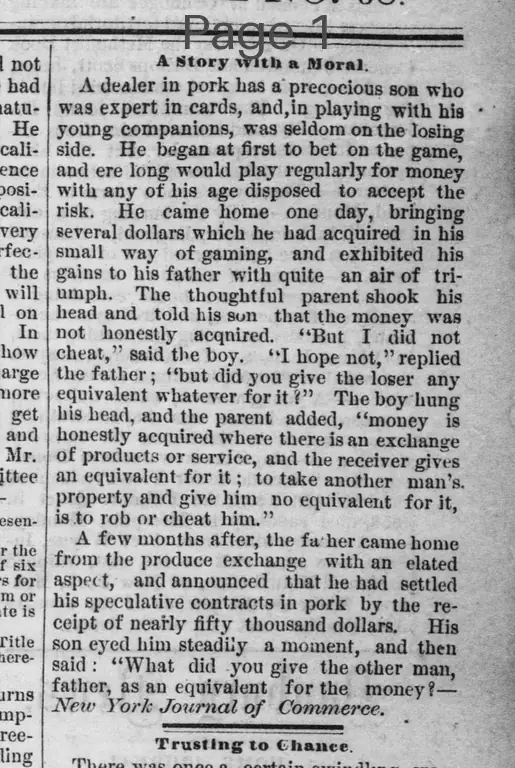
A Story with a Moral.
A dealer in pork has a precocious son who was expert in cards, and, in playing with his young companions, was seldom on the losing side. He began at first to bet on the game. and ere long would play regularly for money with any of his age disposed to accept the risk. He came home one day, bringing several dollars which he had acquired in his small way of gaming, and exhibited his gains to his father with quite an air of triumph. The thoughtful parent shook his head and told his son that the money was not honestly acquired. "But I did not cheat," said the boy. "I hope not," replied the father; "but did you give the loser any equivalent whatever for it ?" The boy hung his head, and the parent added, "money is honestly acquired where there is an exchange of products or service, and the receiver gives an equivalent for it; to take another man's property and give him no equivalent for it, is to rob or cheat him."
A few months after, the father came home from the produce exchange with an elated aspect, and announced that he had settled his speculative contracts in pork by the receipt of nearly fifty thousand dollars. His son eyed him steadily a moment, and then said: "What did you give the other man, father, as an equivalent for the money?"- New York Journal of Commerce.
A dealer in pork has a precocious son who was expert in cards, and, in playing with his young companions, was seldom on the losing side. He began at first to bet on the game. and ere long would play regularly for money with any of his age disposed to accept the risk. He came home one day, bringing several dollars which he had acquired in his small way of gaming, and exhibited his gains to his father with quite an air of triumph. The thoughtful parent shook his head and told his son that the money was not honestly acquired. "But I did not cheat," said the boy. "I hope not," replied the father; "but did you give the loser any equivalent whatever for it ?" The boy hung his head, and the parent added, "money is honestly acquired where there is an exchange of products or service, and the receiver gives an equivalent for it; to take another man's property and give him no equivalent for it, is to rob or cheat him."
A few months after, the father came home from the produce exchange with an elated aspect, and announced that he had settled his speculative contracts in pork by the receipt of nearly fifty thousand dollars. His son eyed him steadily a moment, and then said: "What did you give the other man, father, as an equivalent for the money?"- New York Journal of Commerce.
What sub-type of article is it?
Fable
Prose Fiction
What themes does it cover?
Moral Virtue
Commerce Trade
What keywords are associated?
Moral Tale
Honest Acquisition
Gaming
Pork Dealer
Speculation
What entities or persons were involved?
New York Journal Of Commerce
Literary Details
Title
A Story With A Moral.
Author
New York Journal Of Commerce
Key Lines
"Money Is Honestly Acquired Where There Is An Exchange Of Products Or Service, And The Receiver Gives An Equivalent For It; To Take Another Man's Property And Give Him No Equivalent For It, Is To Rob Or Cheat Him."
"What Did You Give The Other Man, Father, As An Equivalent For The Money?"