Thank you for visiting SNEWPapers!
Sign up free
Literary
June 17, 1830
Martinsburg Gazette And Public Advertiser
Martinsburg, Berkeley County, West Virginia
What is this article about?
A young man and his father visit an insane asylum in the city, witnessing the misery of the mad, including an old man ruined by his sons' vices. This sparks a deep dialogue on insanity as a fate worse than death, equating vice to madness, and the importance of virtue. The son vows to resist temptation, inspired by the day and his father's farewell.
Clipping
OCR Quality
95%
Excellent
Full Text
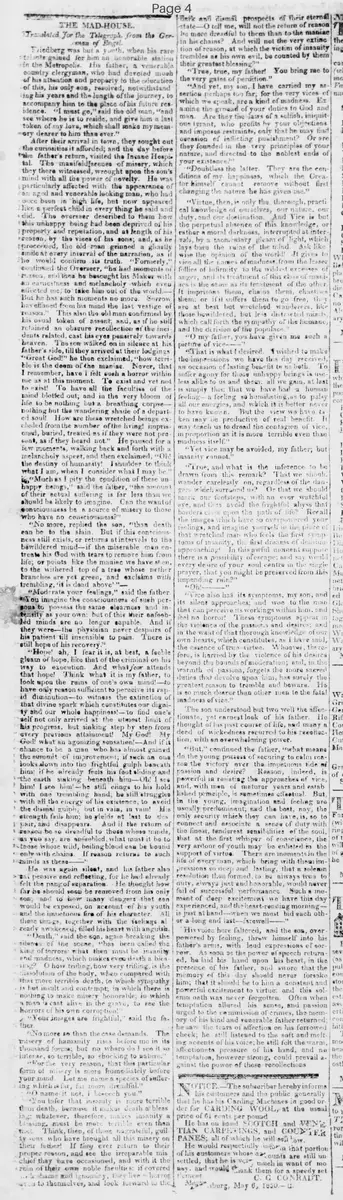
THE MAD-HOUSE.
Translated for the Telegraph, from the German of Engel.
Friedberg was but a youth, when his rare talents gained for him an honorable station in the Metropolis. His father, a venerable country clergyman, who had devoted much of his attention and property to the education of this, his only son, resolved, notwithstanding his years and the length of the journey, to accompany him to the place of his future residence. "I must go," said the old man, "and see where he is to reside, and give him a last token of my love, which shall make my memory dearer to him than ever."
After their arrival in town, they sought out the curiosities it afforded; and the day before the father's return, visited the Insane Hospital. The manifold scenes of misery, which they there witnessed, wrought upon the son's mind with all the power of novelty. He was particularly affected with the appearance of an aged and venerable looking man, who had once been in high life, but now appeared like a perfect child in every thing he said and did. The overseer described to them how this unhappy being had been deprived of his property and reputation, and at length of his reason, by the vices of his sons; and, as he proceeded, the old man grinned a ghastly smile at every interval of the narration, as if he would confirm its truth. "Formerly," continued the Overseer, "he had moments of reason, and then he besought his Maker with an earnestness and melancholy which even affected me; to take him out of the world.— But he has such moments no more. Sorrow has effaced from his mind the last vestige of reason." This also the old man confirmed by his usual token of assent, and, as if he still retained an obscure recollection of the incidents related, cast his eyes pensively towards heaven. The son walked on in silence at his father's side, till they arrived at their lodgings.
"Great God!" he then exclaimed, "how terrible is the doom of the maniac. Never, that I remember, have I felt such a horror within me as at this moment. To exist and yet not to exist! To have all the faculties of the mind blotted out; and in the very bloom of life to be nothing but a breathing corpse— nothing but the wandering shade of a departed soul! How are these wretched beings excluded from the number of the living! imprisoned, buried, treated as if they were not present, as if they heard not." He paused for a few moments, walking back and forth with a melancholy aspect, and then exclaimed, "Oh! the destiny of humanity! I shudder to think what I am, when I consider what I may be."
"Much as I pity the condition of these unhappy beings," said the father, "the amount of their actual suffering is far less than we should be likely to imagine. Can the want of consciousness be a source of misery to those who have no consciousness?"
"No more," replied the son, "than death can be to the slain. But if this consciousness still exists, or returns at intervals to the bewildered mind—if the miserable man entreats his God with tears to remove him from life; or points like the maniac we have seen, to the withered top of a tree whose nether branches are yet green, and exclaims with trembling, 'it is dead above!'"
"Moderate your feelings," said the father. "You imagine the consciousness of such persons to possess the same clearness and intensity as your own: but of this their enfeebled minds are no longer capable. And if they were—the physician never despairs of his patient till insensible to pain. There is still hope of his recovery."
"Hope! ah, I fear it is, at best, a feeble gleam of hope, like that of the criminal on his way to execution. And what fear attends that hope! Think what it is my father, to look upon the ruins of one's own mind!—to have only reason sufficient to perceive its rapid diminution—to witness the extinction of that divine spark which constitutes our dignity and our whole happiness!—to find one's self not only arrived at the utmost limit of his progress, but sinking step by step from every previous attainment! My God! My God! what an agonizing sensation!—And if it chance to be a man who has almost gained the summit of improvement; if such an one looks down into the frightful gulph beneath him: if he already feels his foot sliding and the earth sinking beneath him—Oh! I see him! I see him!—he still clings to his hold with one trembling hand; he still struggles with all the energy of his existence, to avoid the dismal gulph, but in vain, in vain! His strength fails him: he yields at last to despair, and disappears. "And if the return of reason be so dreadful to those whose minds, as you say, are enfeebled, what must it be to those whose wild, boiling blood can be bound only with chains. If reason returns to such a mind as these
He was again silent, and his father also sat pensive and reflecting, for he had already felt the pang of separation. He thought how far he should soon be removed from his only son; and to how many dangers that son would be exposed, on account of his youth and the impetuous fire of his character. All these things, together with the feelings already awakened, filled his heart with anguish.
"Death," said the son, again breaking the silence of the scene, "has been called the king of terrors: what then must be insanity and madness, which makes even death a blessing. Oh! how trifling, how very trifling, is the dissolution of the body, when compared with that more terrible death, to which sympathy is but insult and contempt; in which there is nothing to make misery honorable; in which a man is cast alive in the grave, to see the horrors of his own corruption."
"Your images are frightful," said the father.
"No more so than the case demands. The misery of humanity rises before me in its thousand forms; but nowhere do I see it so intense, so terrible, so shocking to nature."
"For the very reason, that this particular form of misery is more immediately before your mind. Let me name a species of suffering which is far more dreadful."
"O name it not, I beseech you."
"You infer that insanity is more terrible than death, because it makes death a blessing whatever, therefore, makes insanity a blessing, must be more terrible even than what! Think, then, of those ungrateful, guilty sons who have brought all this misery on their father! If they ever return to their proper reason, and see the irreparable mischief they have occasioned, and with it the ruin of their own noble faculties: if covered with shame and ignominy, they live a horror to themselves, and look forward to the rank and dismal prospects of their eternal state—O tell me, will not the return of reason be more dreadful to them than to the maniac in his chains? And will not the very extinction of reason, at which the victim of insanity trembles as his own evil, be counted by them their greatest blessing?"
"True, true, my father! You bring me to the very gates of perdition."
"And yet, my son, I have carried my assertion perhaps too far; for the very vices of which we speak, are a kind of madness. Examine the ground of your duties to God and man. Are they the laws of a selfish, iniquitous tyrant, who profits by your objections and imposes restraints, only that he may find occasion of inflicting punishment? Or are they founded in the very principles of your nature, and directed to the noblest ends of your existence?"
"Doubtless the latter. They are the conditions of my happiness, which the Creator himself cannot remove without first changing the nature he has given me."
"Virtue, then, is only the thorough, practical knowledge of ourselves, our nature, our duty, and our destination. And Vice is but the perpetual absence of this knowledge, or rather a moral darkness, interrupted at intervals, by a momentary gleam of light, which lays bare the ruins of the mind. Ask likewise the opinion of the world! It gives to vice all the names of madness, from the lesser follies of infirmity to the wildest excesses of anger, and its treatment of this class of maniacs is the same as its treatment of the other. It imprisons them, chains them, chastises them: or if it suffers them to go free, they are at best but wretched wanderers, like those bewildered, but less distracted minds which call forth the sympathy of the humane, and the derision of the populace."
"O my father, you have given me such a picture of vice—"
"That is what I desired. I wished to make the impressions we have this day received, an occasion of lasting benefit to us both. To suffer agony for those unhappy beings is useless alike to us and them. all we gain, at last is simply this: that we have had a human feeling—a feeling so humiliating, as to palsy all our energies, and which it is better never to have known. But the view we have taken may be productive of real benefit. It may teach us to dread the contagion of vice, in proportion as it is more terrible even than madness itself."
"Yet vice may be avoided, my father; but insanity cannot."
"True, and what is the inference to be drawn from this remark? That we should wander carelessly on, regardless of the dangers which surround us? Or that we should mark our footsteps, with an ever watchful eye, and thus avoid the frightful abyss that borders close upon the path of life? "Recall the images which have so overpowered your feelings, and imagine yourself in the place of that wretched man who feels the first symptoms of insanity, the first dreams of delusion approaching! In this awful moment suppose there is a possibility of escape: and say would every desire of your soul centre in the single prayer, that you might be preserved from this impending ruin?"
"Oh!—"
"Vice also has its symptoms, my son, and its silent approaches: and woe to the man that can perceive its workings within him, and feel no horror! These symptoms appear in the violence of the passions and desires: and in the want of that thorough knowledge of our own hearts, which constitutes, as I have said, the essence of true virtue. Whoever, therefore, is hurried by the violence of his desires beyond the bounds of moderation; and, in the warmth of passion, forgets the more sacred duties that devolve upon him, has surely the greatest reason to tremble and beware. He is so much dearer than other men to the fatal madness of vice."
The son understood but too well the affectionate, yet earnest look of his father. He thought of his past course of life, and many a deed of wickedness recurred to his recollection, with an overwhelming power.
"But," continued the father, "what means do the young possess of securing to calm reason the victory over the impetuous tide of passion and desire? Reason, indeed, is powerful in resisting the approaches of vice, and, with men of maturer years and established principle, is sometimes effectual. But, in the young, imagination and feeling are usually predominant; and the best, nay, the only security which they can have, is, so to connect and associate a sense of duty with the finest, tenderest sensibilities of the soul, that at the first whisper of conscience, the very ardour of youth may be enlisted in the support of virtue. There are moments in the life of every man, which bring with them impressions so deep and lasting, that a solemn resolution then formed, to be always true to duty, always just and honorable, would never fail of successful performance. Such a moment of deep excitement we have this day experienced, and the heart-rending morning is just at hand—when we must bid each other a long and last farewell.—"
His voice here faltered, and the son, overpowered by feeling, threw himself into his father's arms, with loud expressions of sorrow. As soon as the power of speech returned, he laid his hand upon his heart, in the presence of his father, and swore that the memory of this day should never forsake him; that it should be to him a constant and powerful excitement to virtue: and this solemn oath was never forgotten. Often when temptation allured his sense, and passion urged to the commission of crimes, the memory of his kind and venerable father returned: he saw the tears of affection on his furrowed cheek; he still listened to the soft and melting accents of his voice; he still felt the warm, affectionate pressure of his hand, and no temptation, however strong, could prevail against the power of these recollections.
Translated for the Telegraph, from the German of Engel.
Friedberg was but a youth, when his rare talents gained for him an honorable station in the Metropolis. His father, a venerable country clergyman, who had devoted much of his attention and property to the education of this, his only son, resolved, notwithstanding his years and the length of the journey, to accompany him to the place of his future residence. "I must go," said the old man, "and see where he is to reside, and give him a last token of my love, which shall make my memory dearer to him than ever."
After their arrival in town, they sought out the curiosities it afforded; and the day before the father's return, visited the Insane Hospital. The manifold scenes of misery, which they there witnessed, wrought upon the son's mind with all the power of novelty. He was particularly affected with the appearance of an aged and venerable looking man, who had once been in high life, but now appeared like a perfect child in every thing he said and did. The overseer described to them how this unhappy being had been deprived of his property and reputation, and at length of his reason, by the vices of his sons; and, as he proceeded, the old man grinned a ghastly smile at every interval of the narration, as if he would confirm its truth. "Formerly," continued the Overseer, "he had moments of reason, and then he besought his Maker with an earnestness and melancholy which even affected me; to take him out of the world.— But he has such moments no more. Sorrow has effaced from his mind the last vestige of reason." This also the old man confirmed by his usual token of assent, and, as if he still retained an obscure recollection of the incidents related, cast his eyes pensively towards heaven. The son walked on in silence at his father's side, till they arrived at their lodgings.
"Great God!" he then exclaimed, "how terrible is the doom of the maniac. Never, that I remember, have I felt such a horror within me as at this moment. To exist and yet not to exist! To have all the faculties of the mind blotted out; and in the very bloom of life to be nothing but a breathing corpse— nothing but the wandering shade of a departed soul! How are these wretched beings excluded from the number of the living! imprisoned, buried, treated as if they were not present, as if they heard not." He paused for a few moments, walking back and forth with a melancholy aspect, and then exclaimed, "Oh! the destiny of humanity! I shudder to think what I am, when I consider what I may be."
"Much as I pity the condition of these unhappy beings," said the father, "the amount of their actual suffering is far less than we should be likely to imagine. Can the want of consciousness be a source of misery to those who have no consciousness?"
"No more," replied the son, "than death can be to the slain. But if this consciousness still exists, or returns at intervals to the bewildered mind—if the miserable man entreats his God with tears to remove him from life; or points like the maniac we have seen, to the withered top of a tree whose nether branches are yet green, and exclaims with trembling, 'it is dead above!'"
"Moderate your feelings," said the father. "You imagine the consciousness of such persons to possess the same clearness and intensity as your own: but of this their enfeebled minds are no longer capable. And if they were—the physician never despairs of his patient till insensible to pain. There is still hope of his recovery."
"Hope! ah, I fear it is, at best, a feeble gleam of hope, like that of the criminal on his way to execution. And what fear attends that hope! Think what it is my father, to look upon the ruins of one's own mind!—to have only reason sufficient to perceive its rapid diminution—to witness the extinction of that divine spark which constitutes our dignity and our whole happiness!—to find one's self not only arrived at the utmost limit of his progress, but sinking step by step from every previous attainment! My God! My God! what an agonizing sensation!—And if it chance to be a man who has almost gained the summit of improvement; if such an one looks down into the frightful gulph beneath him: if he already feels his foot sliding and the earth sinking beneath him—Oh! I see him! I see him!—he still clings to his hold with one trembling hand; he still struggles with all the energy of his existence, to avoid the dismal gulph, but in vain, in vain! His strength fails him: he yields at last to despair, and disappears. "And if the return of reason be so dreadful to those whose minds, as you say, are enfeebled, what must it be to those whose wild, boiling blood can be bound only with chains. If reason returns to such a mind as these
He was again silent, and his father also sat pensive and reflecting, for he had already felt the pang of separation. He thought how far he should soon be removed from his only son; and to how many dangers that son would be exposed, on account of his youth and the impetuous fire of his character. All these things, together with the feelings already awakened, filled his heart with anguish.
"Death," said the son, again breaking the silence of the scene, "has been called the king of terrors: what then must be insanity and madness, which makes even death a blessing. Oh! how trifling, how very trifling, is the dissolution of the body, when compared with that more terrible death, to which sympathy is but insult and contempt; in which there is nothing to make misery honorable; in which a man is cast alive in the grave, to see the horrors of his own corruption."
"Your images are frightful," said the father.
"No more so than the case demands. The misery of humanity rises before me in its thousand forms; but nowhere do I see it so intense, so terrible, so shocking to nature."
"For the very reason, that this particular form of misery is more immediately before your mind. Let me name a species of suffering which is far more dreadful."
"O name it not, I beseech you."
"You infer that insanity is more terrible than death, because it makes death a blessing whatever, therefore, makes insanity a blessing, must be more terrible even than what! Think, then, of those ungrateful, guilty sons who have brought all this misery on their father! If they ever return to their proper reason, and see the irreparable mischief they have occasioned, and with it the ruin of their own noble faculties: if covered with shame and ignominy, they live a horror to themselves, and look forward to the rank and dismal prospects of their eternal state—O tell me, will not the return of reason be more dreadful to them than to the maniac in his chains? And will not the very extinction of reason, at which the victim of insanity trembles as his own evil, be counted by them their greatest blessing?"
"True, true, my father! You bring me to the very gates of perdition."
"And yet, my son, I have carried my assertion perhaps too far; for the very vices of which we speak, are a kind of madness. Examine the ground of your duties to God and man. Are they the laws of a selfish, iniquitous tyrant, who profits by your objections and imposes restraints, only that he may find occasion of inflicting punishment? Or are they founded in the very principles of your nature, and directed to the noblest ends of your existence?"
"Doubtless the latter. They are the conditions of my happiness, which the Creator himself cannot remove without first changing the nature he has given me."
"Virtue, then, is only the thorough, practical knowledge of ourselves, our nature, our duty, and our destination. And Vice is but the perpetual absence of this knowledge, or rather a moral darkness, interrupted at intervals, by a momentary gleam of light, which lays bare the ruins of the mind. Ask likewise the opinion of the world! It gives to vice all the names of madness, from the lesser follies of infirmity to the wildest excesses of anger, and its treatment of this class of maniacs is the same as its treatment of the other. It imprisons them, chains them, chastises them: or if it suffers them to go free, they are at best but wretched wanderers, like those bewildered, but less distracted minds which call forth the sympathy of the humane, and the derision of the populace."
"O my father, you have given me such a picture of vice—"
"That is what I desired. I wished to make the impressions we have this day received, an occasion of lasting benefit to us both. To suffer agony for those unhappy beings is useless alike to us and them. all we gain, at last is simply this: that we have had a human feeling—a feeling so humiliating, as to palsy all our energies, and which it is better never to have known. But the view we have taken may be productive of real benefit. It may teach us to dread the contagion of vice, in proportion as it is more terrible even than madness itself."
"Yet vice may be avoided, my father; but insanity cannot."
"True, and what is the inference to be drawn from this remark? That we should wander carelessly on, regardless of the dangers which surround us? Or that we should mark our footsteps, with an ever watchful eye, and thus avoid the frightful abyss that borders close upon the path of life? "Recall the images which have so overpowered your feelings, and imagine yourself in the place of that wretched man who feels the first symptoms of insanity, the first dreams of delusion approaching! In this awful moment suppose there is a possibility of escape: and say would every desire of your soul centre in the single prayer, that you might be preserved from this impending ruin?"
"Oh!—"
"Vice also has its symptoms, my son, and its silent approaches: and woe to the man that can perceive its workings within him, and feel no horror! These symptoms appear in the violence of the passions and desires: and in the want of that thorough knowledge of our own hearts, which constitutes, as I have said, the essence of true virtue. Whoever, therefore, is hurried by the violence of his desires beyond the bounds of moderation; and, in the warmth of passion, forgets the more sacred duties that devolve upon him, has surely the greatest reason to tremble and beware. He is so much dearer than other men to the fatal madness of vice."
The son understood but too well the affectionate, yet earnest look of his father. He thought of his past course of life, and many a deed of wickedness recurred to his recollection, with an overwhelming power.
"But," continued the father, "what means do the young possess of securing to calm reason the victory over the impetuous tide of passion and desire? Reason, indeed, is powerful in resisting the approaches of vice, and, with men of maturer years and established principle, is sometimes effectual. But, in the young, imagination and feeling are usually predominant; and the best, nay, the only security which they can have, is, so to connect and associate a sense of duty with the finest, tenderest sensibilities of the soul, that at the first whisper of conscience, the very ardour of youth may be enlisted in the support of virtue. There are moments in the life of every man, which bring with them impressions so deep and lasting, that a solemn resolution then formed, to be always true to duty, always just and honorable, would never fail of successful performance. Such a moment of deep excitement we have this day experienced, and the heart-rending morning is just at hand—when we must bid each other a long and last farewell.—"
His voice here faltered, and the son, overpowered by feeling, threw himself into his father's arms, with loud expressions of sorrow. As soon as the power of speech returned, he laid his hand upon his heart, in the presence of his father, and swore that the memory of this day should never forsake him; that it should be to him a constant and powerful excitement to virtue: and this solemn oath was never forgotten. Often when temptation allured his sense, and passion urged to the commission of crimes, the memory of his kind and venerable father returned: he saw the tears of affection on his furrowed cheek; he still listened to the soft and melting accents of his voice; he still felt the warm, affectionate pressure of his hand, and no temptation, however strong, could prevail against the power of these recollections.
What sub-type of article is it?
Prose Fiction
Dialogue
What themes does it cover?
Moral Virtue
Death Mortality
Religious
What keywords are associated?
Madhouse
Insanity
Vice
Virtue
Father Son Dialogue
Moral Lesson
Madness Metaphor
What entities or persons were involved?
Translated For The Telegraph, From The German Of Engel.
Literary Details
Title
The Mad House.
Author
Translated For The Telegraph, From The German Of Engel.
Key Lines
"Great God!" He Then Exclaimed, "How Terrible Is The Doom Of The Maniac. Never, That I Remember, Have I Felt Such A Horror Within Me As At This Moment. To Exist And Yet Not To Exist!"
"Death," Said The Son, Again Breaking The Silence Of The Scene, "Has Been Called The King Of Terrors: What Then Must Be Insanity And Madness, Which Makes Even Death A Blessing."
"Virtue, Then, Is Only The Thorough, Practical Knowledge Of Ourselves, Our Nature, Our Duty, And Our Destination. And Vice Is But The Perpetual Absence Of This Knowledge, Or Rather A Moral Darkness..."
"Yet Vice May Be Avoided, My Father; But Insanity Cannot."
He Laid His Hand Upon His Heart, In The Presence Of His Father, And Swore That The Memory Of This Day Should Never Forsake Him; That It Should Be To Him A Constant And Powerful Excitement To Virtue: And This Solemn Oath Was Never Forgotten.