Thank you for visiting SNEWPapers!
Sign up free
Buckeye Valley News And Buckeye Review
Buckeye, Maricopa County, Arizona
What is this article about?
The U.S. Soil Conservation Service promotes native grasses for livestock feed, soil conservation, and erosion control in western states and the Great Plains. Wartime demand for beef drives seed collection and a new farm industry, aiding land rehabilitation post-dust bowl.
Clipping
OCR Quality
Full Text
Native grass seed stands well to the forefront of the feed picture. Native grasses are handy, economical and highly palatable. They supply about 65 per cent of the forage and feed for livestock in the western range states.
As a result of the plant explorations of the U. S. Soil Conservation Service among native species growing here in America, specifically to find better soil-conserving and range forage plants, a number of grasses not previously cultivated have been brought into use.
The seed of a number of native grasses could not be purchased anywhere a few years ago. The SCS personally had to collect all the seed needed for its land rehabilitation projects. But, since then, the agency has carried on an educational campaign for the harvesting, processing and planting of the seed. Interest in the importance of the seed was spurred. Prices went up.
The seed of a number of native grasses is now being sold on an important scale by seedsmen. The establishment of a new farm industry—collection of wild grass seeds—has been the result. The SCS can now buy most of its seed from farmers and ranchers.
Just what are the native grasses? Some of the principal ones are buffalo grass, blue grama grass, side-oats grama, various bluestem grasses, switchgrass, sand dropseed, tobosa grass, western wheatgrass, galleta, Indian grass, and various wild-rye grasses.
Some of these native grasses took quite a beating from expanded dry-land farming in the latter part of the 19th century. Farmers kicked up more dust than the thundering herd. Subsequent drouths and severe winter storms didn't help matters any. The "dust bowl" was inevitable.
Much of the range area is eroding to a certain degree. On most farms in the Great Plains and western states there are fields that should be revegetated, and the native grasses of the region, together with a few adapted introduced grasses, have proved most suitable for the purpose.
Although farmers have come to the rescue of the land by providing grass cover for more than 75 per cent of the former dust bowl, still more native grass seed is needed. It is needed for producing meat, for curing "sick" land, and for healing unsightly gullies.
In considering the particular use to which a grass known to be excellent in erosion control can be put, it is necessary first to know where this grass will grow. If a grass that protects and enriches the soil grows on many different types of soils and under a wide range of climatic conditions it will rank high among the grasses used in conservation plantings.
Since artificial revegetation requires planting, the seeding habits of grasses must be studied. Some grasses shatter their seed soon after it ripens, some are not reliable seed producers, and some grow only in scattered stands or in locations inaccessible to harvesting machinery. Other native stands produce seed of good quality that can be readily harvested.
Improvements have been made in the methods and machinery used in the collection of seed of native grasses. As a result, unit costs have been reduced and the harvesting of certain species formerly considered economically prohibitive have been undertaken. Direct purchase of seed from farmers and ranchers has been on the increase.
The processing of seed of native grasses has developed rapidly. Many of our native grasses have awns or appendages that require special drills. Since seed of different species vary in amount of processing required to give a product of standard quality, processing schedules giving duration of treatment and mill speed have been determined by various types of mills.
Milling costs are very low considering the improvement obtained in the quality of the seed.
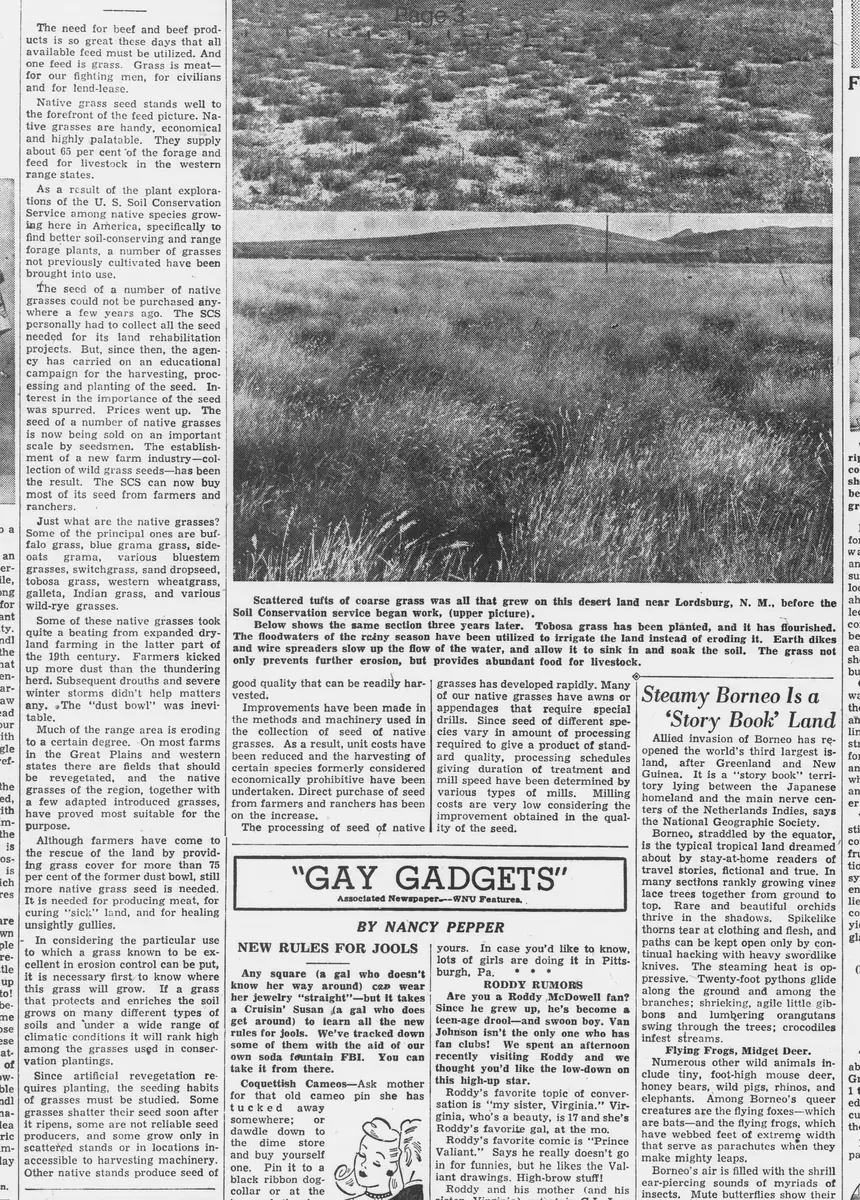
Scattered tufts of coarse grass was all that grew on this desert land near Lordsburg, N. M., before the Soil Conservation service began work, (upper picture).
Below shows the same section three years later. Tobosa grass has been planted, and it has flourished.
The floodwaters of the rainy season have been utilized to irrigate the land instead of eroding it. Earth dikes and wire spreaders slow up the flow of the water, and allow it to sink in and soak the soil. The grass not only prevents further erosion, but provides abundant food for livestock.
What sub-type of article is it?
What keywords are associated?
What entities or persons were involved?
Where did it happen?
Domestic News Details
Primary Location
Great Plains And Western States
Key Persons
Outcome
establishment of new farm industry for wild grass seed collection; improved seed availability and quality; revegetation of over 75% of former dust bowl areas; reduced erosion and enhanced livestock feed production.
Event Details
Native grasses are promoted for beef production amid wartime needs, supplying 65% of livestock forage in western states. U.S. Soil Conservation Service explorations introduced new species for soil conservation. Educational campaigns increased seed harvesting, processing, and sales, creating a new industry. Specific grasses listed include buffalo grass and tobosa grass. Historical damage from dry-land farming and dust bowl addressed through revegetation. Improvements in harvesting and milling reduce costs. Example: Tobosa grass planting near Lordsburg, N.M., transformed desert land into productive pasture.