Thank you for visiting SNEWPapers!
Sign up free
Weekly National Intelligencer
Washington, District Of Columbia
What is this article about?
Letter from Rio de Janeiro reports US Minister R.C. Schenck concluding a treaty with the Argentine Confederation for free navigation of the River Plate and tributaries, plus religious freedoms for US citizens. Similar privileges in Paraguay; British and French secure comparable treaties.
Clipping
OCR Quality
Full Text
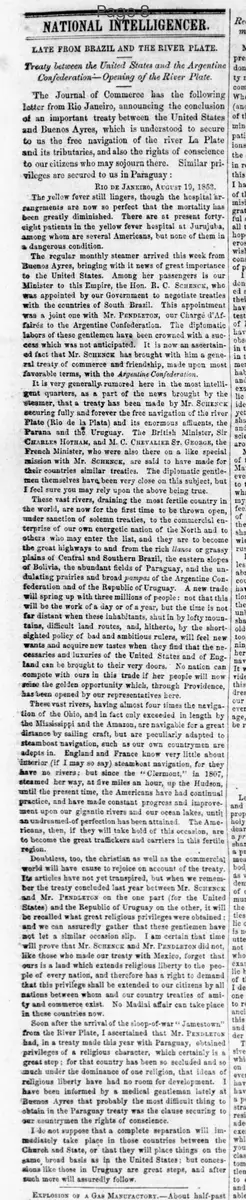
LATE FROM BRAZIL AND THE RIVER PLATE.
Treaty between the United States and the Argentine Confederation—Opening of the River Plate.
The Journal of Commerce has the following letter from Rio Janeiro, announcing the conclusion of an important treaty between the United States and Buenos Ayres, which is understood to secure to us the free navigation of the river La Plata and its tributaries, and also the rights of conscience to our citizens who may sojourn there. Similar privileges are secured to us in Paraguay:
Rio de Janeiro, August 19, 1853.
The yellow fever still lingers, though the hospital arrangements are now so perfect that the mortality has been greatly diminished. There are at present forty-eight patients in the yellow fever hospital at Jurujuba, among whom are several Americans, but none of them in a dangerous condition.
The regular monthly steamer arrived this week from Buenos Ayres, bringing with it news of great importance to the United States. Among her passengers is our Minister to this Empire, the Hon. R. C. Schenck, who was appointed by our Government to negotiate treaties with the countries of South Brazil. This appointment was a joint one with Mr. Pendleton, our Chargé d'Affaires to the Argentine Confederation. The diplomatic labors of these gentlemen have been crowned with a success which was not anticipated. It is now an ascertained fact that Mr. Schenck has brought with him a general treaty of commerce and friendship, made upon most favorable terms, with the Argentine Confederation.
It is very generally rumored here in the most intelligent quarters, as a part of the news brought by the Steamer, that a treaty has been made by Mr. Schenck securing fully and forever the free navigation of the river Plate (Rio de la Plata) and its enormous affluents, the Parana and the Uruguay. The British Minister, Sir Charles Hotham, and M. C. Chevalier St. George, the French Minister, who were also there on a like special mission with Mr. Schenck, are said to have made for their countries similar treaties. The diplomatic gentlemen themselves have been very close on this subject, but I feel sure you may rely upon the above being true.
These vast rivers, draining the most fertile country in the world, are now for the first time to be thrown open, under sanction of solemn treaties, to the commercial enterprise of our own energetic nation of the North and to others who may enter the list, and they are to become the great highways to and from the rich llanos or grassy plains of Central and Southern Brazil, the eastern slopes of Bolivia, the abundant fields of Paraguay, and the undulating prairies and broad pampas of the Argentine Confederation and of the Republic of Uruguay. A new trade will spring up with three millions of people: not that this will be the work of a day or of a year, but the time is not far distant when these inhabitants, shut in by lofty mountains, difficult land routes, and, hitherto, by the short-sighted policy of bad and ambitious rulers, will feel new wants and acquire new tastes when they find that the necessaries and luxuries of the United States and of England can be brought to their very doors. No nation can compete with ours in this trade if her people will now seize the golden opportunity which, through Providence, has been opened by our representatives here.
These vast rivers, having almost four times the navigation of the Ohio, and in fact only exceeded in length by the Mississippi and the Amazon, are navigable for a great distance by sailing craft, but are peculiarly adapted to steamboat navigation, such as our own countrymen are adepts in. England and France know very little about interior (if I may so say) steamboat navigation, for they have no rivers; but since the "Clermont," in 1807, steamed her way, at five miles an hour, up the Hudson, until the present time, the Americans have had continual practice, and have made constant progress and improvement upon our gigantic rivers and our ocean lakes, until an undreamed-of perfection has been attained. The Americans, then, if they will take hold of this occasion, are to become the great traffickers and carriers in this fertile region.
Doubtless, too, the Christian as well as the commercial world will have cause to rejoice on account of the treaty. Its articles have not yet transpired, but when we remember the treaty concluded last year between Mr. Schenck and Mr. Pendleton on the one part (for the United States) and the Republic of Uruguay on the other, it will be recalled what great religious privileges were obtained: and we can assuredly gather that these gentlemen have not let a similar occasion slip. I am certain that time will prove that Mr. Schenck and Mr. Pendleton did not, like those who made our treaty with Mexico, forget that ours is a land which extends religious liberty to the people of every nation, and therefore has a right to demand that this privilege shall be extended to our citizens by all nations between whom and our country treaties of amity and commerce exist. No Madiai affair can take place in these countries now.
Soon after the arrival of the sloop-of-war "Jamestown" from the River Plate, I ascertained that Mr. Pendleton had, in a treaty made this year with Paraguay, obtained privileges of a religious character, which certainly is a great step; for that country has been so secluded and so much under the dominance of one religion, that ideas of religious liberty have had no room for development. I have been informed by a medical gentleman lately at Buenos Ayres that probably the most difficult thing to obtain in the Paraguay treaty was the clause securing to our countrymen the rights of conscience.
I do not suppose that a complete separation will immediately take place in those countries between the Church and State, or that they will place things on the same broad basis as in the United States; but concessions like those in Uruguay are great steps, and after such more will assuredly follow.
What sub-type of article is it?
What keywords are associated?
What entities or persons were involved?
Where did it happen?
Foreign News Details
Primary Location
Argentine Confederation
Event Date
August 19, 1853
Key Persons
Outcome
treaty secures free navigation of river plate and tributaries, rights of conscience for us citizens; similar privileges in paraguay; british and french obtain comparable treaties; opens trade with region including paraguay, uruguay, bolivia, brazil.
Event Details
US Minister R.C. Schenck, with Mr. Pendleton, negotiates treaty of commerce and friendship with Argentine Confederation, rumored to guarantee permanent free navigation of River Plate (La Plata), Parana, and Uruguay rivers. Includes religious liberties for US citizens. Similar treaty with Paraguay secures conscience rights. British and French ministers secure analogous agreements. Reported via steamer from Buenos Ayres to Rio de Janeiro.