Thank you for visiting SNEWPapers!
Sign up free
Editorial
September 5, 1855
Raftsman's Journal
Clearfield, Clearfield County, Pennsylvania
What is this article about?
This editorial, continued from last week, defends William Penn against Thomas Babington Macaulay's historical charges, refuting claims of Penn's involvement in court seductions, his stance on the Declaration of Indulgence, unpopularity among Quakers, and actions at Magdalen College, portraying him as a principled intercessor for tolerance and liberty under James II.
Clipping
OCR Quality
98%
Excellent
Full Text
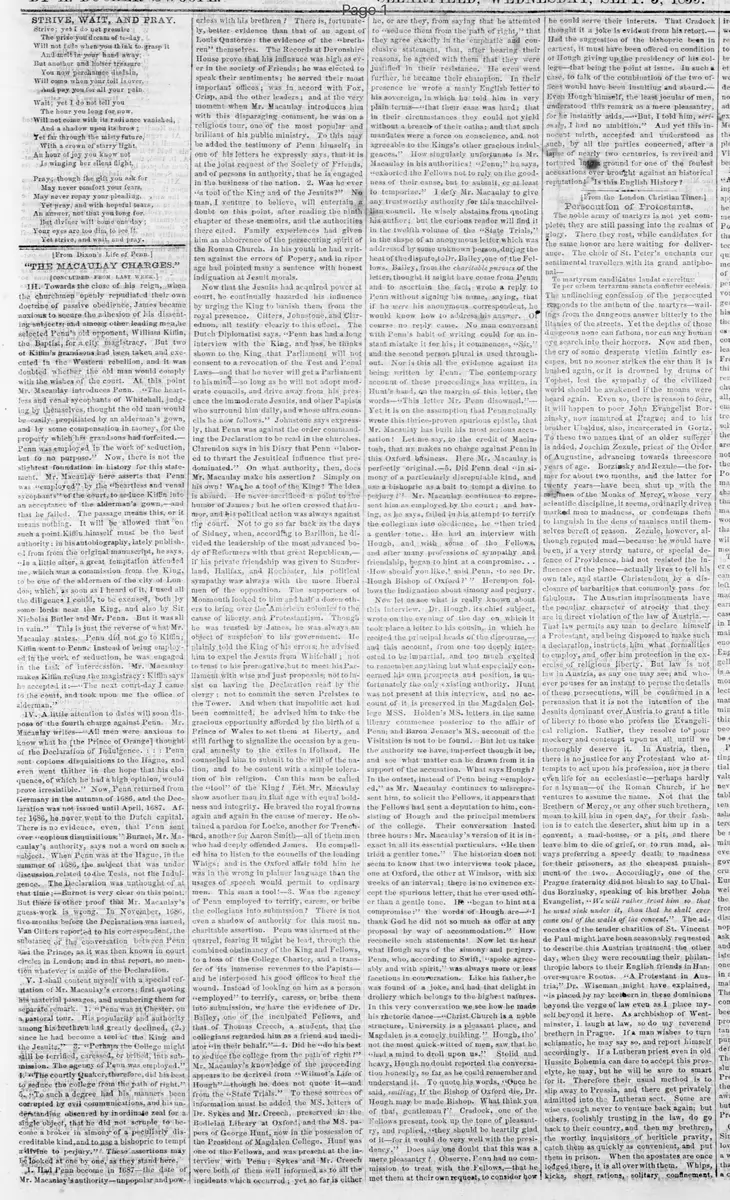
THE MACAULAY CHARGES.
[CONCLUDED FROM LAST WEEK.]
III. Towards the close of his reign, when the churchmen openly repudiated their own doctrine of passive obedience, James became anxious to secure the adhesion of his dissenting subjects, and among other leading men, he selected Penn's old opponent, William Kiffin, the Baptist, for a city magistracy. But two of Kiffin's grandsons had been taken and executed in the Western rebellion, and it was doubted whether the old man would comply with the wishes of the court. At this point Mr. Macaulay introduces Penn. "The heartless and venal sycophants of Whitehall, judging by themselves, thought the old man would be easily propitiated by an alderman's gown, and by some compensation in money, for the property which his grandsons had forfeited. Penn was employed in the work of seduction. But to no purpose."
Now, there is not the slightest foundation in history for this statement. Mr. Macaulay here asserts that Penn was "employed" by the "heartless and venal sycophants" of the court, to seduce Kiffin into an acceptance of the alderman's gown,--and that he failed. The passage means this, or it means nothing. It will be allowed that on such a point Kiffin himself must be the best authority: in his autobiography, lately published from the original manuscript, he says,--"In a little after, a great temptation attended me, which was a commission from the King, to be one of the aldermen of the city of London: which, as soon as I heard of it, I used all the diligence I could, to be excused, both by some lords near the King, and also by Sir Nicholas Butler and Mr. Penn. But it was all in vain." This is just the reverse of what Mr. Macaulay states. Penn did not go to Kiffin; Kiffin went to Penn. Instead of being employed in the work of seduction, he was engaged in the task of intercession. Mr. Macaulay makes Kiffin refuse the magistracy: Kiffin says he accepted it:--"The next court-day I came to the court, and took upon me the office of alderman."
IV. A little attention to dates will soon dispose of the fourth charge against Penn. Mr. Macaulay writes--"All men were anxious to know what he [the Prince of Orange] thought of the Declaration of Indulgence. ... Penn sent copious disquisitions to the Hague, and even went thither in the hope that his eloquence, of which he had a high opinion, would prove irresistible." Now, Penn returned from Germany in the autumn of 1686, and the Declaration was not issued until April, 1687. After 1686, he never went to the Dutch capital. There is no evidence, even, that Penn sent over "copious disquisitions;" Burnet, Mr. Macaulay's authority, says not a word on such a subject. When Penn was at the Hague, in the summer of 1686, the subject that was under discussion related to the Tests, not the Indulgence. The Declaration was unthought of at that time;--Burnet is very clear on this point. But there is other proof that Mr. Macaulay's guess-work is wrong. In November, 1686, five months before the Declaration was issued, Van Citters reported to his correspondent, the substance of the conversation between Penn and the Prince, as it was then known in court circles in London; and in that report, no mention whatever is made of the Declaration.
V. I shall content myself with a special refutation of Mr. Macaulay's errors; first quoting his material passages, and numbering them for separate remark. 1. "Penn was at Chester, on a pastoral tour. His popularity and authority among his brethren had greatly declined, (2.) since he had become a tool of the King and the Jesuits." 3. "Perhaps the College might still be terrified, caressed, or bribed, into submission. The agency of Penn was employed." 4. "This courtly Quaker, therefore, did his best to seduce the college from the path of right." 5. "To such a degree had his manners been corrupted by evil communications, and his understanding obscured by inordinate zeal for a single object, that he did not scruple to become a broker in simony of a peculiarly discreditable kind, and to use a bishopric to tempt a divine to perjury." These assertions may be looked at one by one, as they stand here.
1. Had Penn become in 1687--the date of Mr. Macaulay's authority--unpopular and powerless with his brethren? There is, fortunately, better evidence than that of an agent of Louis Quatorze: the evidence of the "brethren" themselves. The Records at Devonshire House prove that his influence was high as ever in the society of Friends; he was elected to speak their sentiments; he served their most important offices; was in accord with Fox, Crisp, and the other leaders; and at the very moment when Mr. Macaulay introduces him with this disparaging comment, he was on a religious tour, one of the most popular and brilliant of his public ministry. To this may be added the testimony of Penn himself; in one of his letters he expressly says, that it is at the joint request of the Society of Friends, and of persons in authority, that he is engaged in the business of the nation. 2. Was he ever "a tool of the King and of the Jesuits?" No man, I venture to believe, will entertain a doubt on this point, after reading the ninth chapter of these memoirs, and the authorities there cited. Family experiences had given him an abhorrence of the persecuting spirit of the Roman Church. In his youth he had written against the errors of Popery, and in riper age had pointed many a sentence with honest indignation at Jesuit morals.
Now that the Jesuits had acquired power at court, he continually hazarded his influence by urging the King to banish them from the royal presence. Citters, Johnstone, and Clarendon, all testify clearly to this effect. The Dutch Diplomatist says, "Penn has had a long interview with the King, and has, he thinks, shown to the King that Parliament will not consent to a revocation of the Test and Penal Laws--and that he never will get a Parliament to his mind--so long as he will not adopt moderate councils, and drive away from his presence the immoderate Jesuits, and other Papists who surround him daily, and whose ultra councils he now follows." Johnstone says expressly, that Penn was against the order commanding the Declaration to be read in the churches. Clarendon says in his Diary that Penn "labored to thwart the Jesuitical influence that predominated." On what authority, then, does Mr. Macaulay make his assertion? Simply on his own! Was he a tool of the King! The idea is absurd. He never sacrificed a point to the humor of James; but he often crossed that humor, and his political action was always against the court. Not to go so far back as the days of Sidney, when, according to Barillon, he divided the leadership of the most advanced body of Reformers with that great Republican,--if his private friendship was given to Sunderland, Halifax, and Rochester, his political sympathy was always with the more liberal men of the opposition. The supporters of Monmouth looked to him and half a dozen others to bring over the American colonies to the cause of liberty and Protestantism. Though he was trusted by James, he was always an object of suspicion to his government. He plainly told the King of his errors; he advised him to expel the Jesuits from Whitehall; not to trust to his prerogative, but to meet his Parliament with wise and just proposals; not to insist on having the Declaration read by the clergy; not to commit the seven Prelates to the Tower. And when that impolitic act had been committed, he advised him to take the gracious opportunity afforded by the birth of a Prince of Wales to set them at liberty, and still further to signalize the occasion by a general amnesty to the exiles in Holland. He counselled him to submit to the will of the nation, and to be content with a simple toleration of his religion. Can this man be called the "tool" of the King? Let Mr. Macaulay show another man in that age with equal boldness and integrity. He braved the royal frowns again and again in the cause of mercy. He obtained a pardon for Locke, another for Trenchard, another for Aaron Smith--all of them men who had deeply offended James. He compelled him to listen to the councils of the leading Whigs: and in the Oxford affair told him he was in the wrong in plainer language than the usages of speech would permit to ordinary men. This man a tool!--3. Was the agency of Penn employed to terrify, caress, or bribe the collegians into submission? There is not even a shadow of authority for this most uncharitable assertion. Penn was alarmed at the quarrel, fearing it might lead, through the combined obstinacy of the King and Fellows, to a loss of the College Charter, and a transfer of its immense revenues to the Papists--and he interposed his good offices to heal the wound. Instead of looking on him as a person "employed" to terrify, caress, or bribe them into submission, we have the evidence of Dr. Bailey, one of the inculpated Fellows, and that of Thomas Creech, a student, that the collegians regarded him as a friend and mediator in their behalf.--4. Did he "do his best to seduce the college from the path of right?" Mr. Macaulay's knowledge of the proceeding appears to be derived from "Wilmot's Life of Hough" though he does not quote it--and from the "State Trials." To these sources of information must be added the MS. letters of Dr. Sykes and Mr. Creech, preserved in the Bodleian Library at Oxford, and the MS. papers of George Hunt, now in the possession of the President of Magdalen College. Hunt was one of the Fellows, and was present at the interview with Penn: Sykes and Mr. Creech were both of them well informed as to all the incidents which occurred; yet so far is either he, or are they, from saying that he attempted to "seduce them from the path of right," that they agree exactly in the emphatic and conclusive statement, that, after hearing their reasons, he agreed with them that they were justified in their resistance. He even went further, he became their champion. In their presence he wrote a manly English letter to his sovereign, in which he told him in very plain terms--"that their case was hard; that in their circumstances they could not yield without a breach of their oaths; and that such mandates were a force on conscience, and not agreeable to the King's other gracious indulgences." How singularly unfortunate is Mr. Macaulay in his authorities! "Penn," he says, "exhorted the Fellows not to rely on the goodness of their cause, but to submit, or at least to temporize." I defy Mr. Macaulay to give any trustworthy authority for this Machiavellian council. He wisely abstains from quoting his author: but the curious reader will find it in the twelfth volume of the "State Trials," in the shape of an anonymous letter which was addressed by some unknown person, during the heat of the dispute, to Dr. Bailey, one of the Fellows. Bailey, from the charitable purposes of the letter, thought it might have come from Penn; and to ascertain the fact, wrote a reply to Penn without signing his name, saying, that if he were his anonymous correspondent, he would know how to address his answer. Of course no reply came. No man conversant with Penn's habit of writing could for an instant mistake it for his; it commences, "Sir," and the second person plural is used throughout. Nor is this all the evidence against its being written by Penn. The contemporary account of these proceedings has written, in Hunt's hand, on the margin of this letter, the words--"This letter Mr. Penn disowned."
Yet it is on the assumption that Penn actually wrote this thrice-proven spurious epistle, that Mr. Macaulay has built his most serious accusation! Let me say, to the credit of Macintoshes, that HE makes no charge against Penn in this Oxford business. Here Mr. Macaulay is perfectly original.--5. Did Penn deal "in simony of a particularly disreputable kind, and use a bishopric as a bait to tempt a divine to perjury?" Mr. Macaulay continues to represent him as employed by the court; and having, as he says, failed in his attempt to terrify the collegians into obedience, he "then tried a gentler tone. He had an interview with Hough, and with some of the Fellows, and after many professions of sympathy and friendship, began to hint at a compromise. ... 'How should you like,' said Penn, 'to see Dr. Hough Bishop of Oxford?' " Hereupon follows the indignation about simony and perjury.
Now let us see what is really known about this interview. Dr. Hough, its chief subject, wrote on the evening of the day on which it took place a letter to his cousin, in which he recited the principal heads of the discourse,--and this account, from one too deeply interested to be impartial, and too much excited to remember anything but what especially concerned his own prospects and position, is unfortunately the only existing authority. Hunt was not present at this interview, and no account of it is preserved in the Magdalen College MSS. Holden's MS. letters in the same library commence posterior to the affair of Penn; and Baron Jenner's MS. account of the Visitation is not to be found. But let us take the authority we have, imperfect though it be, and see what matter can be drawn from it in support of the accusation. What says Hough? In the outset, instead of Penn being "employed," as Mr. Macaulay continues to misrepresent him, to solicit the Fellows, it appears that the Fellows had sent a deputation to him, consisting of Hough and the principal members of the college. Their conversation lasted three hours: Mr. Macaulay's version of it is inexact in all its essential particulars. "He then tried a gentler tone." The historian does not seem to know that two interviews took place, one at Oxford, the other at Windsor, with six weeks of an interval; there is no evidence except the spurious letter, that he ever used other than a gentle tone. He "began to hint at a compromise:" the words of Hough are--I thank God he did not so much as offer at any proposal by way of accommodation." How reconcile such statements! Now let us hear what Hough says of the simony and perjury. Penn, who, according to Swift, "spoke agreeably and with spirit," was always more or less facetious in conversation. Like his father, he was fond of a joke, and had that delight in drollery which belongs to the highest natures. In this very conversation we see how he made his rhetoric dance--"Christ Church is a noble structure, University is a pleasant place, and Magdalen is a comely building." Hough, though not the most quick-witted of men, saw that he "had a mind to droll upon us." Stolid and heavy, Hough no doubt reported the conversation honestly, so far as he could remember and understand it. To quote his words, "Once he said, smiling, If the Bishop of Oxford die, Dr. Hough may be made Bishop. What think you of that, gentlemen?' Cradock, one of the Fellows present, took up the tone of pleasantry, and replied, 'they should be heartily glad of it--for it would do very well with the presidency.'" Does any one doubt that this was a mere pleasantry? Observe, Penn had no commission to treat with the Fellows, that he met them at their own request, to consider how he could serve their interests. That Cradock thought it a joke is evident from his retort. Had the suggestion of the bishopric been in earnest, it must have been offered on condition of Hough giving up the presidency of his college--that being the point at issue. In such a case, to talk of the combination of the two offices would have been insulting and absurd. Even Hough himself, the least jocular of men, understood this remark as a mere pleasantry, for he instantly adds,--"But, I told him, seriously, I had no ambition." And yet this innocent mirth, accepted and understood as such, by all the parties concerned, after a lapse of nearly two centuries, is revived and tortured into a ground for one of the foulest accusations ever brought against an historical reputation! Is this English History?
[CONCLUDED FROM LAST WEEK.]
III. Towards the close of his reign, when the churchmen openly repudiated their own doctrine of passive obedience, James became anxious to secure the adhesion of his dissenting subjects, and among other leading men, he selected Penn's old opponent, William Kiffin, the Baptist, for a city magistracy. But two of Kiffin's grandsons had been taken and executed in the Western rebellion, and it was doubted whether the old man would comply with the wishes of the court. At this point Mr. Macaulay introduces Penn. "The heartless and venal sycophants of Whitehall, judging by themselves, thought the old man would be easily propitiated by an alderman's gown, and by some compensation in money, for the property which his grandsons had forfeited. Penn was employed in the work of seduction. But to no purpose."
Now, there is not the slightest foundation in history for this statement. Mr. Macaulay here asserts that Penn was "employed" by the "heartless and venal sycophants" of the court, to seduce Kiffin into an acceptance of the alderman's gown,--and that he failed. The passage means this, or it means nothing. It will be allowed that on such a point Kiffin himself must be the best authority: in his autobiography, lately published from the original manuscript, he says,--"In a little after, a great temptation attended me, which was a commission from the King, to be one of the aldermen of the city of London: which, as soon as I heard of it, I used all the diligence I could, to be excused, both by some lords near the King, and also by Sir Nicholas Butler and Mr. Penn. But it was all in vain." This is just the reverse of what Mr. Macaulay states. Penn did not go to Kiffin; Kiffin went to Penn. Instead of being employed in the work of seduction, he was engaged in the task of intercession. Mr. Macaulay makes Kiffin refuse the magistracy: Kiffin says he accepted it:--"The next court-day I came to the court, and took upon me the office of alderman."
IV. A little attention to dates will soon dispose of the fourth charge against Penn. Mr. Macaulay writes--"All men were anxious to know what he [the Prince of Orange] thought of the Declaration of Indulgence. ... Penn sent copious disquisitions to the Hague, and even went thither in the hope that his eloquence, of which he had a high opinion, would prove irresistible." Now, Penn returned from Germany in the autumn of 1686, and the Declaration was not issued until April, 1687. After 1686, he never went to the Dutch capital. There is no evidence, even, that Penn sent over "copious disquisitions;" Burnet, Mr. Macaulay's authority, says not a word on such a subject. When Penn was at the Hague, in the summer of 1686, the subject that was under discussion related to the Tests, not the Indulgence. The Declaration was unthought of at that time;--Burnet is very clear on this point. But there is other proof that Mr. Macaulay's guess-work is wrong. In November, 1686, five months before the Declaration was issued, Van Citters reported to his correspondent, the substance of the conversation between Penn and the Prince, as it was then known in court circles in London; and in that report, no mention whatever is made of the Declaration.
V. I shall content myself with a special refutation of Mr. Macaulay's errors; first quoting his material passages, and numbering them for separate remark. 1. "Penn was at Chester, on a pastoral tour. His popularity and authority among his brethren had greatly declined, (2.) since he had become a tool of the King and the Jesuits." 3. "Perhaps the College might still be terrified, caressed, or bribed, into submission. The agency of Penn was employed." 4. "This courtly Quaker, therefore, did his best to seduce the college from the path of right." 5. "To such a degree had his manners been corrupted by evil communications, and his understanding obscured by inordinate zeal for a single object, that he did not scruple to become a broker in simony of a peculiarly discreditable kind, and to use a bishopric to tempt a divine to perjury." These assertions may be looked at one by one, as they stand here.
1. Had Penn become in 1687--the date of Mr. Macaulay's authority--unpopular and powerless with his brethren? There is, fortunately, better evidence than that of an agent of Louis Quatorze: the evidence of the "brethren" themselves. The Records at Devonshire House prove that his influence was high as ever in the society of Friends; he was elected to speak their sentiments; he served their most important offices; was in accord with Fox, Crisp, and the other leaders; and at the very moment when Mr. Macaulay introduces him with this disparaging comment, he was on a religious tour, one of the most popular and brilliant of his public ministry. To this may be added the testimony of Penn himself; in one of his letters he expressly says, that it is at the joint request of the Society of Friends, and of persons in authority, that he is engaged in the business of the nation. 2. Was he ever "a tool of the King and of the Jesuits?" No man, I venture to believe, will entertain a doubt on this point, after reading the ninth chapter of these memoirs, and the authorities there cited. Family experiences had given him an abhorrence of the persecuting spirit of the Roman Church. In his youth he had written against the errors of Popery, and in riper age had pointed many a sentence with honest indignation at Jesuit morals.
Now that the Jesuits had acquired power at court, he continually hazarded his influence by urging the King to banish them from the royal presence. Citters, Johnstone, and Clarendon, all testify clearly to this effect. The Dutch Diplomatist says, "Penn has had a long interview with the King, and has, he thinks, shown to the King that Parliament will not consent to a revocation of the Test and Penal Laws--and that he never will get a Parliament to his mind--so long as he will not adopt moderate councils, and drive away from his presence the immoderate Jesuits, and other Papists who surround him daily, and whose ultra councils he now follows." Johnstone says expressly, that Penn was against the order commanding the Declaration to be read in the churches. Clarendon says in his Diary that Penn "labored to thwart the Jesuitical influence that predominated." On what authority, then, does Mr. Macaulay make his assertion? Simply on his own! Was he a tool of the King! The idea is absurd. He never sacrificed a point to the humor of James; but he often crossed that humor, and his political action was always against the court. Not to go so far back as the days of Sidney, when, according to Barillon, he divided the leadership of the most advanced body of Reformers with that great Republican,--if his private friendship was given to Sunderland, Halifax, and Rochester, his political sympathy was always with the more liberal men of the opposition. The supporters of Monmouth looked to him and half a dozen others to bring over the American colonies to the cause of liberty and Protestantism. Though he was trusted by James, he was always an object of suspicion to his government. He plainly told the King of his errors; he advised him to expel the Jesuits from Whitehall; not to trust to his prerogative, but to meet his Parliament with wise and just proposals; not to insist on having the Declaration read by the clergy; not to commit the seven Prelates to the Tower. And when that impolitic act had been committed, he advised him to take the gracious opportunity afforded by the birth of a Prince of Wales to set them at liberty, and still further to signalize the occasion by a general amnesty to the exiles in Holland. He counselled him to submit to the will of the nation, and to be content with a simple toleration of his religion. Can this man be called the "tool" of the King? Let Mr. Macaulay show another man in that age with equal boldness and integrity. He braved the royal frowns again and again in the cause of mercy. He obtained a pardon for Locke, another for Trenchard, another for Aaron Smith--all of them men who had deeply offended James. He compelled him to listen to the councils of the leading Whigs: and in the Oxford affair told him he was in the wrong in plainer language than the usages of speech would permit to ordinary men. This man a tool!--3. Was the agency of Penn employed to terrify, caress, or bribe the collegians into submission? There is not even a shadow of authority for this most uncharitable assertion. Penn was alarmed at the quarrel, fearing it might lead, through the combined obstinacy of the King and Fellows, to a loss of the College Charter, and a transfer of its immense revenues to the Papists--and he interposed his good offices to heal the wound. Instead of looking on him as a person "employed" to terrify, caress, or bribe them into submission, we have the evidence of Dr. Bailey, one of the inculpated Fellows, and that of Thomas Creech, a student, that the collegians regarded him as a friend and mediator in their behalf.--4. Did he "do his best to seduce the college from the path of right?" Mr. Macaulay's knowledge of the proceeding appears to be derived from "Wilmot's Life of Hough" though he does not quote it--and from the "State Trials." To these sources of information must be added the MS. letters of Dr. Sykes and Mr. Creech, preserved in the Bodleian Library at Oxford, and the MS. papers of George Hunt, now in the possession of the President of Magdalen College. Hunt was one of the Fellows, and was present at the interview with Penn: Sykes and Mr. Creech were both of them well informed as to all the incidents which occurred; yet so far is either he, or are they, from saying that he attempted to "seduce them from the path of right," that they agree exactly in the emphatic and conclusive statement, that, after hearing their reasons, he agreed with them that they were justified in their resistance. He even went further, he became their champion. In their presence he wrote a manly English letter to his sovereign, in which he told him in very plain terms--"that their case was hard; that in their circumstances they could not yield without a breach of their oaths; and that such mandates were a force on conscience, and not agreeable to the King's other gracious indulgences." How singularly unfortunate is Mr. Macaulay in his authorities! "Penn," he says, "exhorted the Fellows not to rely on the goodness of their cause, but to submit, or at least to temporize." I defy Mr. Macaulay to give any trustworthy authority for this Machiavellian council. He wisely abstains from quoting his author: but the curious reader will find it in the twelfth volume of the "State Trials," in the shape of an anonymous letter which was addressed by some unknown person, during the heat of the dispute, to Dr. Bailey, one of the Fellows. Bailey, from the charitable purposes of the letter, thought it might have come from Penn; and to ascertain the fact, wrote a reply to Penn without signing his name, saying, that if he were his anonymous correspondent, he would know how to address his answer. Of course no reply came. No man conversant with Penn's habit of writing could for an instant mistake it for his; it commences, "Sir," and the second person plural is used throughout. Nor is this all the evidence against its being written by Penn. The contemporary account of these proceedings has written, in Hunt's hand, on the margin of this letter, the words--"This letter Mr. Penn disowned."
Yet it is on the assumption that Penn actually wrote this thrice-proven spurious epistle, that Mr. Macaulay has built his most serious accusation! Let me say, to the credit of Macintoshes, that HE makes no charge against Penn in this Oxford business. Here Mr. Macaulay is perfectly original.--5. Did Penn deal "in simony of a particularly disreputable kind, and use a bishopric as a bait to tempt a divine to perjury?" Mr. Macaulay continues to represent him as employed by the court; and having, as he says, failed in his attempt to terrify the collegians into obedience, he "then tried a gentler tone. He had an interview with Hough, and with some of the Fellows, and after many professions of sympathy and friendship, began to hint at a compromise. ... 'How should you like,' said Penn, 'to see Dr. Hough Bishop of Oxford?' " Hereupon follows the indignation about simony and perjury.
Now let us see what is really known about this interview. Dr. Hough, its chief subject, wrote on the evening of the day on which it took place a letter to his cousin, in which he recited the principal heads of the discourse,--and this account, from one too deeply interested to be impartial, and too much excited to remember anything but what especially concerned his own prospects and position, is unfortunately the only existing authority. Hunt was not present at this interview, and no account of it is preserved in the Magdalen College MSS. Holden's MS. letters in the same library commence posterior to the affair of Penn; and Baron Jenner's MS. account of the Visitation is not to be found. But let us take the authority we have, imperfect though it be, and see what matter can be drawn from it in support of the accusation. What says Hough? In the outset, instead of Penn being "employed," as Mr. Macaulay continues to misrepresent him, to solicit the Fellows, it appears that the Fellows had sent a deputation to him, consisting of Hough and the principal members of the college. Their conversation lasted three hours: Mr. Macaulay's version of it is inexact in all its essential particulars. "He then tried a gentler tone." The historian does not seem to know that two interviews took place, one at Oxford, the other at Windsor, with six weeks of an interval; there is no evidence except the spurious letter, that he ever used other than a gentle tone. He "began to hint at a compromise:" the words of Hough are--I thank God he did not so much as offer at any proposal by way of accommodation." How reconcile such statements! Now let us hear what Hough says of the simony and perjury. Penn, who, according to Swift, "spoke agreeably and with spirit," was always more or less facetious in conversation. Like his father, he was fond of a joke, and had that delight in drollery which belongs to the highest natures. In this very conversation we see how he made his rhetoric dance--"Christ Church is a noble structure, University is a pleasant place, and Magdalen is a comely building." Hough, though not the most quick-witted of men, saw that he "had a mind to droll upon us." Stolid and heavy, Hough no doubt reported the conversation honestly, so far as he could remember and understand it. To quote his words, "Once he said, smiling, If the Bishop of Oxford die, Dr. Hough may be made Bishop. What think you of that, gentlemen?' Cradock, one of the Fellows present, took up the tone of pleasantry, and replied, 'they should be heartily glad of it--for it would do very well with the presidency.'" Does any one doubt that this was a mere pleasantry? Observe, Penn had no commission to treat with the Fellows, that he met them at their own request, to consider how he could serve their interests. That Cradock thought it a joke is evident from his retort. Had the suggestion of the bishopric been in earnest, it must have been offered on condition of Hough giving up the presidency of his college--that being the point at issue. In such a case, to talk of the combination of the two offices would have been insulting and absurd. Even Hough himself, the least jocular of men, understood this remark as a mere pleasantry, for he instantly adds,--"But, I told him, seriously, I had no ambition." And yet this innocent mirth, accepted and understood as such, by all the parties concerned, after a lapse of nearly two centuries, is revived and tortured into a ground for one of the foulest accusations ever brought against an historical reputation! Is this English History?
What sub-type of article is it?
Moral Or Religious
Partisan Politics
What keywords are associated?
William Penn
Macaulay Charges
James Ii Reign
Quaker Influence
Magdalen College
Declaration Of Indulgence
Jesuit Opposition
What entities or persons were involved?
William Penn
Mr. Macaulay
James Ii
William Kiffin
Prince Of Orange
Dr. Hough
Society Of Friends
Jesuits
Editorial Details
Primary Topic
Refutation Of Macaulay's Charges Against William Penn
Stance / Tone
Strongly Defensive Of Penn's Integrity
Key Figures
William Penn
Mr. Macaulay
James Ii
William Kiffin
Prince Of Orange
Dr. Hough
Society Of Friends
Jesuits
Key Arguments
Penn Was Not Employed To Seduce Kiffin But Interceded For His Refusal
Penn Did Not Visit The Hague After 1686 Regarding The Declaration Of Indulgence
Penn Remained Popular And Influential Among Quakers In 1687
Penn Opposed Jesuit Influence And Advised James Ii Against Court Policies
Penn Acted As Mediator, Not Agent, In Magdalen College Dispute
Anonymous Letter Falsely Attributed To Penn
Bishopric Suggestion To Hough Was Mere Pleasantry, Not Simony