Thank you for visiting SNEWPapers!
Sign up free
Canton Weekly Register
Canton, Fulton County, Illinois
What is this article about?
In August 1864, revelations expose a Copperhead conspiracy by the Sons of Liberty in Indiana, plotting to seize government officials, arsenals, and liberate prisoners to spark Northwest rebellion. Arms shipments seized, key figures like H.H. Dodd implicated via letters and rituals found in offices.
Merged-components note: These two components on page 1 form a single continuous article on the Copperhead Conspiracy, with the second continuing the correspondence and letters from the first.
Clipping
OCR Quality
Full Text
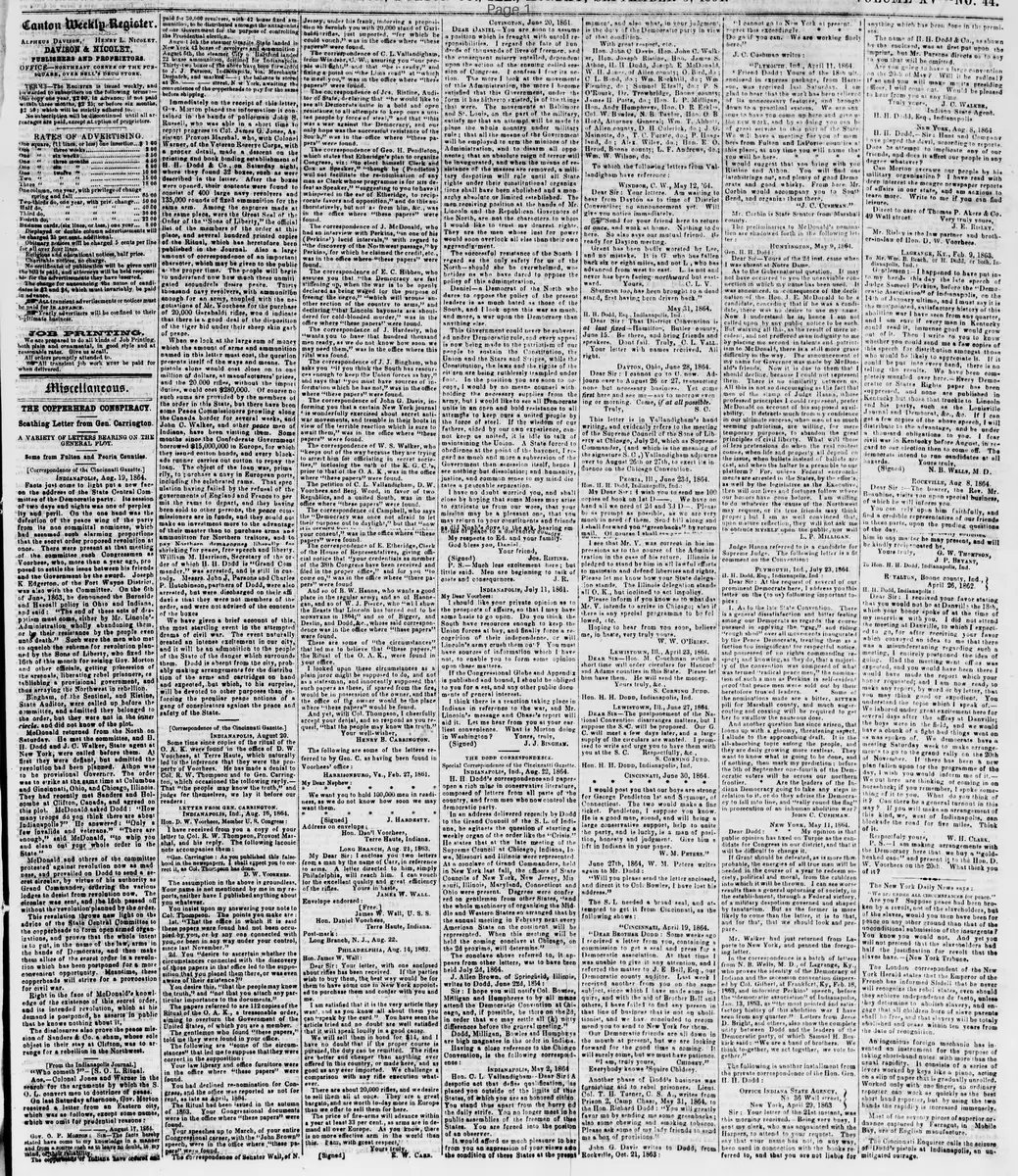
THE COPPERHEAD CONSPIRACY.
Scathing Letter from Gen. Carrington
A VARIETY OF LETTERS BEARING ON THE GENERAL PLOT.
Some from Fulton and Peoria Counties.
[Correspondence of the Cincinnati Gazette.]
Indianapolis, Aug. 19, 1864.
Facts just come to light put a new face on the address of the State Central Committee of the Democratic party. Its session of two days and nights was one of perplexity and peril. On the one hand was the defection of the peace wing of the party from its non-committal nominees, which had assumed such alarming proportions that the secret order proposed revolution at once. There were present at that meeting of the committee such Congressmen as Voorhees, who, more than a year ago, proposed to settle the issue between his friends and the Government by the sword. Joseph K. Edgerton, of the Fort Wayne District, was also with the Committee. On the 6th of June, 1863, he denounced the Burnside and Hascall policy in Ohio and Indiana, despotism must come, either by Mr. Lincoln's Administration wholly abandoning them, or by their resistance by the people even unto death. Such were the men who met to squelch the scheme for revolution planned by the Sons of Liberty, who fixed the 16th of this month for seizing Gov. Morton and other officials, getting possession of the arsenals, liberating rebel prisoners, establishing a provisional government, and thus arraying the Northwest in rebellion.
Bingham, of the Sentinel, and Ristine, State Auditor, were called up before the committee, and admitted they belonged to the order, but they were not in the inner circle, and did not know of the plot.
McDonald returned from the North on Saturday. He met the committee, and H. H. Dodd and J. C. Walker, State agent at New York, were called before them. At first they were defiant, but admitted the revolution had been planned. Athon was to be provisional Governor. The order was to strike at the same time at Columbus and Cincinnati, Ohio, and Chicago, Illinois. They had recently met Sanders and Holcombe at Clifton, Canada, and agreed on this plot. McDonald asked Dodd: "How many troops do you think there are about Indianapolis?" He answered: "Only a few invalids and veterans." "There are enough," said McDonald, "to whip you and clean out your whole order in the State."
McDonald and others of the committee protested against revolution now as mad, and prevailed on Dodd to send a secret circular, by virtue of his authority as Grand Commander, ordering the various lodges to desist from revolution now. The circular was sent, and the 16th passed off without the revolution planned by the order.
This revelation throws new light on the advice of the State Central Committee to the copperheads to form open armed organizations, and proves that the whole intent is to put, in the name of the law, arms in the hands of Democrats, and then make them allies of the secret order in a revolution which has been postponed for a more convenient opportunity. Meantime, these copperheads will strive for a provocation for civil war.
Right in the face of McDonald's knowledge of the existence of this secret order, and its intended revolution, which at his demand is postponed, he asserts in public that he knows nothing about it.
The disclosures also prove the peace mission of Sanders & Co. & sham, whose sole object in their stay at Clifton, was to arrange for a rebellion in the Northwest.
From the Indianapolis Journal.]
"Who cometh?"—[S. O. L. Ritual.
Ans.—Colonel Jones and Warner in the search for the arguments by which the S. O. L. convert men to doctrines of peace.
On last Saturday afternoon, Gov. Morton received a letter from an Eastern city, which was as follows, except some names, which we omit for prudential reasons:
August 17, 1864.
Gov. O. P. Morton: Sir—The facts hereby stated have come to my knowledge in a manner and from a source such as to leave no doubt, in my mind, of their reliability.
The copperheads paid for 30,000 revolvers, with 42 boxes fixed ammunition, to be distributed amongst the antagonists of our Government for the purpose of controlling the Presidential election?
August 6th the steamer Arapahoe State landed in New York 42 boxes of revolvers and ammunition.
August 6th, the steamer City of Hartford landed 22 boxes ammunition, destined for Indianapolis.
Thirty-two boxes of the above have been forwarded to J. J. Parsons, Indianapolis, Ind. Merchants Despatch, and marked *; the balance is stored at No. ... street, New York, awaiting the convenience of the copperheads to pay for the same before shipping.
Immediately on the receipt of this letter Gov. Morton placed the information it contained in the hands of policeman John S. Russell, who was able in a short time to report progress to Col. James G. Jones, Assistant Provost Marshal, who, with Colonel Warner, of the Veteran Reserve Corps, with proper detail, made a descent on the printing and book binding establishment of H. H. Dodd & Co. on Saturday night, where they found 32 boxes, such as were described in the letter. After the boxes were opened, their contents were found to consist of 400 large navy revolvers and 135,000 rounds of fixed ammunition for the same arm. Among the captures made at the same place, were the Great Seal of the Order of the "Sons of Liberty," the official list of the members of the order at this place, and several hundred printed copies of the Ritual, which has heretofore been published in the Journal. Also a large amount of correspondence of an important character, which may be given to the public at the proper time. The people will begin to understand now how much these unitiated scoundrels desire peace. Thirty thousand navy revolvers, with ammunition enough for an army, coupled with the negotiations of Mr. Voorhees for the purchase of 20,000 Garibaldi rifles, would indicate that there is a good deal of the tiger hid under their sheep skin garb of peace.
When we look at the large sum of money which the amount of arms and ammunition named in this letter must cost, the question presents itself of the ways and means. The pistols alone would cost close on to one million of dollars, at manufacturers' prices, and the 20,000 rifles, without the import duties, would cost $280,000. Of course no such sums are provided by the members of the order in this State, but there have been some Peace Commissioners prowling along the Canada border for several weeks, and John O. Walker, and other peace men of Indiana, have been visiting them. Some months since the Confederate Government borrowed $15,000,000 in Europe, for which they issued cotton bonds, and every blockade-runner carries out cotton to repay the loan. The object of the loan was, primarily, to purchase a Navy in European ports, including the celebrated rams. That speculation having failed by the refusal of the governments of England and France to permit the rams to depart, and they having been sold to other persons, the peace commissioners are in funds, and they could not make an investment more to the advantage of their masters than to purchase arms and ammunition for Northern traitors, and to pay Northern demagogues liberally for shrieking for peace, free speech and liberty.
William M. Harrison, Secretary of the order of which H. H. Dodd is "Grand Commander," was arrested, and is still in custody. Messrs. John J. Parsons and Charles P. Hutchinson, partners of Dodd, were also arrested, but were discharged on their affidavits that they were not members of the order, and were not advised of the contents of the boxes.
We have given a brief account of this, the most startling event in the attempted drama of civil war. The event naturally created an intense excitement in our city, and it will be an admonition to the people of the State of the danger which surrounds them. Dodd is absent from the city, probably making arrangements for the distribution of the arms and cartridges on hand and expected, but which, to his surprise, will be devoted to other purposes than enforcing the peculiar peace notions of a gang of conspirators against the peace and safety of the State.
[Correspondence of the Cincinnati Gazette.]
Indianapolis, August 20.
Some time since copies of the ritual of the O. A. K. were found in the office of D. W. Voorhees, at Terre Haute, which naturally led to the inference that they were the property of Voorhees. He has made a denial to Col. R. W. Thompson and to Gen. Carrington, which occasioned the following reply.
That the people may know the truth, and judge for themselves, we lay it before our readers;
LETTER FROM GEN. CARRINGTON.
Indianapolis, Ind., Aug. 16, 1864
Hon. D. W. Voorhees, Member U. S. Congress:
I have received from you a copy of your letter to Col. R. W. Thompson, Provost Marshal, and his reply. The following laconic note accompanies them:
"Gen. Carrington: As you published this falsehood in the newspapers, I shall expect you to correct it, as Col. Thompson has done.
D. W. Voorhees."
The assumption in the above is groundless. Your name is not mentioned by me in my reports, neither have I published anything about you whatever.
You insist upon my answering your note to Col. Thompson. The points you make are:
1st. 'That the office in which it is said these papers were found had not been occupied by you, or by any one connected with you, or been in any way under your control, since last November."
2d. You "desire to ascertain whether the circumstances connected with the discovery of those papers in that office led to the supposition that you placed them there, or was even aware of their existence?"
You desire this, "that the people may know the truth," and "not that you attach any particular importance to the documents."
The papers referred to are 112 copies of the Ritual of the O. A. K., a treasonable order, aiming to overturn the Government of the United States, of which you are a member.
The gentlemen who found "these papers," told me they were found in your office.
The following are some of the circumstances that led me to suppose that they were correct in the supposition:
Your law library and office furniture were in the office where "these papers" were found.
You had declined re-nomination for Congress, and the office was reported as not occupied or for rent, as late as April, 1864.
The Ritual had been issued in the autumn of 1863. Your Congressional documents were in the office where "these papers" were found.
Your speeches up to March, of your entire Congressional career, with the "John Brown" speech, were in the office where "these papers" were found.
The correspondence of Senator Wall, of New Jersey, under his frank, indorsing a proposition to furnish you with 20,000 stand of Garibaldi rifles, just imported, "for which he could vouch," was in the office where "these papers" were found.
The correspondence of G. L. Vallandigham, from Windsor, U. W., assuring you "our people will fight," and that "he is ready," and fixing a point on "the Lima road" at "which to meet you" was in the office where "these papers" were found.
The correspondence of Jos. Ristine, Auditor of State, declaring that "he would like to see all Democrats unite in a bold and open resistance to all attempts to keep ours a united people by force of steel," and that "this was a war against the Democracy, and our only hope was the successful resistance of the South" was in the office where "these papers" were found.
The correspondence of Geo. H. Pendleton which states that Etheridge's plan to organize Congress, viz: to elect himself Clerk and Cox as Speaker, "though he (Pendleton) will not facilitate the re-nomination of any man as Clerk whose programming is for his defeat as Speaker," "suggesting to you to have it whispered in the ear of Etheridge, to reciprocate favors and opposition," and do this authoritatively, but not as from him, &c., was in the office where "these papers" were found.
The correspondence of J. McDonald, who had an interview with Perkins, "in one of his Perkins' lucid intervals," with regard to "the discovery of the Northwest passage," by Perkins, for which he claimed the credit, etc., was in the office where "these papers" were found.
The correspondence of E. C. Hibben, who assures you that the Democracy are fast stiffening up, when the war is to be openly declared as being waged for the purpose of freeing the negro "which will arouse another section of the country to arms," and declaring that Lincoln bayonets are shouldered for cold-blooded murder," was in the office where "these papers" were found.
The correspondence of J. Hardesty, who "wants you to have that hundred thousand men ready, as we do not know how soon we may need them," was in the office where this ritual was found.
The correspondence of J. J. Bingham, who asks you "if you think the South has resources enough to keep the Union forces at bay," and says that "you must have sources of information which he has not," was in the office where "these papers" were found.
The correspondence of John G. Davis, informing you that a certain New York journal is wonderfully exercised about secret anti-war movements, and tremble in their boots in view of the terrible reaction which is sure to await them," was in the office where "these papers" were found.
The correspondence of W. S. Walker, who "keeps out of the way because they are trying to arrest him for officiating in secret societies," inclosing the oath of the K. G. C.'s prior to that of the O. A. K., was in the office where "these papers" were found.
The petition of C. L. Vallandigham, D. W. Voorhees and Benj. Wood, in favor of two Republics, and a united South, was in the office where "these papers" were found.
The correspondence of Campbell, who says the "Democracy was once not afraid to let their purpose out to daylight," but that "now it is determined by your consent," was in the office where "these papers" were found.
The correspondence of E. Etheridge, Clerk of the House of Representatives, giving official notice that "your credentials as member of the 38th Congress have been received and filed in the proper office," and for you "to come on," was in the office where "there papers" were found.
And so of B. W. Hanna, who wants a good place in the regular army; and so of Hannegan, and so of W. J. Pierce, who "will show the Beast that Lincoln has turned out to be Monarchs in 1864," and so of Bigger, and Devlin, and Dodd, &c., whose said correspondence was in the office where "these papers" were found.
These are some of "the circumstances" that led me to believe that "these papers," the Ritual of the O. A. K., were found in your office.
I looked upon these circumstances as a plain juror might be supposed to do, and not as a statesman, and innocently supposed that such papers as these, if spared from the fire, would be in possession of the owner, and that the office of the owner would be the place where "these papers" would be found.
And yet, with Col. Thompson, I cheerfully accept your denial, and so respond as you request, "that the people may know the truth."
Your well-wisher,
Henry B. Carrington.
The following are some of the letters referred to by Gen. C. as having been found in Voorhees' office:
Harrisonburg, Va., Feb. 27, 1861.
My Dear Nephew:
We want you to hold 100,000 men in readiness, as we do not know how soon we may want them.
[Signed]
J. HARDEITY.
Address on envelope:
Hon. Dan'l Voorhees,
Terre Haute, Indiana.
Long Branch, Aug. 21, 1863.
My Dear Sir: I enclose you two letters from a man by the name of Carr, in reference to arms. A letter directed to him, simply Philadelphia, will reach him. I can vouch for the excellent quality and great efficiency of the rifles.
Yours in haste
James W. Wall.
Envelope endorsed:
[Free.]
James W. Wall, U. S. S.
Hon. Daniel Voorhees,
Terre Haute, Indiana.
Post-mark:
Long Branch, N. J., Aug. 22.
Philadelphia, Aug. 14, 1863.
Hon. James W. Wall:
Dear Sir: Your letter, with one enclosed about rifles has been received. If the parties wish to buy them, the best way would be for them to have some one in New York appointed to purchase them and confer with you and me.
I am satisfied that it is the very article they want, and as you know all about them you can "speak by the card." You have seen the article tried and no doubt are well satisfied that it will speak loudly in a good cause.
We will sell them in bond for $14, and I have no doubt that if the proper course is pursued, the duty can be remitted. The rifles are better and cheaper than anything ever offered in this country, or made here, and as good as any ever imported. We challenge a comparison with any rifle execution whatever.
There are about 20,000 rifles, and we desire to sell them all at once. They are a great bargain, and are worth to-day more in Europe than we offer to sell them for here.
The price of fire-arms will advance within a year at least 33 per cent., as arms are in demand all over Europe. As you know, there is no more effective arm in the world than this. Yours, with great respect,
truly
[Signed]
E. W. Carr.
Covington, June 20, 1861.
Dear Daniel—You are soon to assume a position which is fraught with untold responsibilities. I regard the fate of hundreds of thousands of lives of freemen, and the consequent misery entailed, dependent upon the action of the ensuing called session of Congress. I confess I fear its action. The more I look at the movements of this Administration, the more I become satisfied that this Government, under the form it has hitherto existed, is one of the things that were. The movements at Baltimore and St. Louis, on the part of the military, satisfy me that an attempt will be made to place the whole country under military rule; that all the means of the Government will be employed to arm the minions of the Administration, and to disarm all opponents; that an absolute reign of terror will be inaugurated, and when the means of resistance of the masses are removed, a military despotism will rule until all State rights under their constitutional organizations shall have been abolished and a monarchy absolute or limited established. The men receiving position at the hands of Mr. Lincoln and the Republican Governors of the North, are not the characters to whom I would like to trust my dearest rights. They are the men whose lust for power would soon overlook all else than their own aggrandizement.
The successful resistance of the South I regard as the only safety for us of the North—should she be overwhelmed, woe betides us who have dared to oppose the policy of this administration.
Daniel—a Democrat of the North who dares to oppose the policy of the present leaders is as much hated as those of the South, and I look upon this war as much, and more, a war upon the Democracy than anything else.
This Government could never be subverted under Democratic rule, and every appeal is now being made to the patriotism of our people to sustain the Constitution, the Union and the Stars and Stripes, while the Constitution, the laws and the rights of the citizen are being ruthlessly trampled under foot. In the position you are soon to occupy, I would by no means counsel withholding the necessary supplies from the army, but I would like to see all Democrats unite in an open and bold resistance to all attempts to keep ours a united people by force of steel. If the wisdom of our fathers, aided by our own experience, cannot keep us united, it is idle to talk of maintaining the Union. A State forced to obedience at the point of the bayonet, I regard as much and more a subversion of the Government than secession itself, hence I see nothing but dissolution; and humanity, justice, and common sense to my mind dictate a peaceable separation.
I have no doubt worried you, and shall close by hoping that some Moses may arise to extricate us from our woes, that your mission may be a pleasant one, that you may return to your constituents and friends
My respects to Ed.
God bless you, Daniel
Your friend.
(Signed)
Jos. Ristine.
P. S.—Much less excitement here; but little said. Men are beginning to talk of costs and consequences.
J. R.
Indianapolis, July 11, 1861.
My Dear Voorhees:
I should like your private opinion as to the prospects of affairs, so that I may have some basis to go upon. Do you think the South have resources enough to keep the Union forces at bay, and finally force a recognition of their independence, or will Lincoln's army crush them out? You must have sources of information which I have not, to enable you to form some opinion upon these matters.
If the Congressional Globe and Appendix is published and bound, I should be obliged to you for a set, and any other public documents of general interest.
I think there is a reaction taking place in Indiana in reference to the war, and Mr. Lincoln's message and Chase's report will aid it. Let me hear from you at your earliest convenience.
What is Morton doing in Washington?
Yours, truly,
(Signed)
J. J. Bingham.
THE DODD CORRESPONDENCE.
Special Correspondence of the Cincinnati Gazette.
Indianapolis, Ind., Aug. 22, 1864.
H. H. Dodd's correspondence and papers open a rich mine in conservative literature, composed of letters from all parts of the country, and from men who now control the democratic party.
In an address delivered recently by Dodd to the Grand Council of the S. L. of Indiana, he agitates the question of starting a weekly organ of the order like the "Crisis."
He states that at the late meeting of the Supreme Council at Chicago, Indiana, Io., Missouri and Illinois were represented.
At a conclave of Grand Commanders, held in New York last fall, the officers of State Councils of New York, New Jersey, Missouri, Illinois, Maryland, Connecticut and Ohio were present. Degrees were conferred on gentlemen from other States, "and the whole machinery of organizing the Middle and Western States so arranged that by the annual meeting in February next every American State on the continent will be represented. When this meeting will be held the coming conclave at Chicago, on the 2d proximo, will determine."
The conclave above referred to, it appears from other letters, was to have been held July 2d, 1864.
J. Allen Brown, of Springfield, Illinois, writes to Dodd, June 22d, 1864:
Sir: I hope you will notify Col. Bowles, Milligan and Humphreys to by all means attend the Democratic Convention at Chicago, and, if possible, be there on the 2d, in order that we may settle all (k) nitty differences before the general meeting."
Dodd, Milligan, Bowles and Humphreys are high magnates in the order in Indiana.
Having a close reference to the Chicago Convention, is the following correspondence:
Indianapolis, May 2, 1864
Hon. C. L. Vallandigham—Dear Sir: A despotic act that defies qualification, as placed you outside of the limits of these States, of which you are an honored citizen.
You stand thus apart from the hurry of the daily strife. You no longer meet in the public assemblies of the freemen of these States. You are forced into the position of an observer.
It would afford us much pleasure to hear from you an expression of your views as to the condition of these States at the present moment, and also what, in your judgment, is the duty of the Democratic party in view of that condition.
With great respect, etc.,
Hon. John C. Davis, Hon. John O. Walker, Hon. Joseph Ristine, Hon. James S. Athon, H. H. Dodd, Joseph E. McDonald, W. H. Jones, of Allen county; O. Bird, do; C. L. Bond, do; Wm. Rockhill, do; Wm. Fleming, do; Samuel Elsall, do; P. S. O'Rourke, Dr. Trowbridge, Boone county; James H. Potts, do; Hon. L. P. Milligan, Hon. Andy Humphreys, Hon. D. R. Eckles, Col. W. Bowles, N. B. Taylor, Hon. O. B. Hord, Attorney General; Wm. T. Abbott, of Allen county, D. W. Colerick, do; J. G. Mainotte, do., T. C. Fueste, do.; P. Long, Land, do; Alex. Wiley, do.; Hon. E. O. Herod, Boone county; L. F. Andrews, do.; Wm. W. Wilson, do.
To which the following letters from Vallandigham have reference:
Windsor, C. W., May 12, '64.
Dear Sir: Your letter. Am waiting to hear from Dayton as to time of District Convention; no announcement yet. Will give you notice immediately.
"Send for your friend here to return at once, and work at home. Nothing to do here. So also says our mutual friend. Be ready for Dayton meeting.
Grant has been badly worsted by Lee, and no mistake. It is G. who has fallen back six or eight miles, and not L., who has advanced from west to east. L. is not and never has been facing northward but eastward.
Yours,
C. L. V.
Sherman too, has been brought to a dead stand, first having been driven back."
May 31, 1864.
H. H. Dodd, Esq., Indianapolis, Ind.:
Dear Sir: That District Convention is at last fixed—Hamilton, Butler county, June 15. Be there, and bring friends and speakers. Dont fail. Truly, C. L. Vall.
Your letter with names received. All right.
Dayton, Ohio, June 28, 1864.
Dear Sir: I cannot go to C. now. Adjourn over to August 26 or 27, transacting none but necessary business. Yet come first here and see me—say to-morrow evening or morning. Come, if at all possible.
Truly,
S. C.
This letter is in Vallandigham's hand writing, and evidently refers to the meeting of the Supreme Council of the Sons of Liberty at Chicago, July 2d, which as Supreme Commander, (and which is the meaning of the signature S. C.) Vallandigham adjourned over to August 26th or 27th, to exert its influence on the Chicago Convention.
Peoria, Ill., June 23d, 1864.
Hon. H. H. Dodd, Indianapolis, Ind.:
My Dear Sir: I wish you to send me 100 copies of book on 1st D—r. We have on hand all we need of 2d and 3d D—. Please be as prompt as possible, as we are very much in need of them. Send bill along and I shall forward you "greenbacks" by return mail. Of course I shall conceal
I see that Mr. V. was correct in his impressions as to the course of the Administration in the case of his return. Illinois is pledged to stand by him in all lawful effort to maintain and defend liberties and rights.
Please let me know how your State delegation stands. The Illinois delegation stands all O. K., but inclined to act impolitely.
Please inform if you know me to what day Mr. V. intends to arrive in Chicago; also if there is any special programme to be followed, etc.
Hoping to hear from you soon, believe me, in haste, very truly yours,
W. W. O'BRIEN.
Lewistown, Ill., April 23, 1864.
Dear Sir—Hon. M. Cushman within a short time will order circulars for Hancock and Adams counties in this State. Please let him have them. He will send the money.
Yours truly, &c.,
S. Corning Judd.
Hon. H. H. Dodd, Indianapolis, Ind.
Lewistown, Ill., June 27, 1864.
Dear Sir—The postponement of the National Convention disarranges matters, but I suppose the S. C. will be postponed. Our G. C. will meet a few days later, and a large supply of the circulars are wanted. I promised to write and urge you to have them with you at the S. C.
Respectfully, &c.,
S. Corning Judd.
Hon. H. H. Dodd, Indianapolis, Ind.
Cincinnati, June 30, 1864.
I would post you that our boys are strong for George Pendleton 1st and Seymour, of Connecticut. The two would make a fine ticket. Pendleton, I suppose you know. He is a good man, sound, and will bring a large conservative support, help to unite the party, and is lucky, is a man of position, honesty and judgment. Give him a lift in Indiana in your paper.
W. M. Peters.
June 27th, 1864, W. M. Peters writes again to Mr. Dodd:
"Will you please send the letter enclosed, and direct it to Col. Bowles, I have lost his address."
The S. L. needed a broad seal, and attempted to get it from Cincinnati, as the following shows:
"Cincinnati, April 19, 1864.
"Dear Brother Dodd: Some weeks ago I received a letter from you, containing a commission to get a seal and press for a Democratic association. At that time I was unable to give it any attention, and I referred the matter to J. E. Bell, Esq., our Democratic county auditor. Last week I received another from you on the same subject, since which I have made some inquiry, and with the aid of Brother Bell and others, I have failed to find any person in that line of business that is not an abolitionist, and we have concluded to recommend you to send to New York for them.
Our Democratic friends are all down in the mouth at present, but we are looking forward for the good time a coming. It will surely come, but we must have patience.
"I am, truly yours,
CHIDSEY."
Everybody knows 'Squire Chidsey.
Another phase of Dodd's business was furnishing aid to rebel prisoners. Lieut. Col. T. H. Turner, C. S. A., writes from Prison 2, Camp Chase, May 31, 1864, to the Hon. Richard Dodd: "You will greatly favor me by sending me some greenbacks; also some chewing and smoking tobacco. Please ask some of my lady friends to send me a box of provisions."
John G. Davis writes to Dodd, from Rockville, Oct. 21, 1863;
"I cannot go to New York at present. regret thus exceedingly. Do go if you can. We are working fine here."
J. O. Cushman writes:
"Plymouth, Ind., April 11, 1864.
Friend Dodd: Yours of the 18th ult. enclosed in express package, from Harrison, was received last Saturday. I am glad to hear that the work has been relieved of its unnecessary features, and brought down to a practical system. We are anxious to have you come up here and give us the new work, and by so doing you can be of great service to this part of the State.
We will have a meeting for you of members from Fulton and LaPorte counties at this place, at any time you will name that you will be here.
I would suggest that you bring with you Ristine and Athon. You will find our latchstrings out, and plenty of good Democrats and good whisky. From here Mr. Corbin would accompany you to South Bend, and organize them there.
J. C. Cushman."
Mr. Corbin is State Senator from Marshall county.
The preliminaries to McDonald's nomination are shadowed forth in the following letter:
Huntington, May 9, 1864.
Gen. H. H. Dodd:
Dear Sir: Yours of the 2d inst. came when I was absent at Notre Dame.
As to the Gubernatorial question. It may not have occurred to you the unenviable connection in which my name has been used. It was announced, in consequence of the declination of the Hon. J. E. McDonald to be a candidate, conceding that if he was a candidate, there was no desire to use my name.
Now I understand he is, hence I am not called upon by any public notice to be such.
But waiving all this, as the result of mere accident, and not proffered as an indignity to me by placing me second in talents and patriotism to McDonald, there is a still more grave difficulty in the way. The announcement of my name for Governor was made by McDonald's friends. Now it is due to them that I should decline, because I could not represent them. There is no similarity between us.
All this is not so discouraging as the fact that men of the stamp of Judge Hanna, whose professed principles I could represent, prefer McDonald on account of his supposed availability. It detracts much from my confidence in our ultimate success, when men of so much seeming patriotism, are willing, for mere temporary purposes, to abandon the great principles of civil liberty. What will those of less pretensions do when the real contest comes, when life and property all depend on the issue, when bullets instead of ballots are cast, and when the halter is a preamble to our platform? For, unless Federal encroachments are arrested in the States, by the efforts as well by the legislative as the Executive, then will our lives and fortunes follow where our honors have gone before. I am willing to do whatever the cause of the Northwest may require, or its true friends may think proper; but I am as well convinced that, upon mature reflection, they will not ask me to obtrude myself upon the public, nor will
L. P. Milligan.
Judge Hanna referred to is a candidate for Supreme Judge. The following letter is a fit comment on the Convention:
Plymouth, Ind., July 23, 1864
H. H. Dodd, Esq., Indianapolis, Ind:
Dear Sir: At the request of several of our prominent Democrats here, I address you this letter on the (to us) following important topics:
1. As to the late State Convention. There is a general dissatisfaction and bitter feeling among our Democrats as regards the course pursued in applying the "gag," and riding "rough shod" over all movements inaugurated by the Peace Democrats, treating them as a faction too insignificant for respectful notice, and possessed of no rights commanding respect; and knowing, as they do, that a majority of the convention was composed of what was termed "radical peace men," the nomination of such a man as Perkins is self-evident proof that peace men were sold out by their heretofore trusted leaders.
Some of the nominations made are a bitter, BITTER pill for Marshall county, and much sugar-coating and coaxing will be required to get her to swallow the nauseous dose.
And another question has since arisen, that looms up with a gloomy, threatening aspect. I allude to the approaching draft. It is the all-absorbing topic among the people, and they are daily growing more restless. They want to know what is going to be done, and if nothing, then mark my prediction; before the 5th of September one-fourth of the Democratic voters will be across our northern frontier.
Are the leaders of the Indiana Democracy going to take any steps in relation to it, or do they advise the Democracy to fall into line, and "rally round the flag" in prosecution of an inhuman abolition war?
John C. Cushman.
New York, May 11, 1864.
Dear Dodd:
My opinion is that public opinion has fixed on Turpie as the candidate for Congress in our district, and that it will be difficult to change it.
If Grant should be defeated, as is more than probable, the energies of all true men will be needed in the course of a year to redeem society, political and moral, from the cauldron into which it will be thrown. I can see worse results than a general upturning of society, in the establishment, through a Federal victory, of a military despotism governed and shaped by fanaticism. But as the former is more likely to come than the latter, it is to that, and for that, that we should look and prepare.
Mr. Walker had just returned from LaPorte to New York, and penned the foregoing letter.
In the correspondence is a batch of letters from N. B. Wells, M. D., of Lagrange, Ky., who proves the identity of the Democracy of Indiana and the secession convention dispersed by Col. Gilbert, at Frankfort, Ky., Feb. 18, 1863, and indorsing Perkins' speech, before the "democratic association" of Indianapolis, Jan. 13, 1863, as "the most pointed and satisfactory history of this abolition war I have seen from any quarter." Letters from Jesse D. Bright, and others, also show the complete unity between Dodd and the leaders of the Democratic party, of which Samuel H. Buskirk said: We are a band of brothers. We think together, we act together, we vote together."
The following is another installment from the private correspondence of the Hon. Gen. H. H. Dodd:
Office Indiana State Agency,
No. 36 Wall street,
New York, April 29, 1863
Sir: Your letter of the 21st instant, was this morning received.—Being very busy, I sent my clerk, who was acquainted with the Harpers, to attend to your request. They say that your name has not, in any way, been used in connection with the books referred to, and that you are not liable for anything which has been done in the premises.
The name of H. H. Dodd & Co., "as shown by the enclosed, was at first put upon the imprint, but Mr. Parsons directs me to say to you that will be omitted.
Are you going to have a large convention on the 20th of May? Will it be radical? If so and you will make me its presiding officer, I will come on. Would be pleased to hear from you at any time
Truly yours,
J. O. Walker,
Indiana State Agent.
H. H. Dodd, Esq., Indianapolis
New York, Aug. 8, 1864
H. H. Dodd.—Sir: Hunt and Company have played the devil, according to reports.
Does he attempt to implicate any of our friends, and does it affect our people in any degree whatever?
Can Morton overawe our people by his military organization? I have read with deep interest the meagre newspaper reports of affairs in our state, and am anxious to learn more. Write to me if you can find leisure.
Direct to care of Thomas P. Akers & Co., 49 Wall street.
Very truly yours,
J. E. Risley.
Mr. Risley is the law partner and brother-in-law of Hon. D. W. Voorhees.
LaGrange, Ky., Feb. 9, 1863.
To Mr. Wm. B. Beach, or H. Dodd, or both. Indianapolis, Ind.:
Gentlemen:—I happened to have put into my hand— this day the late speech of Judge Samuel Perkins, before the "Democratic Association" of Indianapolis, on the 14th of January ultimo, and must say it is the most pointed, satisfactory history of this abolition war I have seen from any quarter, and I am sure if every man in Kentucky could read it, immense good would grow out of it. Then I write to you to know whether you could send me a few copies of this speech for distribution amongst those who would be likely to appreciate it. If it could be put into every hand, there is no telling the results. We have been completely muzzled over here.—Every Democratic or States Rights paper has been suppressed, and none are published in Kentucky but those that truckle to Lincoln and his party, such as the Louisville Journal and Democrat, &c., &c. If I can get a few copies of the above speech, I will distribute to the advantage, and be under a thousand obligations to you. I fear civil war in Kentucky before August, in regard to our election then to come off. The democrats intend to run candidates at all hazards.
Yours truly,
(Signed)
N. B. Wells, M. D.
Rockville, Aug 8, 1864.
Dear Sir:—The bearer, the Rev. Mr. Benhine, visits you upon special business, of which he will inform you.
You can rely upon him faithfully, and find a credible representative of our friends in these parts, upon the pending questions of the day.
Aid him in any matter he may present, and will be kindly received by.
Your truly,
G. W. Thompson,
J. P. Bryant,
To Hon. H. H. Dodd, Indianapolis, Ind.
Royalton, Boone county, Ind., April 26, 1862.
H. H. Dodd, Indianapolis:
Dear Sir: I received your favor stating that you would not be at Danville the 18th, which your honor spoke of at the time of my interview with you. I did not attend the meeting at Danville, to which I expected to go, for after receiving your favor which conveyed no idea to me that there was a misunderstanding regarding such a meeting, I entirely postponed the idea of going. Had the meeting went off as was expected, and you would have been there I would have made the report which your honor requested; and I am now ready to make any report, by word or by letter, that you may think good or expedient. You understand the topic which I speak of.— We labored under great excitement here for several days after the affray at Danville; the boys were in the field, and we would have had a chunk of a fight had things went on as was spoken of. We democrats have a meeting Saturday week to make arrangements to go to the grand rally on the 20th of November. If there has been a new plan fallen upon for the programme of the day, I wish you would inform me of it.— We out here are thinking of coming in on horseback; if you remember, I spoke something of it to you. What do you think of it? Can there be a general turnout in this way? If you will make an arrangement of this kind, we, west of Indianapolis, can blockade the road for five miles. Think of it.
Respectfully yours,
W. H. Clark.
P. S.—I am making arrangements with the Democracy here that we buy a "gold-headed cane" and present it to the Hon. D. W. Voorhees on the 20th. What think you of it?
The New York Daily News says:
"We are UNDER ALL CIRCUMSTANCES for peace."
Are you? Suppose peace had been broken by a revolt, not of the slaveholders, but of the slaves, would you then have been for peace on any other ground than that of the unconditional submission of the insurgents? You know you would not. And yet you will not pretend that the slaveholders had half the justification for revolt that the slaves have.—[New York Tribune.
The London correspondent of the New York Herald states that the Emperor of the French has informed Slidell that he never will recognize the rebel states, even should they achieve independence de facto, unless they determine to abolish slavery, and engage that all children born of slave parents shall be free, and that slavery will be totally abolished and cease within ten years from the date of recognition.
An ingenious foreign mechanic has invented an instrument for the purpose of taking short-hand notes with more than the usual rapidity. it consists of a series of levers worked by keys like a piano, acting on a slip of paper that is gradually unrolled. Worked only with one finger, an ordinary reporter can work as quickly as the best short hand reporter, but by using the two hands the rapidity is increased immensely.
Most of the seventy pieces of superior ordnance captured by Farragut, in Mobile Bay, are of English manufacture.
The Cincinnati Enquirer calls the seizure of Dodd's pistols at Indianapolis, an unmitigated outrage.
What sub-type of article is it?
What themes does it cover?
What keywords are associated?
What entities or persons were involved?
Where did it happen?
Story Details
Key Persons
Location
Indianapolis, Indiana
Event Date
August 1864
Story Details
The Sons of Liberty, a secret Copperhead order, plotted revolution in the Northwest by seizing officials, arsenals, and prisoners on August 16, 1864. Arms shipments of revolvers and ammunition were intercepted at H. H. Dodd's establishment. Correspondences reveal ties to Democratic leaders, arms deals, and plans influenced by Confederate agents in Canada. Gen. Carrington's letter details evidence found in Voorhees' office linking him to the treasonable order.