Thank you for visiting SNEWPapers!
Sign up free
The New Hampshire Gazette
Portsmouth, Rockingham County, New Hampshire
What is this article about?
An editorial defends the sacred right of trial by jury in New Hampshire, criticizing judges' power to set aside verdicts and a recent legislative attempt to limit juries to facts only. It invokes Gov. Plumer's 1816 speech and constitutional protections, urging limits on judicial interference except for corruption.
Merged-components note: These components form a continuous editorial piece on 'The Sacred Right of the Trial by Jury'.
Clippings
1 of 2
OCR Quality
Full Text
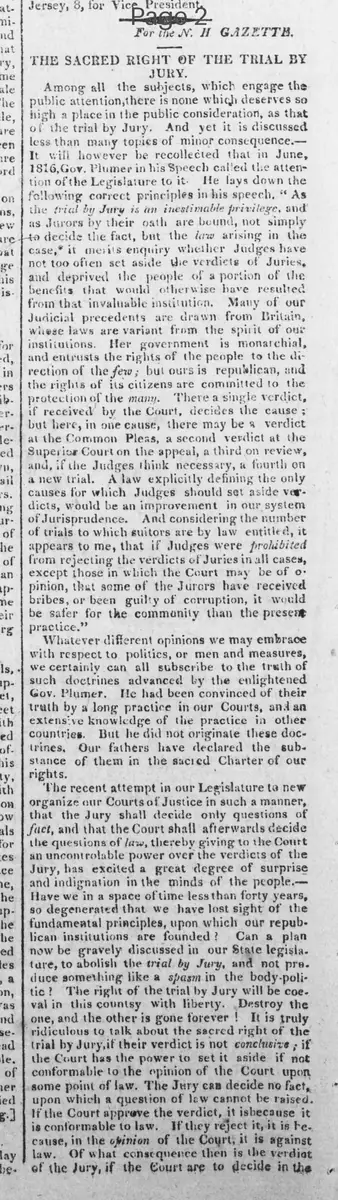
THE SACRED RIGHT OF THE TRIAL BY JURY.
Among all the subjects, which engage the public attention, there is none which deserves so high a place in the public consideration, as that of the trial by Jury. And yet it is discussed less than many topics of minor consequence.
It will however be recollected that in June, 1816, Gov. Plumer in his Speech called the attention of the Legislature to it. He lays down the following correct principles in his speech. "As the trial by Jury is an inestimable privilege, and as Jurors by their oath are bound, not simply to decide the fact, but the law arising in the case, * it merits enquiry whether Judges have not too often set aside the verdicts of Juries, and deprived the people of a portion of the benefits that would otherwise have resulted from that invaluable institution. Many of our Judicial precedents are drawn from Britain, whose laws are variant from the spirit of our institutions. Her government is monarchical, and entrusts the rights of the people to the direction of the few; but ours is republican, and the rights of its citizens are committed to the protection of the many. There a single verdict, if received by the Court, decides the cause; but here, in one cause, there may be a verdict at the Common Pleas, a second verdict at the Superior Court on the appeal, a third on review, and, if the Judges think necessary, a fourth on a new trial. A law explicitly defining the only causes for which Judges should set aside verdicts, would be an improvement in our system of Jurisprudence. And considering the number of trials to which suitors are by law entitled, it appears to me, that if Judges were prohibited from rejecting the verdicts of Juries in all cases, except those in which the Court may be of opinion, that some of the Jurors have received bribes, or been guilty of corruption, it would be safer for the community than the present practice."
Whatever different opinions we may embrace with respect to politics, or men and measures, we certainly can all subscribe to the truth of such doctrines advanced by the enlightened Gov. Plumer. He had been convinced of their truth by a long practice in our Courts, and an extensive knowledge of the practice in other countries. But he did not originate these doctrines. Our fathers have declared the substance of them in the sacred Charter of our rights.
The recent attempt in our Legislature to new organize our Courts of Justice in such a manner, that the Jury shall decide only questions of fact, and that the Court shall afterwards decide the questions of law, thereby giving to the Court an uncontrollable power over the verdicts of the Jury, has excited a great degree of surprise and indignation in the minds of the people.
Have we in a space of time less than forty years, so degenerated that we have lost sight of the fundamental principles, upon which our republican institutions are founded? Can a plan now be gravely discussed in our State legislature, to abolish the trial by Jury, and not produce something like a spasm in the body-politic? The right of the trial by Jury will be coeval in this country with liberty. Destroy the one, and the other is gone forever! It is truly ridiculous to talk about the sacred right of the trial by Jury, if their verdict is not conclusive; if the Court has the power to set it aside if not conformable to the opinion of the Court upon some point of law. The Jury can decide no fact, upon which a question of law cannot be raised. If the Court approve the verdict, it is because it is conformable to law. If they reject it, it is because, in the opinion of the Court, it is against law. Of what consequence then is the verdict of the Jury, if the Court are to decide in the end?
last resort? If the judgment is to be entered according to the opinion of the Court, why not take the opinion of the Court in the first instance, without going through the solemn mockery of a trial by Jury, which is attended with expense? It will rarely be admitted that were our Judges perfect, and had they the eye of Omniscience, the trial by Jury ought to be dispensed with. But we must take human nature as it is. And Judges, like other mortals, are not perfect. Our Judicial system should be so well constructed that even arbitrary and corrupt Judges cannot control the verdict of a Jury. While the great body of the people of this country continue virtuous and enlightened, our Jurors will be a safe depository of our rights, and an invincible bulwark between the strong arm of oppression, and the free enjoyment of the poor man's rights. Let then this sacred right be even considered as the citadel of our liberties. May it be ever guarded with "a flaming sword turning every way," proving death to its foes.
The first article of our bill of rights declares that "a frequent recurrence to the fundamental principles of the constitution (among other things) is indispensably necessary to preserve the blessings of liberty and good government."
Let us then recur to the charter of our rights. It expressly says, that the parties have a right to a trial by Jury, and this method of procedure shall be held sacred." Again—"In order to reap the fairest advantage of the inestimable privilege of the trial by Jury, great care ought to be taken, that none but qualified persons should be appointed to serve."
The People of the U. States have also declared in the 7th art. of the amendments to their constitution, that "in suits at common law, where the value in controversy shall exceed $20, the right of trial by Jury, shall be preserved, and no fact tried by a Jury, shall be otherwise re-examined in any Court of the United States, than according to the rules of the common law."
No statesman would probably advocate the abolition of the trial by Jury in totidem verbis; for the finger of public scorn would be pointed at him. No. if its abolition should ever be effected, it must be done indirectly, covertly and circuitously. But in either mode, the effect is the same. Of what avail would be the mouldering parchment, which contains the declaration of our rights, if the spirit of liberty has fled? Of what possible use would be the mere form of a trial by Jury, if another tribunal can nullify it? Obsta principiis—Resist the first encroachments of arbitrary power, is a maxim, which the supporters of our republican institutions ought to keep nearest their hearts.
Had a Judge thirty years ago set aside a verdict of a Jury, unless for corruption in the Jury, he would have been publicly impeached. And is the practice of setting aside verdicts becoming so common, that it will soon become "common law?"
And will not the legislature interfere, and arrest its progress? Will they not pass a law embracing the principles laid down by Gov. Plumer, defining the causes for which Judges may set aside verdicts, and making the penalty for its violation a removal from office?
The recent attempt in the legislature has called forth these remarks, which have no allusion to any particular Judge or Judges, but to the common practice of setting aside verdicts.
If we rightly understand the principles of our Constitution, we must hold to the following doctrines—That a Jury legally empannelled is a tribunal as independent of the Court, as the Court is of the Jury—each independent in their own department—each equally dependent upon the Constitution and the laws—that the Jury is sworn to decide between party and party according to law and the evidence given them—that it is the duty of the Court to sum up the evidence, and expound the law to the Jury—that after the Jury return their verdict, the Court have no right to set it aside, if the Jurors are qualified persons, have been legally empannelled, and have not been guilty of corruption, or some flagrant misconduct.
A Jury will seldom dissent from the exposition of the law by the Court, but have an undoubted right to. And cases have occurred where Juries, having dissented from the opinion of the Court on questions of law, have had the satisfaction of having their opinions pronounced correct. It is often said that questions of law arise on trials, which the Judges want time till the next term to study and reflect upon. Our answer is that Judges should not only be men of honesty and integrity, but of extensive and profound knowledge of the law. They ought to study the law before being placed on the bench, instead of "preparing" themselves afterwards. But if novel questions arise which render a postponement proper, let the whole cause be postponed, until the Judges can learn what the law is, and then expound it to the Jury.
JUSTICE.
*In 1757, in the reign of George 2d, a prosecution of the Crown, instituted at the request, and founded on a vote of the House of Commons, was commenced against the publisher of a pamphlet in vindication of the Hon. Alexander Murray. "Nevertheless when the cause was heard before the lord chief Justice of England, a Jury of free born Englishmen, citizens of London, asserted their privilege of Judging the law as well as the fact, and acquitted the Defendant with a truly admirable spirit of independence." Hume, 8, 454.
What sub-type of article is it?
What keywords are associated?
What entities or persons were involved?
Editorial Details
Primary Topic
Defense Of The Sacred Right Of Trial By Jury
Stance / Tone
Strongly Supportive Of Jury Independence And Critical Of Judicial Overreach
Key Figures
Key Arguments