Thank you for visiting SNEWPapers!
Sign up free
Editorial
September 12, 1849
Morning Star
Limerick, York County, Maine
What is this article about?
The editorial praises President Zachary Taylor's proclamation for a national day of fasting, humiliation, and prayer amid the Cholera epidemic, defends it against partisan (Democrat and abolitionist) opposition, and rebuts criticism over the omission of Christ's name, emphasizing its Christian undertones and appropriateness.
Clipping
OCR Quality
98%
Excellent
Full Text
MORNING STAR.
For the Morning Star.
NATIONAL FAST—THE PROCLAMATION,
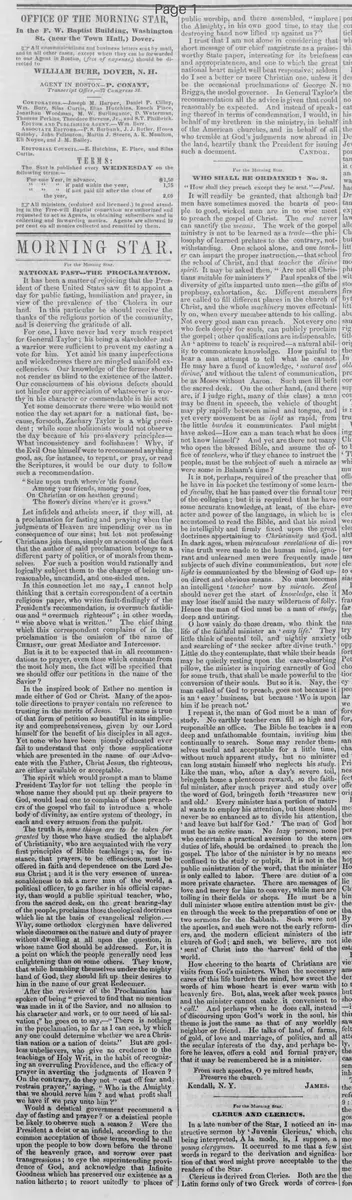
It has been a matter of rejoicing that the President of these United States saw fit to appoint a day for public fasting, humiliation and prayer, in view of the prevalence of the Cholera in our land. In this particular he should receive the thanks of the religious portion of the community, and is deserving the gratitude of all. For one, I have never had very much respect for General Taylor; his being a slaveholder and a warrior were sufficient to prevent my casting a vote for him. Yet amid his many imperfections and wickednesses there are mingled manifold excellencies. Our knowledge of the former should not render us blind to the existence of the latter. Our consciousness of his obvious defects should not hinder our appreciation of whatsoever is worthy in his character or commendable in his acts. Yet some democrats there were who would not notice the day set apart for a national fast, because, forsooth, Zachary Taylor is a whig president; while some abolitionists would not observe the day because of his pro-slavery principles— What inconsistency and foolishness! Why, if the Evil One himself were to recommend anything good, as, for instance, to repent, or pray, or read the Scriptures, it would be our duty to follow such a recommendation.
"Seize upon truth where'er 'tis found
Among your friends, among your foes,
On Christian or on heathen ground;
The flower's divine where'er it grows."
Let infidels and atheists sneer, if they will, at a proclamation for fasting and praying when the judgments of Heaven are impending over us in consequence of our sins; but let not professing Christians join them. simply on account of the fact that the author of said proclamation belongs to a different party of politics, or of morals from themselves. For such a position would rationally and logically subject them to the charge of being unreasonable, uncandid, and one-sided men. In this connection let me say, I cannot help thinking that a certain correspondent of a certain religious paper, who writes fault-findingly of the President's recommendation, is overmuch fastidious and "overmuch righteous"; in other words, "wise above what is written." The chief thing which this correspondent complains of in the proclamation is the omission of the name of Christ, our great Mediator and Intercessor. But is it to be expected that in all recommendations to prayer, even those which emanate from the most holy men, the fact will be specified that we should offer our petitions in the name of the Savior ? In the inspired book of Esther no mention is made either of God or Christ. Many of the apostolic directions to prayer contain no reference to trusting in the merits of Jesus. The same is true of that form of petition so beautiful in its simplicity and comprehensiveness, given by our Lord himself for the benefit of his disciples in all ages. Yet none who have been piously educated ever fail to understand that only those supplications which are presented in the name of our Advocate with the Father, Christ Jesus, the righteous, are either available or acceptable. The spirit which would prompt a man to blame President Taylor for not telling the people in whose name they should put up their prayers to God, would lead one to complain of those preachers of the gospel who fail to introduce a whole body of divinity, an entire system of theology, in each and every sermon from the pulpit. The truth is, some things are to be taken for granted by those who have studied the alphabet of Christianity, who are acquainted with the very first principles of Bible teachings; as, for instance, that prayers, to be efficacious, must be offered in faith and dependence on the Lord Jesus Christ; and it is the very essence of unreasonableness to ask a mere man of the world, a political officer, to go farther in his official capacity, than would a public spiritual teacher, who. from the sacred desk, on the great hearing-day of the people, proclaims those theological doctrines which lie at the basis of evangelical religion.— Why, some orthodox clergymen have delivered whole discourses on the nature and duty of prayer without dwelling at all upon the question, in whose name God should be addressed. For, it is a point on which the people generally need less enlightening than on some others. They know, that while humbling themselves under the mighty hand of God, they should lift up their desires to him in the name of our great Redeemer. After the reviewer of the Proclamation has spoken of being "grieved to find that no mention was made in it of the Savior, and no allusion to his character and work, or to our need of his salvation ;" he goes on to say,—"There is nothing in the proclamation, so far as I can see, by which any one could determine whether we are a Christian nation or a nation of deists." But are godless unbelievers, who give no credence to the teachings of Holy Writ, in the habit of recognizing an overruling Providence, and the efficacy of prayer in averting the judgments of Heaven ? On the contrary, do they not "cast off fear and restrain prayer," saying, "Who is the Almighty that we should serve him ? and what profit shall we have if we pray unto him ?" Would a deistical government recommend a day of fasting and prayer? or a deistical people be likely to observe such a season ? Were the President a deist or an infidel, according to the common acceptation of those terms, would he call upon the people to bow down before the throne of the heavenly grace, and sorrow over past transgressions; to eye the superintending providence of God, and acknowledge that Infinite Goodness which has preserved our existence as a nation hitherto; to resort unitedly to places of public worship, and there assembled, "implore the Almighty, in his own good time, to stay the destroying hand now lifted up against us?" I trust that I am not alone in considering that short message of our chief magistrate as a praiseworthy State paper, interesting for its briefness and appropriateness, and one to which the great national heart might well beat responsive; seldom do I see a better or more Christian one, unless it be the occasional proclamations of George N. Briggs, the model governor. In General Taylor's recommendation all the advice is given that could reasonably be expected. And instead of speaking thereof in terms of condemnation, I would, in behalf of my brethren in the ministry, in behalf of the American churches, and in behalf of all who tremble at God's judgments now abroad in the land, heartily thank the President for issuing such a document.
For the Morning Star.
NATIONAL FAST—THE PROCLAMATION,
It has been a matter of rejoicing that the President of these United States saw fit to appoint a day for public fasting, humiliation and prayer, in view of the prevalence of the Cholera in our land. In this particular he should receive the thanks of the religious portion of the community, and is deserving the gratitude of all. For one, I have never had very much respect for General Taylor; his being a slaveholder and a warrior were sufficient to prevent my casting a vote for him. Yet amid his many imperfections and wickednesses there are mingled manifold excellencies. Our knowledge of the former should not render us blind to the existence of the latter. Our consciousness of his obvious defects should not hinder our appreciation of whatsoever is worthy in his character or commendable in his acts. Yet some democrats there were who would not notice the day set apart for a national fast, because, forsooth, Zachary Taylor is a whig president; while some abolitionists would not observe the day because of his pro-slavery principles— What inconsistency and foolishness! Why, if the Evil One himself were to recommend anything good, as, for instance, to repent, or pray, or read the Scriptures, it would be our duty to follow such a recommendation.
"Seize upon truth where'er 'tis found
Among your friends, among your foes,
On Christian or on heathen ground;
The flower's divine where'er it grows."
Let infidels and atheists sneer, if they will, at a proclamation for fasting and praying when the judgments of Heaven are impending over us in consequence of our sins; but let not professing Christians join them. simply on account of the fact that the author of said proclamation belongs to a different party of politics, or of morals from themselves. For such a position would rationally and logically subject them to the charge of being unreasonable, uncandid, and one-sided men. In this connection let me say, I cannot help thinking that a certain correspondent of a certain religious paper, who writes fault-findingly of the President's recommendation, is overmuch fastidious and "overmuch righteous"; in other words, "wise above what is written." The chief thing which this correspondent complains of in the proclamation is the omission of the name of Christ, our great Mediator and Intercessor. But is it to be expected that in all recommendations to prayer, even those which emanate from the most holy men, the fact will be specified that we should offer our petitions in the name of the Savior ? In the inspired book of Esther no mention is made either of God or Christ. Many of the apostolic directions to prayer contain no reference to trusting in the merits of Jesus. The same is true of that form of petition so beautiful in its simplicity and comprehensiveness, given by our Lord himself for the benefit of his disciples in all ages. Yet none who have been piously educated ever fail to understand that only those supplications which are presented in the name of our Advocate with the Father, Christ Jesus, the righteous, are either available or acceptable. The spirit which would prompt a man to blame President Taylor for not telling the people in whose name they should put up their prayers to God, would lead one to complain of those preachers of the gospel who fail to introduce a whole body of divinity, an entire system of theology, in each and every sermon from the pulpit. The truth is, some things are to be taken for granted by those who have studied the alphabet of Christianity, who are acquainted with the very first principles of Bible teachings; as, for instance, that prayers, to be efficacious, must be offered in faith and dependence on the Lord Jesus Christ; and it is the very essence of unreasonableness to ask a mere man of the world, a political officer, to go farther in his official capacity, than would a public spiritual teacher, who. from the sacred desk, on the great hearing-day of the people, proclaims those theological doctrines which lie at the basis of evangelical religion.— Why, some orthodox clergymen have delivered whole discourses on the nature and duty of prayer without dwelling at all upon the question, in whose name God should be addressed. For, it is a point on which the people generally need less enlightening than on some others. They know, that while humbling themselves under the mighty hand of God, they should lift up their desires to him in the name of our great Redeemer. After the reviewer of the Proclamation has spoken of being "grieved to find that no mention was made in it of the Savior, and no allusion to his character and work, or to our need of his salvation ;" he goes on to say,—"There is nothing in the proclamation, so far as I can see, by which any one could determine whether we are a Christian nation or a nation of deists." But are godless unbelievers, who give no credence to the teachings of Holy Writ, in the habit of recognizing an overruling Providence, and the efficacy of prayer in averting the judgments of Heaven ? On the contrary, do they not "cast off fear and restrain prayer," saying, "Who is the Almighty that we should serve him ? and what profit shall we have if we pray unto him ?" Would a deistical government recommend a day of fasting and prayer? or a deistical people be likely to observe such a season ? Were the President a deist or an infidel, according to the common acceptation of those terms, would he call upon the people to bow down before the throne of the heavenly grace, and sorrow over past transgressions; to eye the superintending providence of God, and acknowledge that Infinite Goodness which has preserved our existence as a nation hitherto; to resort unitedly to places of public worship, and there assembled, "implore the Almighty, in his own good time, to stay the destroying hand now lifted up against us?" I trust that I am not alone in considering that short message of our chief magistrate as a praiseworthy State paper, interesting for its briefness and appropriateness, and one to which the great national heart might well beat responsive; seldom do I see a better or more Christian one, unless it be the occasional proclamations of George N. Briggs, the model governor. In General Taylor's recommendation all the advice is given that could reasonably be expected. And instead of speaking thereof in terms of condemnation, I would, in behalf of my brethren in the ministry, in behalf of the American churches, and in behalf of all who tremble at God's judgments now abroad in the land, heartily thank the President for issuing such a document.
What sub-type of article is it?
Moral Or Religious
Partisan Politics
What keywords are associated?
National Fast
Choleraprayer
President Taylor
Religious Proclamation
Partisan Criticism
Christian Nation
Abolitionist Opposition
What entities or persons were involved?
President Zachary Taylor
General Taylor
Democrats
Abolitionists
George N. Briggs
Editorial Details
Primary Topic
Support For President Taylor's National Fast Proclamation During Cholera Epidemic
Stance / Tone
Supportive And Defensive, Critical Of Partisan And Purist Opposition
Key Figures
President Zachary Taylor
General Taylor
Democrats
Abolitionists
George N. Briggs
Key Arguments
President Taylor Deserves Thanks For Proclaiming A Day Of Fasting And Prayer Amid Cholera
Partisan Refusal To Observe The Fast Due To Taylor's Politics Or Slavery Stance Is Inconsistent And Foolish
Omission Of Christ's Name In The Proclamation Is Not A Flaw, As It Assumes Basic Christian Principles
The Proclamation Reflects Christian Values, Unlike What Deists Would Issue
It Is A Praiseworthy State Paper Worthy Of National Response