Thank you for visiting SNEWPapers!
Sign up free
The Daily Advertiser
New York, New York County, New York
What is this article about?
A Citizen of Philadelphia continues exposing weaknesses in Brutus's arguments against the U.S. Constitution, arguing that a large union requires strong federal powers vested in Congress for raising revenue, military, and courts. Faults any failures on Congress, not the Constitution itself.
Merged-components note: The '[To be continued.]' is the concluding note of the letter 'The Weaknesses of Brutus exposed'.
Clipping
OCR Quality
Full Text
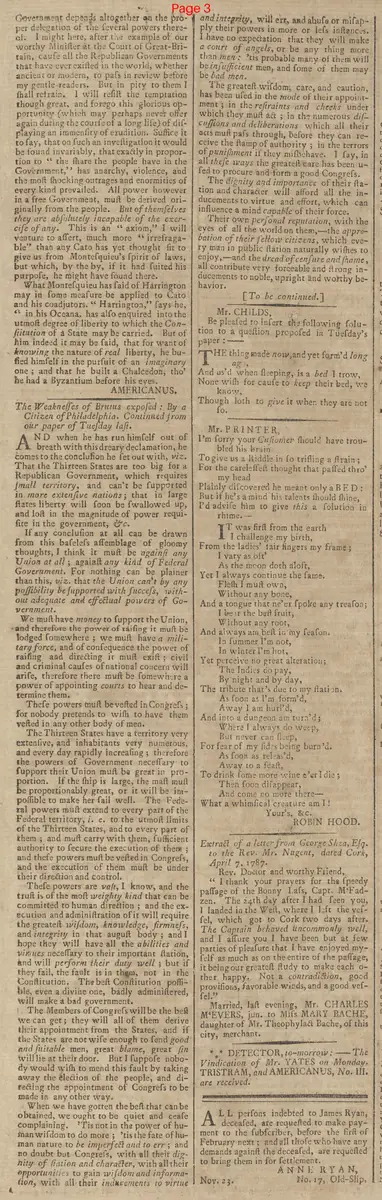
AND when he has run himself out of breath with this dreary declamation, he comes to the conclusion he set out with, viz. That the Thirteen States are too big for a Republican Government, which requires small territory, and can't be supported in more extensive nations; that in large states liberty will soon be swallowed up, and lost in the magnitude of power requisite in the government, &c.
If any conclusion at all can be drawn from this balesome assemblage of gloomy thoughts, I think it must be against any Union at all; against any kind of Federal Government. For nothing can be plainer than this, viz. that the Union can't by any possibility be supported with success, without adequate and effectual powers of Government.
We must have money to support the Union, and therefore the power of raising it must be lodged somewhere; we must have a military force, and of consequence the power of raising and directing it must exist: civil and criminal causes of national concern will arise, therefore there must be somewhere a power of appointing courts to hear and determine them.
These powers must be vested in Congress; for nobody pretends to wish to have them vested in any other body of men.
The Thirteen States have a territory very extensive, and inhabitants very numerous, and every day rapidly increasing; therefore the powers of Government necessary to support their Union must be great in proportion. If the ship is large, the mast must be proportionably great, or it will be impossible to make her sail well. The Federal powers must extend to every part of the Federal territory, i. e. to the utmost limits of the Thirteen States, and to every part of them; and must carry with them, sufficient authority to secure the execution of them; and these powers must be vested in Congress, and the execution of them must be under their direction and control.
These powers are vast, I know, and the trust is of the most weighty kind that can be committed to human direction; and the execution and administration of it will require the greatest wisdom, knowledge, firmness, and integrity in that august body; and I hope they will have all the abilities and virtues necessary to their important station, and will perform their duty well; but if they fail, the fault is in them, not in the Constitution. The best Constitution possible, even a divine one, badly administered, will make a bad government.
The Members of Congress will be the best we can get; they will all of them derive their appointment from the States, and if the States are not wise enough to send good and suitable men, great blame, great infamy will lie at their door. But I suppose nobody would wish to mend this fault by taking away the election of the people, and directing the appointment of Congress to be made in any other way.
When we have gotten the best that can be obtained, we ought to be quiet and cease complaining. 'Tis not in the power of human wisdom to do more; 'tis the fate of human nature to be imperfect and to err; and no doubt but Congress, with all their dignity of station and character, with all their opportunities to gain wisdom and information, with all their inducements to virtue and integrity, will err, and abuse or misapply their powers in more or less instances.
[To be continued.]
What sub-type of article is it?
What themes does it cover?
What keywords are associated?
What entities or persons were involved?
Letter to Editor Details
Author
A Citizen Of Philadelphia
Main Argument
the extensive union of thirteen states requires strong federal powers in congress for revenue, military, and courts to succeed; any failures stem from congress's administration, not the constitution's design.
Notable Details