Thank you for visiting SNEWPapers!
Sign up free
Gazette Of The United States
New York, New York County, New York
What is this article about?
On March 23, 1790, Mr. Barnave presented instructions to the French National Assembly for implementing decrees on colonial assemblies. The guidelines outline proclamation by governors, formation of parochial assemblies, elections of deputies, and procedures for handling existing colonial assemblies based on majority parish votes.
Merged-components note: Continuation of the translated 'INSTRUCTIONS FOR THE COLONIES' from page 1 to page 2, indicated by matching text and '(To be continued.)'.
Clippings
1 of 2
OCR Quality
Full Text
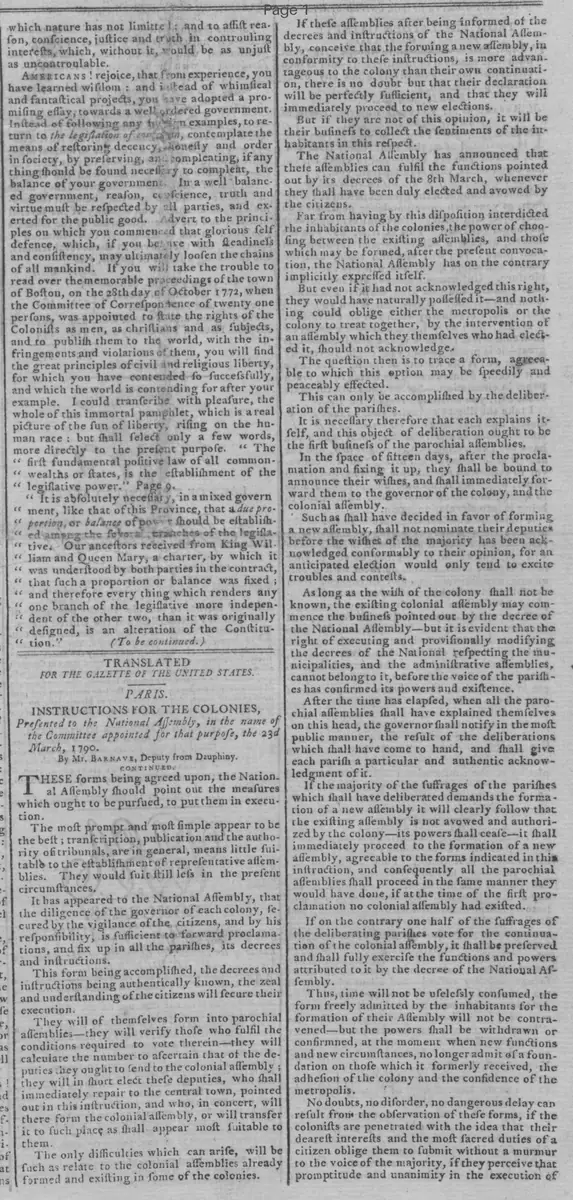
FOR THE GAZETTE OF THE UNITED STATES.
PARIS.
INSTRUCTIONS FOR THE COLONIES,
Presented to the National Assembly, in the name of
the Committee appointed for that purpose, the 23d
March, 1790.
By Mr. BARNAVE, Deputy from Dauphiny.
CONTINUED.
THESE forms being agreed upon, the National
Assembly should point out the measures
which ought to be pursued, to put them in execution.
The most prompt and most simple appear to be
the best; transcription, publication and the authority
of tribunals, are in general, means little suitable
to the establishment of representative assemblies.
They would suit till less in the present
circumstances.
It has appeared to the National Assembly, that
the diligence of the governor of each colony, secured
by the vigilance of the citizens, and by his
responsibility, is sufficient to forward proclamations,
and fix up in all the parishes, its decrees
and instructions.
This form being accomplished, the decrees and
instructions being authentically known, the zeal
and understanding of the citizens will secure their
execution.
They will of themselves form into parochial
assemblies—they will verify those who fulfil the
conditions required to vote therein—they will
calculate the number to ascertain that of the deputies
they ought to send to the colonial assembly;
they will in short elect these deputies, who shall
immediately repair to the central town, pointed
out in this instruction, and who, in concert, will
there form the colonial assembly, or will transfer
it to such place as shall appear most suitable to
them.
The only difficulties which can arise, will be
such as relate to the colonial assemblies already
formed and existing in some of the colonies.
If these assemblies after being informed of the
decrees and instructions of the National Assembly,
conceive that the forming a new assembly, in
conformity to these instructions, is more advantageous
to the colony than their own continuation,
there is no doubt but that their declaration
will be perfectly sufficient, and that they will
immediately proceed to new elections.
But if they are not of this opinion, it will be
their business to collect the sentiments of the inhabitants
in this respect.
The National Assembly has announced that
these assemblies can fulfil the functions pointed
out by its decrees of the 8th March, whenever
they shall have been duly elected and avowed by
the citizens.
Far from having by this disposition interdicted
the inhabitants of the colonies, the power of choosing
between the existing assemblies, and those
which may be formed, after the present convocation,
the National Assembly has on the contrary
implicitly expressed itself.
But even if it had not acknowledged this right,
they would have naturally possessed it—and nothing
could oblige either the metropolis or the
colony to treat together, by the intervention of
an assembly which they themselves who had elected
it, should not acknowledge.
The question then is to trace a form, agreeable
to which this option may be speedily and
peaceably effected.
This can only be accomplished by the deliberation
of the parishes.
It is necessary therefore that each explains itself,
and this object of deliberation ought to be
the first business of the parochial assemblies.
In the space of fifteen days, after the proclamation
and fixing it up, they shall be bound to
announce their wishes, and shall immediately forward
them to the governor of the colony, and the
colonial assembly.
Such as shall have decided in favor of forming
a new assembly, shall not nominate their deputies
before the wishes of the majority has been acknowledged
conformably to their opinion, for an
anticipated election would only tend to excite
troubles and contests.
As long as the wish of the colony shall not be
known, the existing colonial assembly may commence
the business pointed out by the decree of
the National Assembly—but it is evident that the
right of executing and provisionally modifying
the decrees of the National respecting the municipalities,
and the administrative assemblies,
cannot belong to it, before the voice of the parishes
has confirmed its powers and existence.
After the time has elapsed, when all the parochial
assemblies shall have explained themselves
on this head, the governor shall notify in the most
public manner, the result of the deliberations
which shall have come to hand, and shall give
each parish a particular and authentic acknowledgment
of it.
If the majority of the suffrages of the parishes
which shall have deliberated demands the formation
of a new assembly it will clearly follow that
the existing assembly is not avowed and authorized
by the colony—its powers shall cease—it shall
immediately proceed to the formation of a new
assembly, agreeable to the forms indicated in this
instruction, and consequently all the parochial
assemblies shall proceed in the same manner they
would have done, if at the time of the first proclamation
no colonial assembly had existed.
If on the contrary one half of the suffrages of
the deliberating parishes vote for the continuation
of the colonial assembly, it shall be preserved
and shall fully exercise the functions and powers
attributed to it by the decree of the National Assembly.
Thus, time will not be uselessly consumed, the
form freely admitted by the inhabitants for the
formation of their Assembly will not be contravened—but
the powers shall be withdrawn or
confirmed, at the moment when new functions
and new circumstances, no longer admit of a foundation
on those which it formerly received, the
adhesion of the colony and the confidence of the
metropolis.
No doubts, no disorder, no dangerous delay can
result from the observation of these forms, if the
colonists are penetrated with the idea that their
dearest interests and the most sacred duties of a
citizen oblige them to submit without a murmur
to the voice of the majority, if they perceive that
promptitude and unanimity in the execution of
measures which are pointed out to them, can alone
happily extricate them out of the critical situation
in which circumstances have placed them, that it
is their business instantly to secure, by a good constitution,
the hopes which they have conceived, and
the advantages offered to them, and that so far from
conducting them to this end, the prolongation of
public fermentation will shortly surround them with
such pressing and terrible danger, that all the measures
they may take to oppose them will come too
late to secure them against these effects.
(To be continued.)
What sub-type of article is it?
What keywords are associated?
What entities or persons were involved?
Where did it happen?
Foreign News Details
Primary Location
French Colonies
Event Date
23 March 1790
Key Persons
Outcome
instructions establish procedures for forming or confirming colonial assemblies via parochial votes, ensuring prompt implementation without disorder.
Event Details
The National Assembly's instructions detail the execution of decrees for colonial representative assemblies: governors proclaim and post them; citizens form parochial assemblies to elect deputies and decide on new or existing assemblies within 15 days; majority parish votes determine if existing assemblies continue or new ones form, with powers provisional until confirmed.