Thank you for visiting SNEWPapers!
Sign up free
Letter to Editor
February 19, 1875
The Fremont Weekly Journal
Fremont, Sandusky County, Ohio
What is this article about?
Reminiscence praising Samuel J. Randall's integrity, led by his opposition to the civil rights bill boosting his Speaker prospects. Recalls 1867-68 incident where Thaddeus Stevens endorsed Randall's bill to increase pay for U.S. court employees and jurymen without reading details.
Clipping
OCR Quality
95%
Excellent
Full Text
A REMINISCENCE.
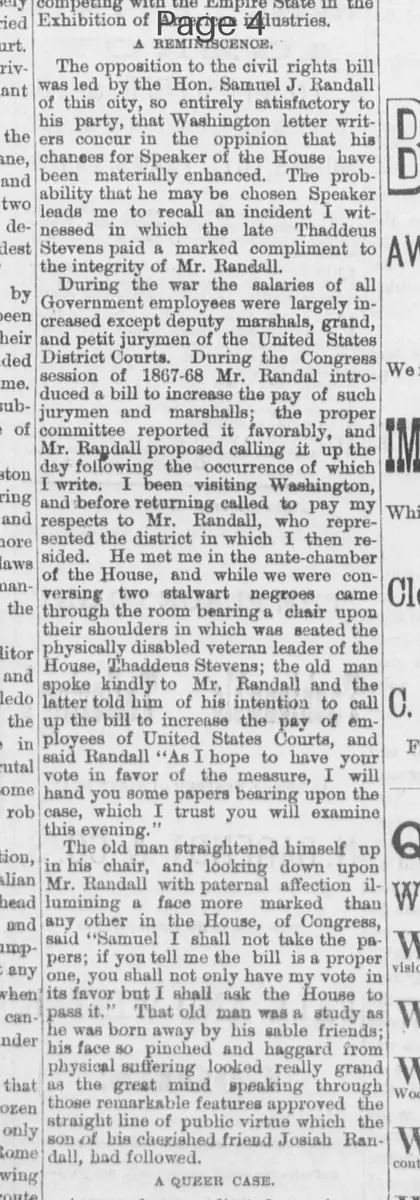
The opposition to the civil rights bill was led by the Hon. Samuel J. Randall of this city, so entirely satisfactory to his party. that Washington letter writers concur in the opinion that his chances for Speaker of the House have been materially enhanced. The probability that he may be chosen Speaker leads me to recall an incident I witnessed in which the late Thaddeus Stevens paid a marked compliment to the integrity of Mr. Randall. During the war the salaries of all Government employees were largely increased except deputy marshals, grand, and petit jurymen of the United States District Courts. During the Congress session of 1867-68 Mr. Randall introduced a bill to increase the pay of such jurymen and marshals; the proper committee reported it favorably, and Mr. Randall proposed calling it up the day following the occurrence of which I write. I had been visiting Washington, and before returning called to pay my respects to Mr. Randall, who represented the district in which I then resided. He met me in the ante-chamber of the House, and while we were conversing two stalwart negroes came through the room bearing a chair upon their shoulders in which was seated the physically disabled veteran leader of the House, Thaddeus Stevens; the old man spoke kindly to Mr. Randall and the latter told him of his intention to call up the bill to increase the pay of employees of United States Courts, and said Randall "As I hope to have your vote in favor of the measure. I will hand you some papers bearing upon the case, which I trust you will examine this evening." The old man straightened himself up in his chair, and looking down upon Mr. Randall with paternal affection illuminating a face more marked than any other in the House, of Congress, said 'Samuel I shall not take the papers; if you tell me the bill is a proper one, you shall not only have my vote in its favor but I shall ask the House to pass it.' That old man was a study as he was borne away by his sable friends; his face so pinched and haggard from physical suffering looked really grand as the great mind speaking through those remarkable features approved the straight line of public virtue which the son of his cherished friend Josiah Randall, had followed.
The opposition to the civil rights bill was led by the Hon. Samuel J. Randall of this city, so entirely satisfactory to his party. that Washington letter writers concur in the opinion that his chances for Speaker of the House have been materially enhanced. The probability that he may be chosen Speaker leads me to recall an incident I witnessed in which the late Thaddeus Stevens paid a marked compliment to the integrity of Mr. Randall. During the war the salaries of all Government employees were largely increased except deputy marshals, grand, and petit jurymen of the United States District Courts. During the Congress session of 1867-68 Mr. Randall introduced a bill to increase the pay of such jurymen and marshals; the proper committee reported it favorably, and Mr. Randall proposed calling it up the day following the occurrence of which I write. I had been visiting Washington, and before returning called to pay my respects to Mr. Randall, who represented the district in which I then resided. He met me in the ante-chamber of the House, and while we were conversing two stalwart negroes came through the room bearing a chair upon their shoulders in which was seated the physically disabled veteran leader of the House, Thaddeus Stevens; the old man spoke kindly to Mr. Randall and the latter told him of his intention to call up the bill to increase the pay of employees of United States Courts, and said Randall "As I hope to have your vote in favor of the measure. I will hand you some papers bearing upon the case, which I trust you will examine this evening." The old man straightened himself up in his chair, and looking down upon Mr. Randall with paternal affection illuminating a face more marked than any other in the House, of Congress, said 'Samuel I shall not take the papers; if you tell me the bill is a proper one, you shall not only have my vote in its favor but I shall ask the House to pass it.' That old man was a study as he was borne away by his sable friends; his face so pinched and haggard from physical suffering looked really grand as the great mind speaking through those remarkable features approved the straight line of public virtue which the son of his cherished friend Josiah Randall, had followed.
What sub-type of article is it?
Historical
Reflective
What themes does it cover?
Politics
Morality
What keywords are associated?
Samuel J Randall
Thaddeus Stevens
Civil Rights Bill
House Speaker
Government Employees Pay
Public Integrity
1867 68 Congress
Letter to Editor Details
Main Argument
recalls an incident demonstrating samuel j. randall's integrity, as praised by thaddeus stevens, in the context of randall's recent political success opposing the civil rights bill.
Notable Details
Thaddeus Stevens Carried In Chair By Two Negroes
Bill To Increase Pay For Deputy Marshals And Jurymen In 1867 68
Stevens Trusts Randall's Word Without Reading Papers
Reference To Josiah Randall As Stevens' Cherished Friend