Thank you for visiting SNEWPapers!
Sign up free
Alexandria Gazette & Daily Advertiser
Alexandria, Virginia
What is this article about?
Report on the March 1820 revolution in Buenos Ayres, detailing Montonero victories, San Martin's refusal to fight, arrests of generals, defeat of government forces, Pueyrredon's flight, counter-revolution by Balcarce, and federalists' return to power under Governor Sarraltea, who issued a strict edict for public order.
Merged-components note: Merged the two sequential components as the text is a direct continuation of the South America revolution report, split across columns.
Clipping
OCR Quality
Full Text
SOUTH AMERICA.
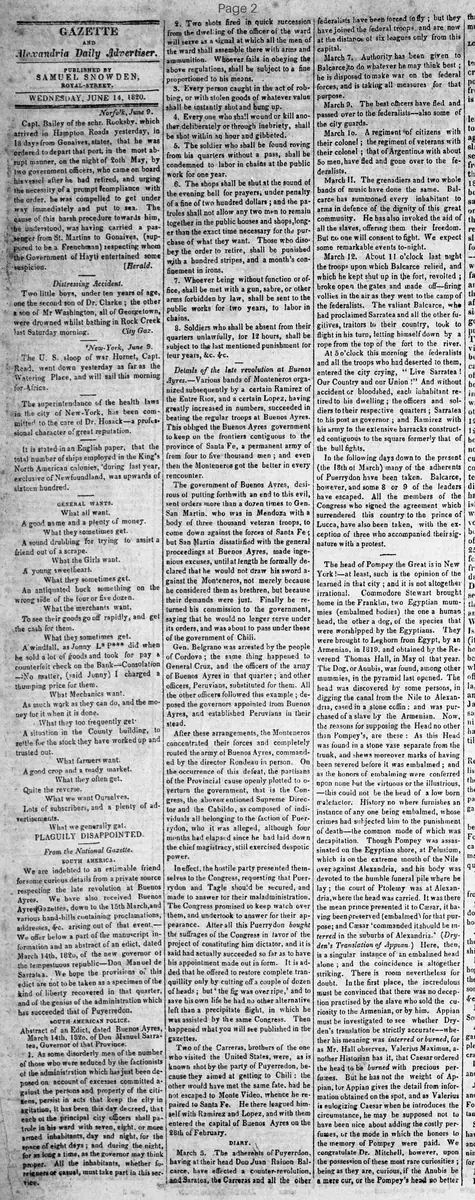
We are indebted to an estimable friend for some curious details from a private source respecting the late revolution at Buenos Ayres. We have also received Buenos Ayres Gazettes, down to the 15th March, and various hand-bills containing proclamations, addresses, &c. arising out of that event,—We offer below a part of the manuscript information and an abstract of an edict, dated March 14th, 1820, of the new governor of the tempestuous republic—Don Manuel de Sarralta. We hope the provisions of this edict are not to be taken as a specimen of the kind of liberty recovered in that quarter, and of the genius of the administration which has succeeded that of Pueyrredon.
SOUTH AMERICAN POLICE.
Abstract of an Edict, dated Buenos Ayres, March 14th, 1820. of Don Manuel Sarraltea, Governor of that Province.
I. As some disorderly men of the number of those who were seduced by the factionists of the administration which has just been deposed on account of excesses committed against the persons and property of the citizens, persist in acts that keep the city in agitation, it has been this day decreed, that each of the principal city officers shall patrol in his ward with seven, eight, or more armed inhabitants, day and night, for the space of eight days; and during the night, for as long a time, as the governor may think proper. All the inhabitants, whether foreigners or casual, must take part in this service.
. Two shots fired in quick succession from the dwelling of the officer of the ward will serve as a signal at which all the men of the ward shall assemble there with arms and ammunition. Whoever fails in obeying the above regulations, shall be subject to a fine proportioned to his means.
3. Every person caught in the act of robbing, or with stolen goods of whatever value shall be instantly shot and hung up.
4. Every one who shall wound or kill another deliberately or through inebriety, shall be shot within an hour and gibbeted.
5. The soldier who shall be found roving from his quarters without a pass, shall be condemned to labor in chains at the public work for one year.
6. The shops shall be shut at the sound of the evening bell for prayers, under penalty of a fine of two hundred dollars; and the patrols shall not allow any two men to remain together in the public houses and shops, longer than the exact time necessary for the purchase of what they want. Those who disobey the order to retire, shall be punished with a hundred stripes, and a month's confinement in irons.
7. Whoever being without function or office, shall be met with a gun, sabre, or other arms forbidden by law, shall be sent to the public works for two years, to labor in chains.
8. Soldiers who shall be absent from their quarters unlawfully, for 12 hours, shall be subject to the last mentioned punishment for four years, &c. &c.
Details of the late revolution at Buenos Ayres.—Various bands of Monteneros organized subsequently by a certain Ramirez of the Entre Rios, and a certain Lopez, having greatly increased in numbers, succeeded in beating the regular troops at Buenos Ayres. This obliged the Buenos Ayres government to keep on the frontiers contiguous to the province of Santa Fe, a permanent army of from four to five thousand men; and even then the Monteneros got the better in every rencounter.
The government of Buenos Ayres, desirous of putting forthwith an end to this evil, sent orders more than a dozen times to Gen. San Martin, who was in Mendoza with a body of three thousand veteran troops, to come down against the forces of Santa Fe—; but San Martin dissatisfied with the general proceedings at Buenos Ayres, made ingenious excuses, until at length he formally declared that he would not draw his sword against the Monteneros, not merely because he considered them as brethren, but because their demands were just. Finally he returned his commission to the government, saying that he would no longer serve under its orders, and was about to pass under those of the government of Chili.
Gen. Belgrano was arrested by the people of Cordova; the same thing happened to General Cruz, and the officers of the army of Buenos Ayres in that quarter; and other officers, Peruvians, substituted for them. All the other officers followed this example; deposed the governors appointed from Buenos Ayres, and established Peruvians in their stead.
After these arrangements, the Monteneros concentrated their forces and completely routed the army of Buenos Ayres, commanded by the director Rondeau in person. On the occurrence of this defeat, the partisans of the Provincial cause openly plotted to overturn the government, that is the Congress, the above mentioned Supreme Director and the Cabildo, as composed of individuals all belonging to the faction of Pueyrredon, who it was alleged, although four months had elapsed since he had laid down the chief magistracy, still exercised despotic power.
In effect, the hostile party presented themselves to the Congress, requesting that Pueyrredon and Tagle should be secured, and made to answer for their maladministration. The Congress promised to keep watch over them, and undertook to answer for their appearance. After all this Pueyrredon bought the suffrages of the Congress in favor of the project of constituting him dictator, and it is said had actually succeeded so far as to have his appointment made out in form. It is added that he offered to restore complete tranquillity only by cutting off a couple of dozen of heads; but 'the fig was over ripe,' and to save his own life he had no other alternative left than a precipitate flight, in which he was assisted by the same Congress. Then happened what you will see published in the gazettes.
Two of the Carreras, brothers of the one who visited the United States, were, as is known shot by the party of Pueyrredon, because they aimed at getting to Chili: the other would have met the same fate, had he not escaped to Monte Video, whence he repaired to Santa Fe. He there leagued himself with Ramirez and Lopez, and with them entered the capital of Buenos Ayres on the 28th of February.
DIARY.
March 5. The adherents of Pueyrredon, having at their head Don Juan Ramon Balcarce, have effected a counter-revolution. and Saratea, the Carreras and all the other federalists have been forced to fly; but they
have joined the federal troops, and are now at the distance of six leagues only from this capital.
March 7. Authority has been given to Balcarce to do whatever he may think best; he is disposed to make war on the federal forces, and is taking all measures for that purpose.
March 9. The best officers have fled and passed over to the federalists—also some of the city guards.
March 10. A regiment of citizens with their colonel; the regiment of veterans with their colonel; that of Argentines with about 50 men, have fled and gone over to the federalists.
March 11. The grenadiers and two whole bands of music have done the same. Balcarce has summoned every inhabitant to arms in defence of the dignity of this great community. He has also invoked the aid of all the slaves, offering them their freedom. But no one will consent to fight. We expect some remarkable events to-night.
March 12. About 11 o'clock last night the troops upon which Balcarce relied, and which he kept shut up in the fort, revolted: broke open the gates and made off—firing vollies in the air as they went to the camp of the federalists. The valiant Balcarce, who had proclaimed Sarratea and all the other fugitives, traitors to their country, took to flight in his turn, letting himself down by a rope from the top of the fort to the river. At 5 o'clock this morning the federalists and all the troops who had deserted to them, entered the city crying, "Live Sarratea! Our Country and our Union!" And without accident or bloodshed, each inhabitant retired to his dwelling; the officers and soldiers to their respective quarters; Sarratea to his post as governor; and Ramirez with his army to the extensive barracks constructed contiguous to the square formerly that of the bull fights.
In the following days down to the present (the 18th of March) many of the adherents of Pueyrredon have been taken. Balcarce, however, and some 8 or 9 of the leaders have escaped. All the members of the Congress who signed the agreement which surrendered this country to the prince of Lucca, have also been taken, with the exception of three who accompanied their signature with a protest.
What sub-type of article is it?
What keywords are associated?
What entities or persons were involved?
Where did it happen?
Foreign News Details
Primary Location
Buenos Ayres
Event Date
March 1820
Key Persons
Outcome
monteneros routed government army; pueyrredon and balcarce fled; federalists regained control without bloodshed on march 12; many pueyrredon adherents arrested; strict edict imposed for order.
Event Details
Montonero bands led by Ramirez and Lopez defeated Buenos Ayres troops; San Martin refused to fight and defected; generals arrested in Cordova; government army routed by Montoneros under Rondeau; plot against Pueyrredon succeeded, forcing his flight; counter-revolution by Balcarce failed as troops deserted to federalists; Sarraltea became governor and issued edict with harsh penalties for disorder.