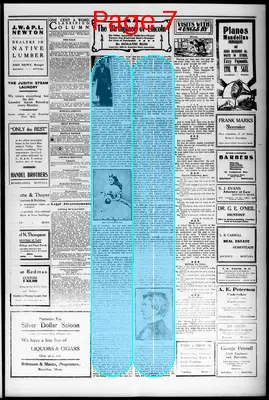
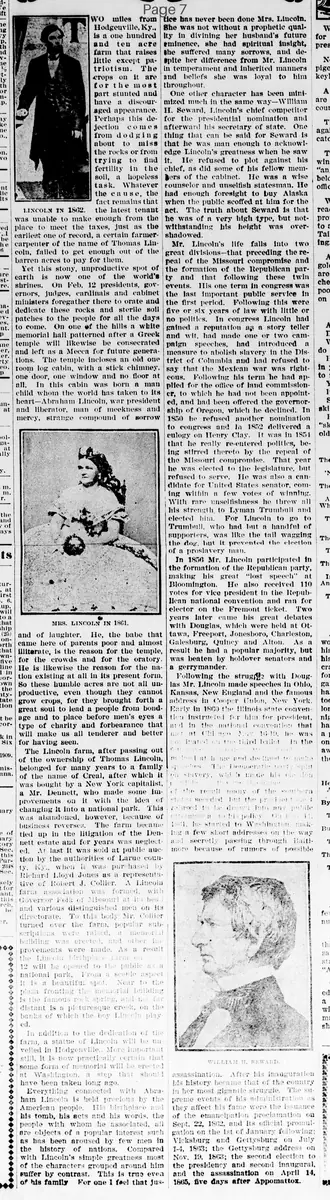
Justice has never been done Mrs. Lincoln. She was not without a prophetic quality in divining her husband's future eminence, she had spiritual insight, he suffered many sorrows, and despite her difference from Mr. Lincoln in temperament and inherited manners and beliefs she was loyal to him throughout. One other character has been minimized much in the same way—William H. Seward. Lincoln's chief competitor for the presidential nomination and afterward his secretary of state. One thing that can be said for Seward is that he was man enough to acknowledge Lincoln's greatness when he saw it. He refused to plot against his chief, as did some of his fellow members of the cabinet. He was a wise counselor and unselfish statesman. He had enough foresight to buy Alaska when the public scoffed at him for the act. The truth about Seward is that he was of a very high type, but notwithstanding his height was overshadowed. Mr. Lincoln's life falls into two great divisions—that preceding the repeal of the Missouri compromise and the formation of the Republican party and that following these twin events. His one term in congress was the last important public service in the first period. Following this were five or six years of law with little or no politics. In congress Lincoln had gained a reputation as a story teller and wit, had made one or two campaign speeches, had introduced a measure to abolish slavery in the District of Columbia and had refused to say that the Mexican war was righteous. Following his term he had applied for the office of land commissioner, to which he had not been appointed, and had been offered the governorship of Oregon, which he declined. In 1850 he refused another nomination to congress and in 1852 delivered a eulogy on Henry Clay. It was in 1854 that he really re-entered politics, being stirred thereto by the repeal of the Missouri compromise. That year he was elected to the legislature, but refused to serve. He was also a candidate for United States senator, coming within a few votes of winning. With rare unselfishness he threw all his strength to Lyman Trumbull and elected him. For Lincoln to go to Trumbull, who had but a handful of supporters, was like the tail wagging the dog, but it prevented the election of a proslavery man. In 1856 Mr. Lincoln participated in the formation of the Republican party, making his great "lost speech" at Bloomington. He also received 110 votes for vice president in the Republican national convention and ran for elector on the Fremont ticket. Two years later came his great debates with Douglas, which were held at Ottawa, Freeport, Jonesboro, Charleston, Galesburg, Quincy and Alton. As a result he had a popular majority, but was beaten by holdover senators and a gerrymander. Following the struggle with Douglas Mr. Lincoln made speeches in Ohio, Kansas, New England and the famous address in Cooper Union, New York. Early in 1860 the Illinois state convention instructed for him for president, and in the national convention that met at Chicago May 16, 1860, he was nominated on the third ballot in the Wigwam. It is estimated that he received many of the same states' votes that had gone to Seward, which made his nomination possible. He started to Washington making a few short addresses on the way and secretly passing through Baltimore because of rumors of possible assassination. After his inauguration his history became that of the country in her most gigantic struggle. The supreme events of his administration as they affect his fame were the issuance of the emancipation proclamation on Sept. 22, 1862, and its official promulgation on the 1st of January following; Vicksburg and Gettysburg on July 1-4, 1863; the Gettysburg address on Nov. 19, 1863; the second election to the presidency and second inaugural, and the assassination on April 14, 1865, five days after Appomattox.