Thank you for visiting SNEWPapers!
Sign up free
Public Ledger
Memphis, Shelby County, Tennessee
What is this article about?
Historical address by J.F.H. Claiborne on Gulf Coast history, covering French exploration by D'Iberville in 1699, colonization of Louisiana, shifts in control among France, Spain, England, and acquisition by the United States in 1803, with focus on territorial changes and settlements in Biloxi, Mobile, and New Orleans.
Clipping
OCR Quality
Full Text
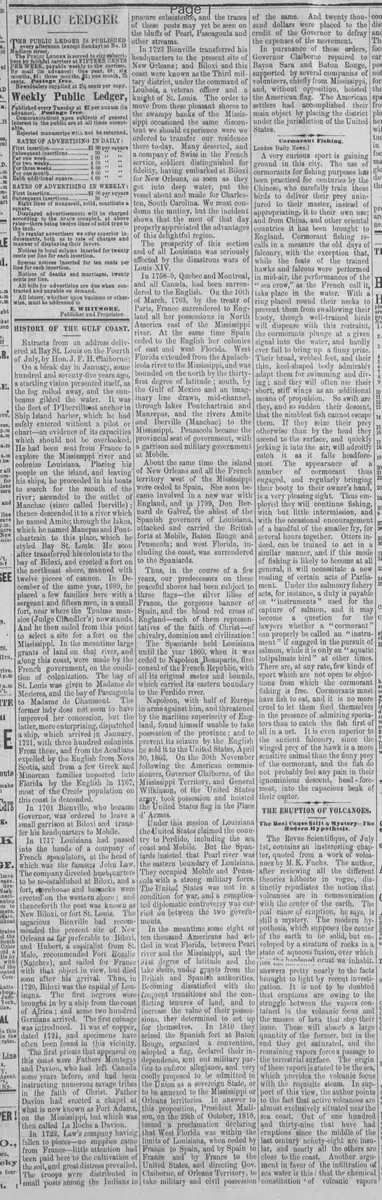
Extracts from an address delivered at Bay St. Louis on the Fourth of July, by Hon. J. F. H. Claiborne:
On a bleak day in January, some hundred and seventy-five years ago, a startling vision presented itself, as the fog rolled away, and the sunbeams gilded the water. It was the fleet of D'Iberville at anchor in Ship Island harbor, which he had safely entered without a pilot or chart—an evidence of its capacities which should not be overlooked.
He had been sent from France to explore the Mississippi river and colonize Louisiana. Placing his people on the island, and leaving his ships, he proceeded in his boats to search for the mouth of the river; ascended to the outlet of Manchac (since called Iberville); thence descended it to a river which he named Amite; through the lakes, which he named Maurepas and Pontchartrain to this place, which he styled Bay St. Louis. He soon after transferred his colonists to the bay of Biloxi, and erected a fort on the northeast shore, manned with twelve pieces of cannon. In December of the same year, 1699, he placed a few families here with a sergeant and fifteen men, in a small fort, near where the Toulme mansion (Judge Chandler's) now stands. And he then sailed from this point to select a site for a fort on the Mississippi. In the meantime large grants of land on that river, and along this coast, were made by the French government, on the condition of colonization. The bay of St. Louis was given to Madame de Mezieres, and the bay of Pascagoula to Madame de Chaumont. The former lady does not seem to have improved her concession, but the latter, more enterprising, dispatched a ship, which arrived in January 1721, with three hundred colonists. From these, and from the Acadians expelled by the English from Nova Scotia, and from a few Greek and Minorcan families imported into Florida by the English in 1767, most of the Creole population on this coast is descended.
In 1701 Bienville, who became Governor, was ordered to leave a small garrison at Biloxi and transfer his headquarters to Mobile.
In 1717 Louisiana had passed into the hands of a company of French speculators, at the head of which was the famous John Law. The company directed headquarters to be re-established at Biloxi, and a fort, storehouse and barracks were erected on the western shore; and thenceforth the post was known as New Biloxi, or Fort St. Louis. The sagacious Bienville had recommended the present site of New Orleans as far preferable to Biloxi, and Hubert, a capitalist from St. Malo, recommended Fort Rosalie (Natchez), and sailed for France with that object in view, but died soon after his arrival. Thus, in 1720, Biloxi was the capital of Louisiana. The first negroes were brought in by a ship from the coast of Africa; and some two hundred Germans arrived. The first coinage was introduced. It was of copper, dated 1721, and specimens have often been found in this vicinity.
The first priests that appeared on this coast were Fathers Montegay and Daviou, who had left Canada some years before, and had been instructing numerous savage tribes in the faith of Christ. Father Davion had erected a chapel at what is now known as Fort Adams, on the Mississippi, but which was then called La Roche a Davion.
In 1722, Law's company having fallen to pieces—no supplies came from France—little attention had been paid here to the cultivation of the soil, and great distress prevailed. The troops were distributed in small posts among the Indians to procure subsistence, and the traces of these posts may yet be seen on the bluffs of Pearl, Pascagoula and other streams.
In 1723 Bienville transferred his headquarters to the present site of New Orleans: and Biloxi and this coast were known as the Third military district, under the command of Loubois, a veteran officer and a knight of St. Louis. The order to move from these pleasant shores to the swampy banks of the Mississippi occasioned the same discontent we should experience were we ordered to transfer our residence there to-day. Many deserted, and a company of Swiss in the French service, soldiers distinguished for fidelity, having embarked at Biloxi for New Orleans, as soon as they got into deep water, put the vessel about and made for Charleston, South Carolina. We must condemn the mutiny, but the incident shows that the men of that day properly appreciated the advantages of this delightful region.
The prosperity of this section and of all Louisiana was seriously affected by the disastrous wars of Louis XIV.
In 1758-9, Quebec and Montreal, and all Canada, had been surrendered to the English. On the 10th of March, 1763, by the treaty of Paris, France surrendered to England all her possessions in North America east of the Mississippi river. At the same time Spain ceded to the English her colonies of east and west Florida. West Florida extended from the Apalachicola river to the Mississippi, and was bounded on the north by the thirty-first degree of latitude; south, by the Gulf of Mexico and an imaginary line drawn, mid-channel, through lakes Pontchartrain and Maurepas, and the rivers Amite and Iberville (Manchac) to the Mississippi. Pensacola became the provincial seat of government, with a garrison and military government at Mobile.
About the same time the island of New Orleans and all the French territory west of the Mississippi were ceded to Spain. She soon became involved in a new war with England, and in 1779, Don Bernard de Galvez, the ablest of the Spanish governors of Louisiana, attacked and carried the British forts at Mobile, Baton Rouge and Pensacola; and west Florida, including the coast, was surrendered to the Spaniards.
Thus, in the course of a few years, our predecessors on these peaceful shores had been subject to three flags—the silver lilies of France, the gorgeous banner of Spain, and the blood red cross of England—each of them representatives of the faith of Christ—of chivalry, dominion and civilization!
The Spaniards held Louisiana until the year 1800, when it was ceded to Napoleon Bonaparte, first consul of the French Republic, with all its original metes and bounds which carried its eastern boundary to the Perdido river.
Napoleon, with half of Europe in arms against him, and threatened by the maritime superiority of England, found himself unable to take possession of the province: and to prevent its seizure by the English he sold it to the United States, April 30, 1803. On the 30th November following the American commissioners, Governor Claiborne, of the Mississippi Territory, and General Wilkinson, of the United States army, took possession and hoisted the United States flag in the Place d'Armes.
Under this session of Louisiana the United States claimed the country to Perdido, including the sea coast and Mobile. But the Spaniards insisted that Pearl river was the eastern boundary of Louisiana. They occupied Mobile and Pensacola with a strong military force. The United States was not in a condition for war, and a complicated diplomatic controversy was carried on between the two governments.
In the meantime some eight or ten thousand Americans had settled in west Florida, between Pearl river and the Mississippi, and the thirty-first degree of latitude and the lake shore, under grants from the British and Spanish authorities. Becoming dissatisfied with the frequent transitions and the conflicting tenures of land, and to increase the value of their possessions, they determined to set up for themselves. In 1810 they seized the Spanish fort at Baton Rouge, organized a convention, adopted a flag, declared their independence, sent out military parties to enforce allegiance, and very coolly proposed to be admitted to the Union as a sovereign State, or to be annexed to the Mississippi or Orleans territories. In answer to this proposition, President Madison, on the 29th of October, 1810, issued a proclamation declaring that West Florida was within the limits of Louisiana, when ceded by France to Spain, and by Spain to France and by France to the United States, and directing Gov. Claiborne, of Orleans Territory, to take military and civil possession of the same. And twenty thousand dollars were placed to the credit of the Governor to defray the expenses of the movement.
In pursuance of these orders, Governor Claiborne repaired to Bayou Sara and Baton Rouge, supported by several companies of volunteers, chiefly from Mississippi, and, without opposition, hoisted the American flag. The American settlers had accomplished their main object by placing the district under the jurisdiction of the United States.
What sub-type of article is it?
What themes does it cover?
What keywords are associated?
What entities or persons were involved?
Where did it happen?
Story Details
Key Persons
Location
Gulf Coast, Louisiana, Bay St. Louis, Biloxi, Mobile, New Orleans
Event Date
1699 1810
Story Details
French explorer D'Iberville arrives in 1699 to colonize Louisiana, establishing settlements at Ship Island, Biloxi, and Bay St. Louis. Subsequent developments include transfers of control among French companies, wars leading to English and Spanish possessions, and final acquisition by the United States in 1803, with American settlers securing West Florida in 1810.