Thank you for visiting SNEWPapers!
Sign up free
The Virginia Gazette
Richmond, Williamsburg, Richmond County, Virginia
What is this article about?
In the British House of Commons on April 4, a debate occurred on addressing the king to declare war on Spain over depredations on British merchants. Sir Robert Walpole opposed rash action, while Mr. Pulteney advocated war. The motion failed 209-256; instead, an address urged diplomatic efforts for satisfaction.
Merged-components note: Continuation of the parliamentary debate on war with Spain across pages, mid-sentence break, sequential reading order.
Clippings
1 of 2
OCR Quality
Full Text
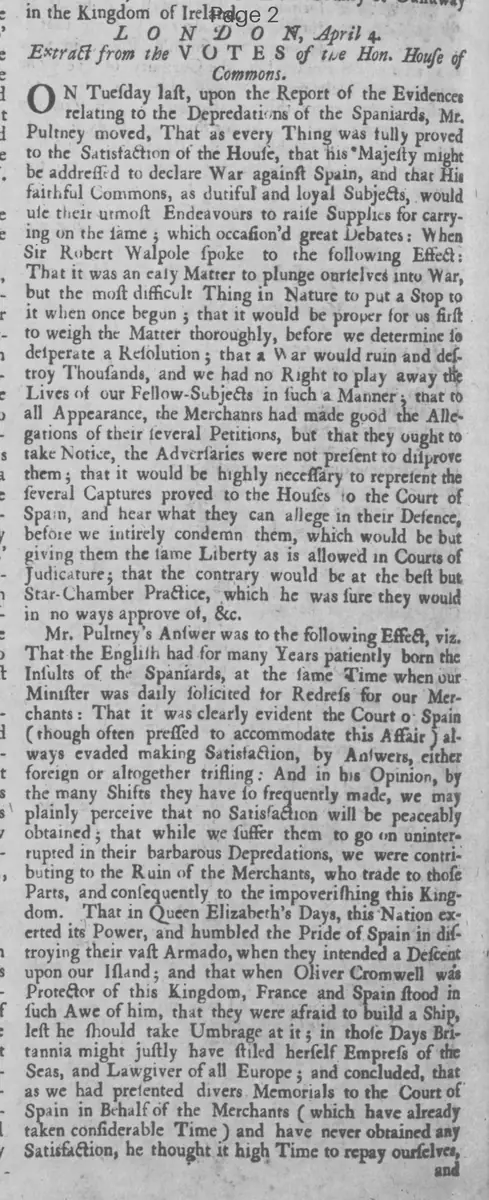
Extract from the VOTES of the Hon. House of Commons.
On Tuesday last, upon the Report of the Evidences relating to the Depredations of the Spaniards, Mr. Pulteney moved, That as every Thing was fully proved to the Satisfaction of the House, that his Majesty might be addressed to declare War against Spain, and that His faithful Commons, as dutiful and loyal Subjects, would use their utmost Endeavours to raise Supplies for carrying on the same; which occasion'd great Debates: When Sir Robert Walpole spoke to the following Effect:
That it was an easy Matter to plunge ourselves into War, but the most difficult Thing in Nature to put a Stop to it when once begun; that it would be proper for us first to weigh the Matter thoroughly, before we determine so desperate a Resolution; that a War would ruin and destroy Thousands, and we had no Right to play away the Lives of our Fellow-Subjects in such a Manner; that to all Appearance, the Merchants had made good the Allegations of their several Petitions, but that they ought to take Notice, the Adversaries were not present to disprove them; that it would be highly necessary to represent the several Captures proved to the Houses of the Court of Spain, and hear what they can allege in their Defence, before we entirely condemn them, which would be but giving them the same Liberty as is allowed in Courts of Judicature; that the contrary would be at the best but Star-Chamber Practice, which he was sure they would in no ways approve of, &c.
Mr. Pulteney's Answer was to the following Effect, viz.
That the English had for many Years patiently born the Insults of the Spaniards, at the same Time when our Minister was daily sollicited for Redress for our Merchants: That it was clearly evident the Court of Spain (though often pressed to accommodate this Affair) always evaded making Satisfaction, by Answers, either foreign or altogether trifling: And in his Opinion, by the many Shifts they have so frequently made, we may plainly perceive that no Satisfaction will be peaceably obtained; that while we suffer them to go on uninterrupted in their barbarous Depredations, we were contributing to the Ruin of the Merchants, who trade to those Parts, and consequently to the impoverishing this Kingdom. That in Queen Elizabeth's Days, this Nation exerted its Power, and humbled the Pride of Spain in destroying their vast Armada, when they intended a Descent upon our Island; and that when Oliver Cromwell was Protector of this Kingdom, France and Spain stood in such Awe of him, that they were afraid to build a Ship, lest he should take Umbrage at it; in those Days Britannia might justly have stiled herself Empress of the Seas, and Lawgiver of all Europe: and concluded, that as we had presented divers Memorials to the Court of Spain in Behalf of the Merchants (which have already taken considerable Time) and have never obtained any Satisfaction, he thought it high Time to repay ourselves, and to punish that Nation for the many repeated Injuries we have often received from them. Mr. Sandys, Mr. Wortley, Sir John Aubyn, &c. spoke to the same Effect.
Sir William Young reply'd to Mr. Pulteney, to the following Effect: That we ought not to be too rash in determining War against the Spaniards, for that upon Inquiry it might be proved to the Satisfaction of the House, that several of those Ships were forfeited to the King of Spain, as being Laden with Contraband Goods; and that he had been informed, that the English Merchants had made Prizes of some Spanish Ships, and Complaint made to our Court on the Account. That we should first consider the Situation our Merchants were in with the Spaniards, before we declare War against them; that, provided the Spaniards were not our Debtors, or that our Merchants had Equivalent in their Hands, the Property would be much altered. But at this Time the Spaniards were in Possession of our Merchants Effects to the Value of Five Millions Sterling, when perhaps they have not the Value of One Million in their own Hands. That the subsequent Consequences of a War would be, that the Spaniards would keep our Merchants Effects in their Hands, and not part with them 'till Necessity obliges them to it. That in the mean while the War was carrying on, our Merchants would be in the utmost Distress for their Effects, especially as their Affairs would remain but in a bad Situation, since they cou'd not possibly trade with Safety, &c. Upon Which the Question put, that His Majesty be address'd for a War, which pass'd in the Negative, Ayes, 209, Noes, 256.
This Day the Commons went with an Address to his Majesty to use his utmost Endeavours with the King of Spain, to obtain Satisfaction for the Losses sustained by the British Merchants, &c. His Majesty's Answer to the said Address, we gave in the Gazette No. 102.
What sub-type of article is it?
What keywords are associated?
What entities or persons were involved?
Where did it happen?
Foreign News Details
Primary Location
Spain
Event Date
April 4
Key Persons
Outcome
motion to address his majesty for declaration of war against spain defeated, ayes 209, noes 256. address made to his majesty to seek satisfaction from king of spain for british merchants' losses valued at five millions sterling.
Event Details
In the House of Commons, debate on Spanish depredations on British merchants' ships. Mr. Pulteney moved for address to king for war declaration, citing historical precedents and failed diplomatic efforts. Sir Robert Walpole urged caution and further representation to Spanish court. Sir William Young highlighted merchants' vulnerable position with effects held by Spaniards. Motion failed; alternative address for diplomatic endeavors passed.