Thank you for visiting SNEWPapers!
Sign up free
Literary
May 26, 1830
Morning Star
Limerick, York County, Maine
What is this article about?
A biblical essay contrasting the Christian spiritual race, where all faithful obtain an incorruptible crown, with ancient Isthmian and Olympic games where only one victor receives a perishable prize. Emphasizes discipline, perseverance, and certainty of reward for Christians.
Clipping
OCR Quality
98%
Excellent
Full Text
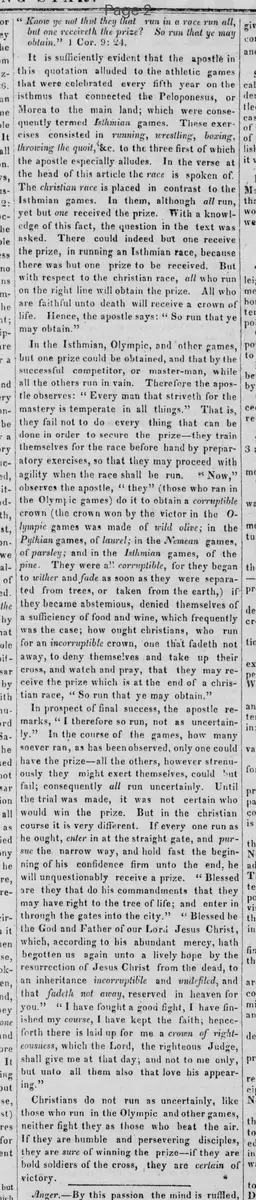
"Know ye not that they that run in a race run all, but one receiveth the prize? So run that ye may obtain." 1 Cor. 9:24.
It is sufficiently evident that the apostle in this quotation alluded to the athletic games that were celebrated every fifth year on the isthmus that connected the Peloponesus, or Morea to the main land; which were consequently termed Isthmian games. These exercises consisted in running, wrestling, boxing, throwing the quoit, &c. to the three first of which the apostle especially alludes. In the verse at the head of this article the race is spoken of. The Christian race is placed in contrast to the Isthmian games. In them, although all run, yet but one received the prize. With a knowledge of this fact, the question in the text was asked. There could indeed but one receive the prize, in running an Isthmian race, because there was but one prize to be received. But with respect to the Christian race, all who run on the right line will obtain the prize. All who are faithful unto death will receive a crown of life. Hence, the apostle says: "So run that ye may obtain."
In the Isthmian, Olympic, and other games, but one prize could be obtained, and that by the successful competitor, or master-man, while all the others run in vain. Therefore the apostle observes: "Every man that striveth for the mastery is temperate in all things." That is, they fail not to do every thing that can be done in order to secure the prize—they train themselves for the race before hand by preparatory exercises, so that they may proceed with agility when the race shall be run. "Now," observes the apostle, "they" (those who ran in the Olympic games) "do it to obtain a corruptible crown" (the crown won by the victor in the Olympic games was made of wild olive; in the Pythian games, of laurel; in the Nemean games, of parsley; and in the Isthmian games, of the pine. They were all corruptible, for they began to wither and fade as soon as they were separated from trees, or taken from the earth,) if they became abstemious, denied themselves of a sufficiency of food and wine, which frequently was the case; how ought Christians, who run for an incorruptible crown, one that fadeth not away, to deny themselves and take up their cross, and watch and pray, that they may receive the prize which is at the end of a Christian race, "So run that ye may obtain."
In prospect of final success, the apostle remarks, "I therefore so run, not as uncertainly." In the course of the games, how many soever ran, as has been observed, only one could have the prize—all the others, however strenuously they might exert themselves, could but fail; consequently all run uncertainly. Until the trial was made, it was not certain who would win the prize. But in the Christian course it is very different. If every one run as he ought, enter in at the straight gate, and pursue the narrow way, and hold fast the beginning of his confidence firm unto the end, he will unquestionably receive a prize. "Blessed are they that do his commandments that they may have right to the tree of life; and enter in through the gates into the city." "Blessed be the God and Father of our Lord Jesus Christ, which, according to his abundant mercy, hath begotten us again unto a lively hope by the resurrection of Jesus Christ from the dead, to an inheritance incorruptible and undefiled, and that fadeth not away, reserved in heaven for you." "I have fought a good fight, I have finished my course, I have kept the faith; henceforth there is laid up for me a crown of righteousness, which the Lord, the righteous Judge, shall give me at that day; and not to me only, but unto all them also that love his appearing."
Christians do not run as uncertainly, like those who run in the Olympic and other games, neither fight they as those who beat the air. If they are humble and persevering disciples, they are sure of winning the prize—if they are bold soldiers of the cross, they are certain of victory.
It is sufficiently evident that the apostle in this quotation alluded to the athletic games that were celebrated every fifth year on the isthmus that connected the Peloponesus, or Morea to the main land; which were consequently termed Isthmian games. These exercises consisted in running, wrestling, boxing, throwing the quoit, &c. to the three first of which the apostle especially alludes. In the verse at the head of this article the race is spoken of. The Christian race is placed in contrast to the Isthmian games. In them, although all run, yet but one received the prize. With a knowledge of this fact, the question in the text was asked. There could indeed but one receive the prize, in running an Isthmian race, because there was but one prize to be received. But with respect to the Christian race, all who run on the right line will obtain the prize. All who are faithful unto death will receive a crown of life. Hence, the apostle says: "So run that ye may obtain."
In the Isthmian, Olympic, and other games, but one prize could be obtained, and that by the successful competitor, or master-man, while all the others run in vain. Therefore the apostle observes: "Every man that striveth for the mastery is temperate in all things." That is, they fail not to do every thing that can be done in order to secure the prize—they train themselves for the race before hand by preparatory exercises, so that they may proceed with agility when the race shall be run. "Now," observes the apostle, "they" (those who ran in the Olympic games) "do it to obtain a corruptible crown" (the crown won by the victor in the Olympic games was made of wild olive; in the Pythian games, of laurel; in the Nemean games, of parsley; and in the Isthmian games, of the pine. They were all corruptible, for they began to wither and fade as soon as they were separated from trees, or taken from the earth,) if they became abstemious, denied themselves of a sufficiency of food and wine, which frequently was the case; how ought Christians, who run for an incorruptible crown, one that fadeth not away, to deny themselves and take up their cross, and watch and pray, that they may receive the prize which is at the end of a Christian race, "So run that ye may obtain."
In prospect of final success, the apostle remarks, "I therefore so run, not as uncertainly." In the course of the games, how many soever ran, as has been observed, only one could have the prize—all the others, however strenuously they might exert themselves, could but fail; consequently all run uncertainly. Until the trial was made, it was not certain who would win the prize. But in the Christian course it is very different. If every one run as he ought, enter in at the straight gate, and pursue the narrow way, and hold fast the beginning of his confidence firm unto the end, he will unquestionably receive a prize. "Blessed are they that do his commandments that they may have right to the tree of life; and enter in through the gates into the city." "Blessed be the God and Father of our Lord Jesus Christ, which, according to his abundant mercy, hath begotten us again unto a lively hope by the resurrection of Jesus Christ from the dead, to an inheritance incorruptible and undefiled, and that fadeth not away, reserved in heaven for you." "I have fought a good fight, I have finished my course, I have kept the faith; henceforth there is laid up for me a crown of righteousness, which the Lord, the righteous Judge, shall give me at that day; and not to me only, but unto all them also that love his appearing."
Christians do not run as uncertainly, like those who run in the Olympic and other games, neither fight they as those who beat the air. If they are humble and persevering disciples, they are sure of winning the prize—if they are bold soldiers of the cross, they are certain of victory.
What sub-type of article is it?
Essay
What themes does it cover?
Religious
Moral Virtue
What keywords are associated?
Christian Race
Isthmian Games
Olympic Games
Incorruptible Crown
Moral Discipline
Biblical Metaphor
Spiritual Perseverance
Literary Details
Subject
On 1 Corinthians 9:24 And The Christian Race
Key Lines
"Know Ye Not That They That Run In A Race Run All, But One Receiveth The Prize? So Run That Ye May Obtain." 1 Cor. 9:24.
"So Run That Ye May Obtain."
"I Therefore So Run, Not As Uncertainly."
"I Have Fought A Good Fight, I Have Finished My Course, I Have Kept The Faith; Henceforth There Is Laid Up For Me A Crown Of Righteousness..."