Thank you for visiting SNEWPapers!
Sign up free
Story
May 4, 1867
Sunbury American
Sunbury, Northumberland County, Pennsylvania
What is this article about?
Detailed description of bee colony structure, including the roles, characteristics, and behaviors of drones, queens, and worker bees, highlighting their industry as a model for humans.
Clipping
OCR Quality
95%
Excellent
Full Text
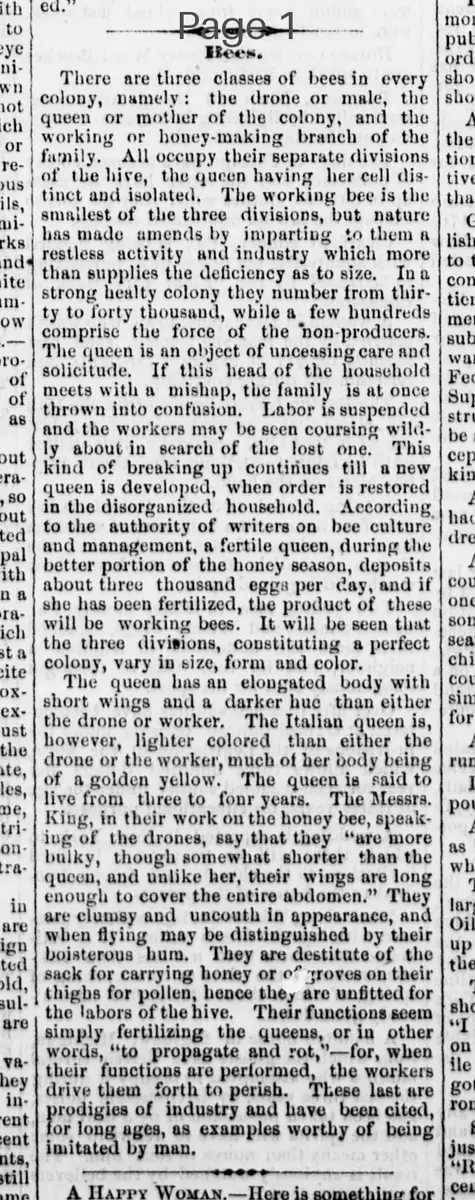
Bees.
There are three classes of bees in every colony, namely: the drone or male, the queen or mother of the colony, and the working or honey-making branch of the family. All occupy their separate divisions of the hive, the queen having her cell distinct and isolated. The working bee is the smallest of the three divisions, but nature has made amends by imparting to them a restless activity and industry which more than supplies the deficiency as to size. In a strong healthy colony they number from thirty to forty thousand, while a few hundreds comprise the force of the non-producers.
The queen is an object of unceasing care and solicitude. If this head of the household meets with a mishap, the family is at once thrown into confusion. Labor is suspended and the workers may be seen coursing wildly about in search of the lost one. This kind of breaking up continues till a new queen is developed, when order is restored in the disorganized household. According to the authority of writers on bee culture and management, a fertile queen, during the better portion of the honey season, deposits about three thousand eggs per day, and if she has been fertilized, the product of these will be working bees. It will be seen that the three divisions, constituting a perfect colony, vary in size, form and color.
The queen has an elongated body with short wings and a darker hue than either the drone or worker. The Italian queen is, however, lighter colored than either the drone or the worker, much of her body being of a golden yellow. The queen is said to live from three to four years. The Messrs. King, in their work on the honey bee, speaking of the drones, say that they "are more bulky, though somewhat shorter than the queen, and unlike her, their wings are long enough to cover the entire abdomen." They are clumsy and uncouth in appearance, and when flying may be distinguished by their boisterous hum. They are destitute of the sack for carrying honey or grooves on their thighs for pollen, hence they are unfitted for the labors of the hive. Their functions seem simply fertilizing the queens, or in other words, "to propagate and rot,"—for, when their functions are performed, the workers drive them forth to perish. These last are prodigies of industry and have been cited, for long ages, as examples worthy of being imitated by man.
There are three classes of bees in every colony, namely: the drone or male, the queen or mother of the colony, and the working or honey-making branch of the family. All occupy their separate divisions of the hive, the queen having her cell distinct and isolated. The working bee is the smallest of the three divisions, but nature has made amends by imparting to them a restless activity and industry which more than supplies the deficiency as to size. In a strong healthy colony they number from thirty to forty thousand, while a few hundreds comprise the force of the non-producers.
The queen is an object of unceasing care and solicitude. If this head of the household meets with a mishap, the family is at once thrown into confusion. Labor is suspended and the workers may be seen coursing wildly about in search of the lost one. This kind of breaking up continues till a new queen is developed, when order is restored in the disorganized household. According to the authority of writers on bee culture and management, a fertile queen, during the better portion of the honey season, deposits about three thousand eggs per day, and if she has been fertilized, the product of these will be working bees. It will be seen that the three divisions, constituting a perfect colony, vary in size, form and color.
The queen has an elongated body with short wings and a darker hue than either the drone or worker. The Italian queen is, however, lighter colored than either the drone or the worker, much of her body being of a golden yellow. The queen is said to live from three to four years. The Messrs. King, in their work on the honey bee, speaking of the drones, say that they "are more bulky, though somewhat shorter than the queen, and unlike her, their wings are long enough to cover the entire abdomen." They are clumsy and uncouth in appearance, and when flying may be distinguished by their boisterous hum. They are destitute of the sack for carrying honey or grooves on their thighs for pollen, hence they are unfitted for the labors of the hive. Their functions seem simply fertilizing the queens, or in other words, "to propagate and rot,"—for, when their functions are performed, the workers drive them forth to perish. These last are prodigies of industry and have been cited, for long ages, as examples worthy of being imitated by man.
What sub-type of article is it?
Animal Story
Curiosity
What themes does it cover?
Nature
Moral Virtue
What keywords are associated?
Bee Colony
Queen Bee
Worker Bees
Drones
Honey Production
Bee Industry
What entities or persons were involved?
Queen Bee
Drones
Worker Bees
Where did it happen?
Bee Hive
Story Details
Key Persons
Queen Bee
Drones
Worker Bees
Location
Bee Hive
Story Details
Description of the three classes of bees in a colony: drones (males for fertilization), queen (egg-layer and leader), and workers (small but industrious honey-makers). Details their physical differences, behaviors, and the workers' role as models of industry.