Thank you for visiting SNEWPapers!
Sign up free
Story
December 12, 1904
The Jersey City News
Jersey City, Hudson County, New Jersey
What is this article about?
Historical overview of godparents' origins in Jewish tradition, early Christian use, regulations in 13th-century England, and literary references in Shakespeare, including name changes at confirmation.
Clipping
OCR Quality
95%
Excellent
Full Text
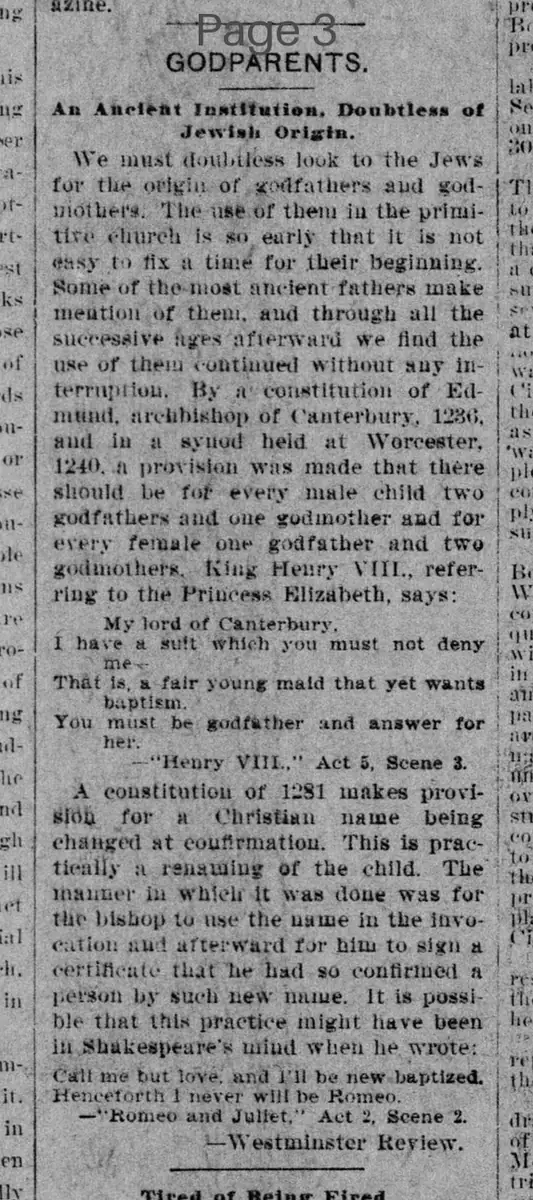
GODPARENTS.
An Ancient Institution, Doubtless of
Jewish Origin.
We Must Doubtless Look to the Jews
for the Origin of Godfathers and God-
mothers. The Use of Them in the Primi-
tive Church Is So Early That It Is Not
Easy to Fix a Time for Their Beginning.
Some of the Most Ancient Fathers Make
Mention of Them, and Through All the
Successive Ages Afterward We Find the
Use of Them Continued Without Any In-
terruption. By a Constitution of Ed-
Mund, Archbishop of Canterbury, 1236,
and in a Synod Held at Worcester,
1240, a Provision Was Made That There
Should Be for Every Male Child Two
Godfathers and One Godmother and for
Every Female One Godfather and Two
Godmothers. King Henry VIII., Refer-
ring to the Princess Elizabeth, Says:
"My Lord of Canterbury,
I Have a Suit Which You Must Not Deny
Me
That Is, a Fair Young Maid That Yet Wants
Baptism.
You Must Be Godfather and Answer for
Her."
—Henry VIII., Act 5, Scene 3.
A Constitution of 1281 Makes Provi-
sion for a Christian Name Being
Changed at Confirmation. This Is Prac-
tically a Renaming of the Child. The
Manner in Which It Was Done Was for
the Bishop to Use the Name in the Invo-
cation and Afterward for Him to Sign a
Certificate That He Had So Confirmed a
Person by Such New Name. It Is Possi-
bble That This Practice Might Have Been
in Shakespeare's Mind When He Wrote:
"Call Me but Love, and I'll Be New Baptized.
Henceforth I Never Will Be Romeo."
—Romeo and Juliet, Act 2, Scene 2.
—Westminster Review.
An Ancient Institution, Doubtless of
Jewish Origin.
We Must Doubtless Look to the Jews
for the Origin of Godfathers and God-
mothers. The Use of Them in the Primi-
tive Church Is So Early That It Is Not
Easy to Fix a Time for Their Beginning.
Some of the Most Ancient Fathers Make
Mention of Them, and Through All the
Successive Ages Afterward We Find the
Use of Them Continued Without Any In-
terruption. By a Constitution of Ed-
Mund, Archbishop of Canterbury, 1236,
and in a Synod Held at Worcester,
1240, a Provision Was Made That There
Should Be for Every Male Child Two
Godfathers and One Godmother and for
Every Female One Godfather and Two
Godmothers. King Henry VIII., Refer-
ring to the Princess Elizabeth, Says:
"My Lord of Canterbury,
I Have a Suit Which You Must Not Deny
Me
That Is, a Fair Young Maid That Yet Wants
Baptism.
You Must Be Godfather and Answer for
Her."
—Henry VIII., Act 5, Scene 3.
A Constitution of 1281 Makes Provi-
sion for a Christian Name Being
Changed at Confirmation. This Is Prac-
tically a Renaming of the Child. The
Manner in Which It Was Done Was for
the Bishop to Use the Name in the Invo-
cation and Afterward for Him to Sign a
Certificate That He Had So Confirmed a
Person by Such New Name. It Is Possi-
bble That This Practice Might Have Been
in Shakespeare's Mind When He Wrote:
"Call Me but Love, and I'll Be New Baptized.
Henceforth I Never Will Be Romeo."
—Romeo and Juliet, Act 2, Scene 2.
—Westminster Review.
What sub-type of article is it?
Historical Event
Curiosity
What themes does it cover?
Family
Providence Divine
What keywords are associated?
Godparents
Jewish Origin
Primitive Church
Archbishop Edmund
Henry Viii
Shakespeare Reference
Confirmation Name Change
What entities or persons were involved?
Edmund, Archbishop Of Canterbury
King Henry Viii
Shakespeare
Where did it happen?
England
Story Details
Key Persons
Edmund, Archbishop Of Canterbury
King Henry Viii
Shakespeare
Location
England
Event Date
1236 1281
Story Details
Explores Jewish origins of godparents, early Christian adoption, 13th-century English regulations on godparent numbers, Henry VIII's request for godfather role, and confirmation name changes referenced in Shakespeare.