Thank you for visiting SNEWPapers!
Sign up free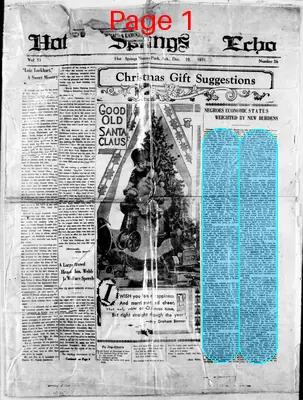
Hot Springs Echo
Hot Springs, Garland County, Arkansas
What is this article about?
During the industrial depression, African Americans face intensified economic threats through job discrimination in private and public enterprises nationwide. Key examples include exclusion from Boulder Dam project in Nevada despite efforts by leaders like Walter W. Hamilton, exploitative peonage on another government project, and mechanization displacing cotton pickers in the South.
Clipping
OCR Quality
Full Text
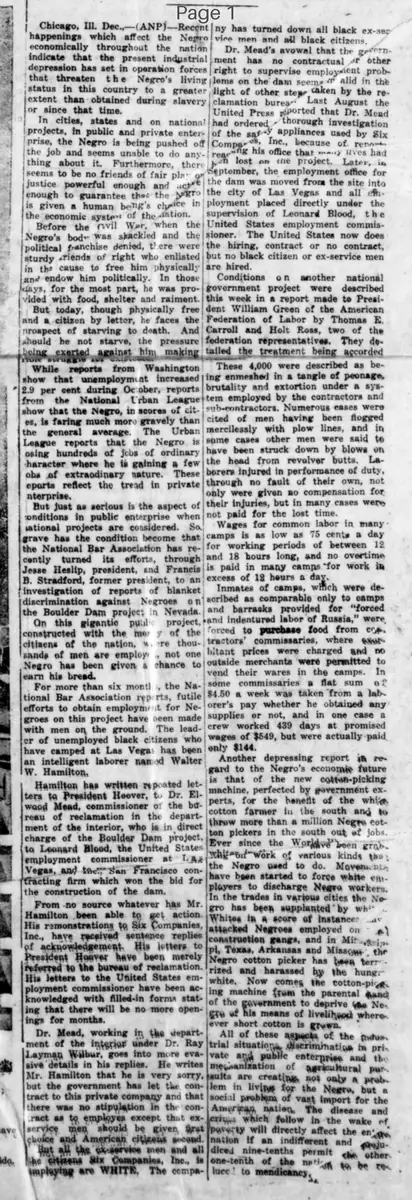
In cities, states and on national projects, in public and private enterprise, the Negro is being pushed off the job and seems unable to do anything about it. Furthermore, there seems to be no friends of fair play justice powerful enough and active enough to guarantee that the Negro is given a human being's chance in the economic system of the nation.
Before the Civil War, when the Negro's body was shackled and the political franchise denied, there were sturdy friends of right who enlisted in the cause to free him physically and endow him politically. In those days, for the most part, he was provided with food, shelter and raiment. But today, though physically free and a citizen by letter, he faces the prospect of starving to death. And should he not starve, the pressure being exerted against him making
While reports from Washington show that unemployment increased 2.9 per cent during October, reports from the National Urban League show that the Negro, in scores of cities, is faring much more gravely than the general average. The Urban League reports that the Negro is losing hundreds of jobs of ordinary character where he is gaining a few jobs of extraordinary nature. These reports reflect the trend in private enterprise.
But just as serious is the aspect of conditions in public enterprise when national projects are considered. So grave has the condition become that the National Bar Association has recently turned its efforts, through Jesse Heslip, president, and Francis B. Stradford, former president, to an investigation of reports of blanket discrimination against Negroes on the Boulder Dam project in Nevada.
On this gigantic public project, constructed with the money of the citizens of the nation, where thousands of men are employed, not one Negro has been given a chance to earn his bread.
For more than six months the National Bar Association reports, futile efforts to obtain employment for Negroes on this project have been made with men on the ground. The leader of unemployed black citizens who have camped at Las Vegas has been an intelligent laborer named Walter W. Hamilton.
Hamilton has written repeated letters to President Hoover, to Dr. Elwood Mead, commissioner of the bureau of reclamation in the department of the interior, who is in direct charge of the Boulder Dam project, to Leonard Blood, the United States employment commissioner at Las Vegas, and to the San Francisco contracting firm which won the bid for the construction of the dam.
From no source whatever has Mr. Hamilton been able to get action. His remonstrations to Six Companies, Inc., have received perfunctory replies of acknowledgement. His letters to President Hoover have been merely referred to the bureau of reclamation. His letters to the United States employment commissioner have been acknowledged with filled-in forms stating that there will be no more openings for months.
Dr. Mead, working in the department of the interior under Dr. Ray Lyman Wilbur, goes into more evasive details in his replies. He writes Mr. Hamilton that he is very sorry, but the government has let the contract to this private company and that there was no stipulation in the contract as to employees except that ex-service men should be given first choice and American citizens second. The Citizens Six Companies, Inc., is employing are WHITE. The company has turned down all black ex-service men and all black citizens.
Dr. Mead's avowal that the government has no contractual or other right to supervise employment problems on the dam seems valid in the light of other steps taken by the reclamation bureau. Last August the United Press reported that Dr. Mead had ordered thorough investigation of the safety appliances used by Six Companies, Inc., because of reports reaching his office that many lives had been lost on the project. Later, in September, the employment office for the dam was moved from the site into the city of Las Vegas and all employment placed directly under the supervision of Leonard Blood, the United States employment commissioner. The United States now does the hiring, contract or no contract, but no black citizen or ex-service men are hired.
Conditions on another national government project were described this week in a report made to President William Green of the American Federation of Labor by Thomas E. Carroll and Holt Ross, two of the federation representatives. They detailed the treatment being accorded These 4,000 were described as being enmeshed in a tangle of peonage, brutality and extortion under a system employed by the contractors and sub-contractors. Numerous cases were cited of men having been flogged mercilessly with plow lines, and in some cases other men were said to have been struck down by blows on the head from revolver butts. Laborers injured in performance of duty, through no fault of their own, not only were given no compensation for their injuries, but in many cases were not paid for the lost time.
Wages for common labor in many camps is as low as 75 cents a day for working periods of between 12 and 18 hours long, and no overtime is paid in many camps for work in excess of 18 hours a day.
Inmates of camps, which were described as comparable only to camps and barracks provided for "forced and indentured labor of Russia," were forced to purchase food from contractors' commissaries, where exorbitant prices were charged and no outside merchants were permitted to vend their wares in the camps. In some commissaries a flat sum of $4.50 a week was taken from a laborer's pay whether he obtained any supplies or not, and in one case a crew worked 439 days at promised wages of $549, but were actually paid only $144.
Another depressing report in regard to the Negro's economic future is that of the new cotton-picking machine, perfected by government experts, for the benefit of the white cotton farmer in the south and to throw more than a million Negro cotton pickers in the south out of jobs.
Ever since the work has been gradually taken over by whites on work of various kinds that the Negro used to do. Movements have been started to force white employers to discharge Negro workers. In the trades in various cities the Negro has been supplanted by whites in a score of instances av attacked Negroes employed on construction gangs, and in Mississippi, Texas, Arkansas and Missouri the Negro cotton picker has been terrorized and harassed by the hungry white. Now comes the cotton-picking machine from the parental arch of the government to deprive the Negro of his means of livelihood wherever short cotton is grown.
All of these aspects of the industrial situation, discrimination in private and public enterprise and the mechanization of agricultural pursuits are creating, not only a problem in living for the Negro, but a social problem of vast import for the American nation. The disease and crime which follow in the wake of poverty will directly affect the entire nation if an indifferent and prejudiced nine-tenths permit the other one-tenth of the nation to be reduced to mendicancy.
What sub-type of article is it?
What themes does it cover?
What keywords are associated?
What entities or persons were involved?
Where did it happen?
Story Details
Key Persons
Location
United States, Boulder Dam Project In Nevada, Las Vegas, Southern States
Event Date
December (During The Industrial Depression, Referencing October Unemployment Increase)
Story Details
The article reports on the severe economic discrimination against African Americans amid the industrial depression, including job losses in private sectors, total exclusion of Negroes from employment on the Boulder Dam project despite advocacy efforts, brutal peonage and exploitation on another national government project involving 4,000 workers, and the introduction of a cotton-picking machine threatening over a million Negro jobs in the South.