Thank you for visiting SNEWPapers!
Sign up free
Story
October 5, 1901
The Providence News
Providence, Providence County, Rhode Island
What is this article about?
A remarkable surge in demand for children's sandals in London and seaside resorts has halted ordinary boot sales, overwhelming adaptable manufacturers. Surgeon Mr. T. W. Nunn endorses the design for foot health benefits.
Clipping
OCR Quality
98%
Excellent
Full Text
A Sandal Fad.
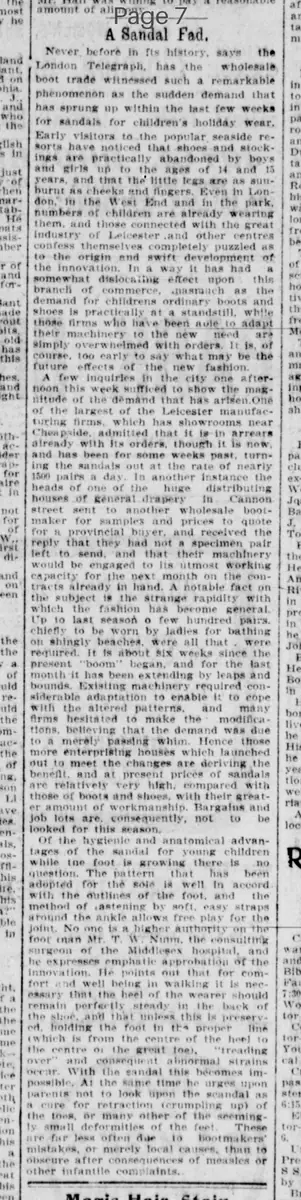
Never before in its history, says the London Telegraph, has the wholesale boot trade witnessed such a remarkable phenomenon as the sudden demand that has sprung up within the last few weeks for sandals for children's holiday wear. Early visitors to the popular seaside resorts have noticed that shoes and stockings are practically abandoned by boys and girls up to the ages of 14 and 15 years, and that the little legs are as sunburnt as cheeks and fingers. Even in London, in the West End and in the park, numbers of children are already wearing them, and those connected with the great industry of Leicester and other centres confess themselves completely puzzled as to the origin and swift development of the innovation. In a way it has had a somewhat dislocating effect upon this branch of commerce, inasmuch as the demand for childrens ordinary boots and shoes is practically at a standstill, while those firms who have been able to adapt their machinery to the new need are simply overwhelmed with orders. It is, of course, too early to say what may be the future effects of the new fashion.
A few inquiries in the city one afternoon this week sufficed to show the magnitude of the demand that has arisen. One of the largest of the Leicester manufacturing firms, which has showrooms near Cheapside, admitted that it is in arrears already with its orders, though it is now, and has been for some weeks past, turning the sandals out at the rate of nearly 1500 pairs a day. In another instance the heads of one of the huge distributing houses of general drapery in Cannon street sent to another wholesale boot-maker for samples and prices to quote for a provincial buyer, and received the reply that they had not a specimen pair left to send, and that their machinery would be engaged to its utmost working capacity for the next month on the contracts already in hand. A notable fact on the subject is the strange rapidity with which the fashion has become general. Up to last season a few hundred pairs, chiefly to be worn by ladies for bathing on shingly beaches, were all that were required. It is about six weeks since the present "boom" began, and for the last month it has been extending by leaps and bounds. Existing machinery required considerable adaptation to enable it to cope with the altered patterns, and many firms hesitated to make the modifications, believing that the demand was due to a merely passing whim. Hence those more enterprising houses which launched out to meet the changes are deriving the benefit, and at present prices of sandals are relatively very high, compared with those of boots and shoes, with their greater amount of workmanship. Bargains and job lots are, consequently, not to be looked for this season.
Of the hygienic and anatomical advantages of the sandal for young children while the foot is growing there is no question. The pattern that has been adopted for the sole is well in accord with the outlines of the foot, and the method of fastening by soft, easy straps around the ankle allows free play for the joint. No one is a higher authority on the foot than Mr. T. W. Nunn, the consulting surgeon of the Middlesex hospital, and he expresses emphatic approbation of the innovation. He points out that for comfort and well being in walking it is necessary that the heel of the wearer should remain perfectly steady in the back of the shoe, and that unless this is preserved, holding the foot in the proper line (which is from the centre of the heel to the centre of the great toe), "treading over" and consequent abnormal strains occur. With the sandal this becomes impossible. At the same time he urges upon parents not to look upon the sandal as a cure for retraction (crumpling up) of the toes, or many other of the seemingly small deformities of the feet. These are far less often due to bootmakers mistakes, or merely local causes, than to obscure after consequences of measles or other infantile complaints.
Never before in its history, says the London Telegraph, has the wholesale boot trade witnessed such a remarkable phenomenon as the sudden demand that has sprung up within the last few weeks for sandals for children's holiday wear. Early visitors to the popular seaside resorts have noticed that shoes and stockings are practically abandoned by boys and girls up to the ages of 14 and 15 years, and that the little legs are as sunburnt as cheeks and fingers. Even in London, in the West End and in the park, numbers of children are already wearing them, and those connected with the great industry of Leicester and other centres confess themselves completely puzzled as to the origin and swift development of the innovation. In a way it has had a somewhat dislocating effect upon this branch of commerce, inasmuch as the demand for childrens ordinary boots and shoes is practically at a standstill, while those firms who have been able to adapt their machinery to the new need are simply overwhelmed with orders. It is, of course, too early to say what may be the future effects of the new fashion.
A few inquiries in the city one afternoon this week sufficed to show the magnitude of the demand that has arisen. One of the largest of the Leicester manufacturing firms, which has showrooms near Cheapside, admitted that it is in arrears already with its orders, though it is now, and has been for some weeks past, turning the sandals out at the rate of nearly 1500 pairs a day. In another instance the heads of one of the huge distributing houses of general drapery in Cannon street sent to another wholesale boot-maker for samples and prices to quote for a provincial buyer, and received the reply that they had not a specimen pair left to send, and that their machinery would be engaged to its utmost working capacity for the next month on the contracts already in hand. A notable fact on the subject is the strange rapidity with which the fashion has become general. Up to last season a few hundred pairs, chiefly to be worn by ladies for bathing on shingly beaches, were all that were required. It is about six weeks since the present "boom" began, and for the last month it has been extending by leaps and bounds. Existing machinery required considerable adaptation to enable it to cope with the altered patterns, and many firms hesitated to make the modifications, believing that the demand was due to a merely passing whim. Hence those more enterprising houses which launched out to meet the changes are deriving the benefit, and at present prices of sandals are relatively very high, compared with those of boots and shoes, with their greater amount of workmanship. Bargains and job lots are, consequently, not to be looked for this season.
Of the hygienic and anatomical advantages of the sandal for young children while the foot is growing there is no question. The pattern that has been adopted for the sole is well in accord with the outlines of the foot, and the method of fastening by soft, easy straps around the ankle allows free play for the joint. No one is a higher authority on the foot than Mr. T. W. Nunn, the consulting surgeon of the Middlesex hospital, and he expresses emphatic approbation of the innovation. He points out that for comfort and well being in walking it is necessary that the heel of the wearer should remain perfectly steady in the back of the shoe, and that unless this is preserved, holding the foot in the proper line (which is from the centre of the heel to the centre of the great toe), "treading over" and consequent abnormal strains occur. With the sandal this becomes impossible. At the same time he urges upon parents not to look upon the sandal as a cure for retraction (crumpling up) of the toes, or many other of the seemingly small deformities of the feet. These are far less often due to bootmakers mistakes, or merely local causes, than to obscure after consequences of measles or other infantile complaints.
What sub-type of article is it?
Curiosity
What themes does it cover?
Social Manners
What keywords are associated?
Sandal Fad
Children's Footwear
Boot Trade Boom
Leicester Manufacturers
Hygienic Advantages
Foot Health
What entities or persons were involved?
Mr. T. W. Nunn
Where did it happen?
London, Leicester, Seaside Resorts
Story Details
Key Persons
Mr. T. W. Nunn
Location
London, Leicester, Seaside Resorts
Event Date
Last Few Weeks
Story Details
Sudden demand for children's sandals for holiday wear disrupts boot trade, overwhelms manufacturers in Leicester; expert approves hygienic benefits for growing feet.