Thank you for visiting SNEWPapers!
Sign up free
Story
April 4, 1872
Mineral Point Tribune
Mineral Point, Iowa County, Wisconsin
What is this article about?
In Daiby town, lawyer Jerry sees the ghost of Dr. Atwick after his accidental death, who guides him to break the news to his wife and later warns of a suicide, but fails to prevent Miss Atwick's death by prussic acid. (187 characters)
Clipping
OCR Quality
95%
Excellent
Full Text
A REAL GHOST STORY.
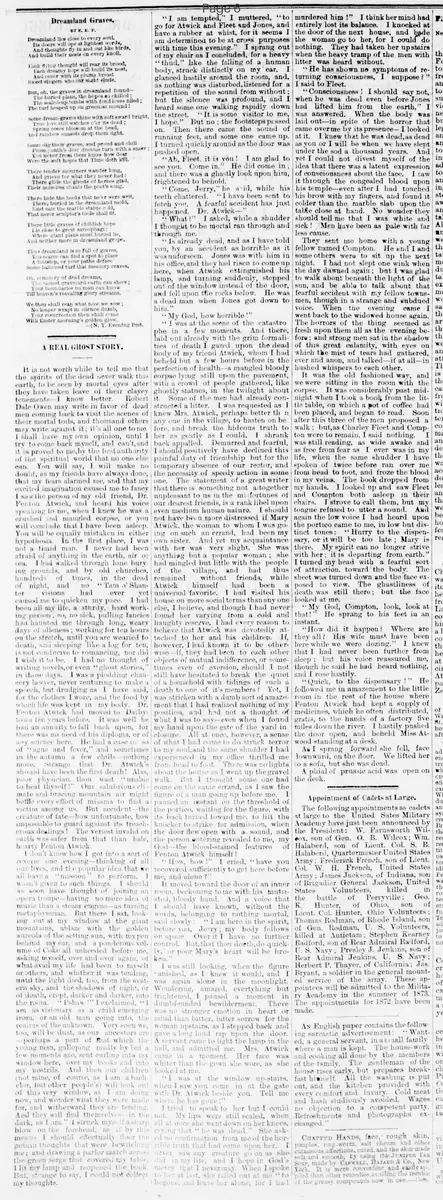
It is not worth while to tell me that the spirits of the dead never walk this earth, to be seen by mortal eyes after they have taken leave of their clayey tenements-I know better. Robert Dale Owen may write in favor of dead men coming back to visit the scenes of their mortal toils, and thousand others may write against it; it's all one to me. I shall have my own opinion, until I try to come back myself, and can't, and it is proved to me, by the best authority of the spiritual world that no one else can. You will say, I will make no doubt, as my friends have always done, that my fears alarmed me, and that my excited imagination caused me to fancy I saw the person of my old friend, Dr. Fenton Atwick, and heard his voice speaking to me, when I knew he was a crushed and mangled corpse, or you will conclude that I have been asleep. You will be equally mistaken in either hypothesis. In the first place, I was not a timid man. I never had been afraid of anything in the earth, air or sea. I had walked through lone burying grounds, and by old churches, hundreds of times, in the dead of night, and no "Tam o'Shanter visions had ever yet caused me to quicken my pace. I had been all my life, a sturdy, hard working person; so, no sick, pulling fancies had haunted me through long, weary days of idleness; working for ten hours on the stretch, until you are wearied to death, and sleeping like a log for ten is not conducive to romancing, nor did I wish it to be. I had no thought of writing novels, or even "ghost stories." In those days, I was a plodding chancery lawyer, never venturing to make a speech, but drudging as I have said, for the clothes I wore, and the food by which life was kept in my body. Dr. Fenton Atwick had moved to Daiby town ten years before. It was well he had an annuity to fall back upon, for there was no need of his diploma, or of any science here. He had a case or so of "ague and fever," and sometimes in the autumn a few chills-nothing more. Strange that Dr. Atwick's should have been the first death! Alas, poor physician, thou wast "unable to heal thyself!" Our salubrious climate and bracing mountain air might baffle every effort of miasma to find a victim among us. But accident-the creature of fate-how unfortunate, how impossible to guard against its treacherous dealings! The veriest invalid on earth was safer from that than hale, hearty Fenton Atwick.
I don't know how I got into a sort of reverie one evening-thinking of all our lives, and the popular idea that we all have a "mission" to perform. I wasn't given to such things. I should as soon have thought of joining an opera troupe-having no more idea of music than a steam engine-as turning metaphysician. But there I sat, looking out at my window at the giant mountains, ablaze with the golden aureola of the setting sun, with my pen behind my ear, and a ponderous volume of Coke all unheeded before me, asking myself, over and over again, of what avail my life had been to myself or others, and whither it was tending, until the light died, too, from the western sky, and the shadows of night, or of death, crept, darker and darker, into the room. "Pshaw!" I exclaimed, "I am as visionary as a child emerging from, or an old man going into, the realms of the unknown. Very soon we, too, will be dust, as our ancestors are perhaps a part of that which the young man, galloping madly by but a few moments ago, sent curling into my window here, over my books and into my nostrils. And then our children (not mine, of course, as I am a bachelor, but other people's) will look out of this very window, as I am doing now, and wonder what they were made for, and whitherward they are tending. And they will find themselves in the dark, as I am." I struck myself a sharp blow on the forehead, as if by this means I should effectually throw the goblin thoughts that were bewitching me; and drawing a parlor match across the green serge that covered my table, I lit my lamp and reopened the book. But, strange to say, I could not collect my thoughts,
"I am tempted," I muttered, "to go for Atwick and Fleet and Jones, and have a rubber at whist, for it seems I am determined to be at cross purposes with time this evening." I sprang out of my chair as I concluded, for a heavy "thud," like the falling of a human body, struck distinctly on my ear. I glanced hastily around the room, and, as nothing was disturbed, listened for a repetition of the sound from without; but the silence was profound, and I heard some one walking rapidly down the street. "It is some visitor to me, I hope." But no; the footsteps passed on. Then there came the sound of running feet, and some one came up. I turned quickly around as the door was pushed open.
"Ah, Fleet, it is you! I am glad to see you. Come in." He did come in, and there was a ghastly look upon him, frightened to behold.
"Come, Jerry," he said, while his teeth chattered. "I have been sent to fetch you. A fearful accident has just happened. Dr. Atwick-"
"What?" I asked, while a shudder I thought to be mortal ran through and through me.
"Is already dead, and as I have told you, by an accident as horrible as it was unforeseen. Jones was with him in his office, and they had risen to come up here, when Atwick extinguished his lamp, and turning suddenly, stepped out of the window instead of the door, and fell upon the rocks below. He was a dead man when Jones got down to him."
"My God, how horrible!"
I was at the scene of the catastrophe in a few moments. And there lay out already with the grim formalities of death I gazed upon the dead body of my friend Atwick, whom I had beheld but a few hours before in the perfection of health-a mangled bloody corpse lying still upon the pavement, with a crowd of people gathered, like ghostly statues, in the twilight about it. Some of the men had already constructed a litter. I was requested as I knew Mrs. Atwick, perhaps better than any one in the village, to hasten on before, and break the hideous truth to her as gently as I could. I shrank back appalled. Demurred and fearful, I should positively have declined this painful duty of friendship but for the temporary absence of our rector, and the necessity of speedy action in some one. The statement of a great writer that there is something not altogether unpleasant to us in the misfortunes of our dearest friends, is a rank libel upon even medium human nature. I should not have been more distressed if Mary Atwick, the woman to whom I was going on such an errand, had been my own sister. And yet my acquaintance with her was very slight. She was anything but a popular woman; she had mingled but little with the people of the village, and had thus remained without friends, while Atwick himself had been a universal favorite. I had visited his house on more social terms than any one else, I believe, and though I had never found her varying from a cold and haughty reserve, I had every reason to believe that Atwick was devotedly attached to her and his children. If, however, I had known it to be otherwise if, they had been to each other objects of mutual indifference, or sometimes even of aversion, should I not still have hesitated to break the quiet of a household with tidings of such a death to one of its members? Yet, I was stricken with a dumb sort of amazement that I had realized nothing of my position, and had not a thought of what I was to say-even when I found my hand upon the gate of the yard inclosure. All at once, however, a sense of what I had come to do struck terror to my soul, and the same shudder I had experienced in my office thrilled me from head to foot. There was no light about the house as I went up the gravel walk. But I thought some one had come on the same errand, as I saw the figure of a man going up before me. I paused an instant on the threshold of the portico, waiting for the figure, with its back turned toward me, to lift the knocker to strike for admission, when the door flew open with a sound, and the person entering revealed to me, my God the blood-stained features of Fenton Atwick himself!
"How, how!" I cried, "have you recovered sufficiently to get here before me, and alone?"
It moved toward the door of an inner room, beckoning to me with his mutilated, bloody hand. And a voice that I should have known, without the words, belonging to nothing mortal, said slowly: "I am here in the spirit, before you, Jerry; my body follows on apace. Over it I have no further control, But, that thou doest, do quickly,' or poor Mary's heart will be broken."
I was still looking, when the figure vanished, as I knew it would, and I was again alone in the moonlight. Wondering, amazed, everything but frightened, I paused a moment in dumbfounded bewilderment. There was no stronger emotion in heart or mind than bitter, bitter sorrow for the woman upstairs, as I stepped back and gave a long loud rap upon the door. A servant came to light the lamp in the hall, and admitted me. Mrs. Atwick came in a moment. Her face was whiter than the gown she wore, as she looked at me.
"I was at the window up-stairs, when I saw you come in at the gate with Dr. Atwick beside you. Tell me where he has gone:"
I tried to speak to her but I could not. My lips were still sealed, when all at once she went down on her knees, crying that "he was dead." She asked no confirmation from me of the horrible truth that had come upon her. I never saw any creature go on as she did in my life, and I hope in God's mercy that I never may. When I spoke to her at last, she railed out at me "to begone and leave her alone, for I had murdered him!" I think her mind had entirely lost its balance. I knocked at the door of the next house, and bade the woman go to her, for I could do nothing. They had taken her upstairs when the heavy tramp of the men with litter was heard without.
"He has shown no symptoms of returning consciousness, I suppose?" I said to Fleet.
"Consciousness! I should say not, when he was dead even before Jones had lifted him from the earth," I was answered. When the body was laid out -in spite of the horror that came over me by its presence- I looked at it. I knew that he was dead, as dead as you or I will be when we have slept under the sod a thousand years. And yet I could not divest myself of the idea that there was a latent expression of consciousness about the face. I saw it through the congealed blood upon his temple-even after I had touched his brow with my fingers, and found it colder than the marble slab upon the table close at hand. No wonder they should tell me that I was white and sick! Men have been as pale with far less cause.
They sent me home with a young fellow named Compton. He and I and some others were to sit up the next night. I had not slept one wink when the day dawned again; but I was glad to walk about beneath the light of the sun, and be able to talk about that fearful accident with my fellow townsmen, though in a strange and subdued voice. When the evening came I went back to the widowed house again. The horrors of the thing seemed as fresh upon them all as the evening before: and strong men sat in the shadow of this great calamity, with eyes on which the mist of tears had gathered, ever and anon, and talked-if at all-in hushed whispers to each other.
It was the old fashioned way, and we were sitting in the room with the corpse. It was considerably past midnight when I took a book from the little table, on which a pot of coffee had been placed, and began to read. Soon after this three of the men proposed a walk; but, as Charley Fleet and Compton were to remain, I said nothing. I was still reading, as wide awake and as free from fear as I ever was in my life, when the same shudder I have spoken of twice before ran over me from head to foot, and froze the blood in my veins. The book dropped from my hands. I looked up and saw Fleet and Compton both asleep in their chairs. I strove to call them, but my tongue refused to utter a sound. And again the low voice I had heard upon the portico came to me, in low but distinct tones: "Hurry to the dispensary, or it will be too late; Mary is there. My spirit can no longer strive with her; it is departing from earth."
I turned my head with a fearful sort of attraction, toward the body. The sheet was turned down and the face exposed to view. The ghastliness of death was still there; but the face looked at me.
"My God, Compton, look, look at that!" He sprang to his feet in an instant.
"How did it happen? Where are they all? His wife must have been here while we were dozing." I knew that I had never been further from sleep; but his voice reassured me, though he said he had heard nothing, and I rose hastily.
"Quick, to the dispensary!" He followed me in amazement to the little room in the rest of the house where Fenton Atwick had kept a supply of medicines, which he often distributed, gratis, to the hands of a factory five miles down the river. I hastily pushed the door open, and beheld Miss Atwick standing at a desk. As I sprang forward she fell, face downward, on the floor. We lifted her to a sofa, but she was dead.
A phial of prussic acid was open on the desk.
It is not worth while to tell me that the spirits of the dead never walk this earth, to be seen by mortal eyes after they have taken leave of their clayey tenements-I know better. Robert Dale Owen may write in favor of dead men coming back to visit the scenes of their mortal toils, and thousand others may write against it; it's all one to me. I shall have my own opinion, until I try to come back myself, and can't, and it is proved to me, by the best authority of the spiritual world that no one else can. You will say, I will make no doubt, as my friends have always done, that my fears alarmed me, and that my excited imagination caused me to fancy I saw the person of my old friend, Dr. Fenton Atwick, and heard his voice speaking to me, when I knew he was a crushed and mangled corpse, or you will conclude that I have been asleep. You will be equally mistaken in either hypothesis. In the first place, I was not a timid man. I never had been afraid of anything in the earth, air or sea. I had walked through lone burying grounds, and by old churches, hundreds of times, in the dead of night, and no "Tam o'Shanter visions had ever yet caused me to quicken my pace. I had been all my life, a sturdy, hard working person; so, no sick, pulling fancies had haunted me through long, weary days of idleness; working for ten hours on the stretch, until you are wearied to death, and sleeping like a log for ten is not conducive to romancing, nor did I wish it to be. I had no thought of writing novels, or even "ghost stories." In those days, I was a plodding chancery lawyer, never venturing to make a speech, but drudging as I have said, for the clothes I wore, and the food by which life was kept in my body. Dr. Fenton Atwick had moved to Daiby town ten years before. It was well he had an annuity to fall back upon, for there was no need of his diploma, or of any science here. He had a case or so of "ague and fever," and sometimes in the autumn a few chills-nothing more. Strange that Dr. Atwick's should have been the first death! Alas, poor physician, thou wast "unable to heal thyself!" Our salubrious climate and bracing mountain air might baffle every effort of miasma to find a victim among us. But accident-the creature of fate-how unfortunate, how impossible to guard against its treacherous dealings! The veriest invalid on earth was safer from that than hale, hearty Fenton Atwick.
I don't know how I got into a sort of reverie one evening-thinking of all our lives, and the popular idea that we all have a "mission" to perform. I wasn't given to such things. I should as soon have thought of joining an opera troupe-having no more idea of music than a steam engine-as turning metaphysician. But there I sat, looking out at my window at the giant mountains, ablaze with the golden aureola of the setting sun, with my pen behind my ear, and a ponderous volume of Coke all unheeded before me, asking myself, over and over again, of what avail my life had been to myself or others, and whither it was tending, until the light died, too, from the western sky, and the shadows of night, or of death, crept, darker and darker, into the room. "Pshaw!" I exclaimed, "I am as visionary as a child emerging from, or an old man going into, the realms of the unknown. Very soon we, too, will be dust, as our ancestors are perhaps a part of that which the young man, galloping madly by but a few moments ago, sent curling into my window here, over my books and into my nostrils. And then our children (not mine, of course, as I am a bachelor, but other people's) will look out of this very window, as I am doing now, and wonder what they were made for, and whitherward they are tending. And they will find themselves in the dark, as I am." I struck myself a sharp blow on the forehead, as if by this means I should effectually throw the goblin thoughts that were bewitching me; and drawing a parlor match across the green serge that covered my table, I lit my lamp and reopened the book. But, strange to say, I could not collect my thoughts,
"I am tempted," I muttered, "to go for Atwick and Fleet and Jones, and have a rubber at whist, for it seems I am determined to be at cross purposes with time this evening." I sprang out of my chair as I concluded, for a heavy "thud," like the falling of a human body, struck distinctly on my ear. I glanced hastily around the room, and, as nothing was disturbed, listened for a repetition of the sound from without; but the silence was profound, and I heard some one walking rapidly down the street. "It is some visitor to me, I hope." But no; the footsteps passed on. Then there came the sound of running feet, and some one came up. I turned quickly around as the door was pushed open.
"Ah, Fleet, it is you! I am glad to see you. Come in." He did come in, and there was a ghastly look upon him, frightened to behold.
"Come, Jerry," he said, while his teeth chattered. "I have been sent to fetch you. A fearful accident has just happened. Dr. Atwick-"
"What?" I asked, while a shudder I thought to be mortal ran through and through me.
"Is already dead, and as I have told you, by an accident as horrible as it was unforeseen. Jones was with him in his office, and they had risen to come up here, when Atwick extinguished his lamp, and turning suddenly, stepped out of the window instead of the door, and fell upon the rocks below. He was a dead man when Jones got down to him."
"My God, how horrible!"
I was at the scene of the catastrophe in a few moments. And there lay out already with the grim formalities of death I gazed upon the dead body of my friend Atwick, whom I had beheld but a few hours before in the perfection of health-a mangled bloody corpse lying still upon the pavement, with a crowd of people gathered, like ghostly statues, in the twilight about it. Some of the men had already constructed a litter. I was requested as I knew Mrs. Atwick, perhaps better than any one in the village, to hasten on before, and break the hideous truth to her as gently as I could. I shrank back appalled. Demurred and fearful, I should positively have declined this painful duty of friendship but for the temporary absence of our rector, and the necessity of speedy action in some one. The statement of a great writer that there is something not altogether unpleasant to us in the misfortunes of our dearest friends, is a rank libel upon even medium human nature. I should not have been more distressed if Mary Atwick, the woman to whom I was going on such an errand, had been my own sister. And yet my acquaintance with her was very slight. She was anything but a popular woman; she had mingled but little with the people of the village, and had thus remained without friends, while Atwick himself had been a universal favorite. I had visited his house on more social terms than any one else, I believe, and though I had never found her varying from a cold and haughty reserve, I had every reason to believe that Atwick was devotedly attached to her and his children. If, however, I had known it to be otherwise if, they had been to each other objects of mutual indifference, or sometimes even of aversion, should I not still have hesitated to break the quiet of a household with tidings of such a death to one of its members? Yet, I was stricken with a dumb sort of amazement that I had realized nothing of my position, and had not a thought of what I was to say-even when I found my hand upon the gate of the yard inclosure. All at once, however, a sense of what I had come to do struck terror to my soul, and the same shudder I had experienced in my office thrilled me from head to foot. There was no light about the house as I went up the gravel walk. But I thought some one had come on the same errand, as I saw the figure of a man going up before me. I paused an instant on the threshold of the portico, waiting for the figure, with its back turned toward me, to lift the knocker to strike for admission, when the door flew open with a sound, and the person entering revealed to me, my God the blood-stained features of Fenton Atwick himself!
"How, how!" I cried, "have you recovered sufficiently to get here before me, and alone?"
It moved toward the door of an inner room, beckoning to me with his mutilated, bloody hand. And a voice that I should have known, without the words, belonging to nothing mortal, said slowly: "I am here in the spirit, before you, Jerry; my body follows on apace. Over it I have no further control, But, that thou doest, do quickly,' or poor Mary's heart will be broken."
I was still looking, when the figure vanished, as I knew it would, and I was again alone in the moonlight. Wondering, amazed, everything but frightened, I paused a moment in dumbfounded bewilderment. There was no stronger emotion in heart or mind than bitter, bitter sorrow for the woman upstairs, as I stepped back and gave a long loud rap upon the door. A servant came to light the lamp in the hall, and admitted me. Mrs. Atwick came in a moment. Her face was whiter than the gown she wore, as she looked at me.
"I was at the window up-stairs, when I saw you come in at the gate with Dr. Atwick beside you. Tell me where he has gone:"
I tried to speak to her but I could not. My lips were still sealed, when all at once she went down on her knees, crying that "he was dead." She asked no confirmation from me of the horrible truth that had come upon her. I never saw any creature go on as she did in my life, and I hope in God's mercy that I never may. When I spoke to her at last, she railed out at me "to begone and leave her alone, for I had murdered him!" I think her mind had entirely lost its balance. I knocked at the door of the next house, and bade the woman go to her, for I could do nothing. They had taken her upstairs when the heavy tramp of the men with litter was heard without.
"He has shown no symptoms of returning consciousness, I suppose?" I said to Fleet.
"Consciousness! I should say not, when he was dead even before Jones had lifted him from the earth," I was answered. When the body was laid out -in spite of the horror that came over me by its presence- I looked at it. I knew that he was dead, as dead as you or I will be when we have slept under the sod a thousand years. And yet I could not divest myself of the idea that there was a latent expression of consciousness about the face. I saw it through the congealed blood upon his temple-even after I had touched his brow with my fingers, and found it colder than the marble slab upon the table close at hand. No wonder they should tell me that I was white and sick! Men have been as pale with far less cause.
They sent me home with a young fellow named Compton. He and I and some others were to sit up the next night. I had not slept one wink when the day dawned again; but I was glad to walk about beneath the light of the sun, and be able to talk about that fearful accident with my fellow townsmen, though in a strange and subdued voice. When the evening came I went back to the widowed house again. The horrors of the thing seemed as fresh upon them all as the evening before: and strong men sat in the shadow of this great calamity, with eyes on which the mist of tears had gathered, ever and anon, and talked-if at all-in hushed whispers to each other.
It was the old fashioned way, and we were sitting in the room with the corpse. It was considerably past midnight when I took a book from the little table, on which a pot of coffee had been placed, and began to read. Soon after this three of the men proposed a walk; but, as Charley Fleet and Compton were to remain, I said nothing. I was still reading, as wide awake and as free from fear as I ever was in my life, when the same shudder I have spoken of twice before ran over me from head to foot, and froze the blood in my veins. The book dropped from my hands. I looked up and saw Fleet and Compton both asleep in their chairs. I strove to call them, but my tongue refused to utter a sound. And again the low voice I had heard upon the portico came to me, in low but distinct tones: "Hurry to the dispensary, or it will be too late; Mary is there. My spirit can no longer strive with her; it is departing from earth."
I turned my head with a fearful sort of attraction, toward the body. The sheet was turned down and the face exposed to view. The ghastliness of death was still there; but the face looked at me.
"My God, Compton, look, look at that!" He sprang to his feet in an instant.
"How did it happen? Where are they all? His wife must have been here while we were dozing." I knew that I had never been further from sleep; but his voice reassured me, though he said he had heard nothing, and I rose hastily.
"Quick, to the dispensary!" He followed me in amazement to the little room in the rest of the house where Fenton Atwick had kept a supply of medicines, which he often distributed, gratis, to the hands of a factory five miles down the river. I hastily pushed the door open, and beheld Miss Atwick standing at a desk. As I sprang forward she fell, face downward, on the floor. We lifted her to a sofa, but she was dead.
A phial of prussic acid was open on the desk.
What sub-type of article is it?
Ghost Story
Supernatural
Tragedy
What themes does it cover?
Misfortune
Tragedy
Providence Divine
What keywords are associated?
Ghost Apparition
Fatal Accident
Suicide
Prussic Acid
Apparition Warning
Widow's Grief
What entities or persons were involved?
Dr. Fenton Atwick
Jerry
Mrs. Atwick
Miss Atwick
Fleet
Jones
Compton
Where did it happen?
Daiby Town
Story Details
Key Persons
Dr. Fenton Atwick
Jerry
Mrs. Atwick
Miss Atwick
Fleet
Jones
Compton
Location
Daiby Town
Story Details
A lawyer named Jerry witnesses the apparition of his friend Dr. Atwick after the doctor's fatal fall from a window. The ghost urges him to inform Mrs. Atwick gently and later warns of her suicide attempt in the dispensary, but Jerry arrives too late to save Miss Atwick, who dies by prussic acid.