Thank you for visiting SNEWPapers!
Sign up free
Editorial
July 22, 1851
The Southern Press
Washington, District Of Columbia
What is this article about?
An editorial extracts from the Mobile Advertiser critiquing the Compromise measures as oppressive to the South, weakening national unity and threatening slavery. It urges Southern states to assert rights, potentially seceding if necessary, citing Jefferson and Webster, and warns of civil war if force is used.
Clipping
OCR Quality
95%
Excellent
Full Text
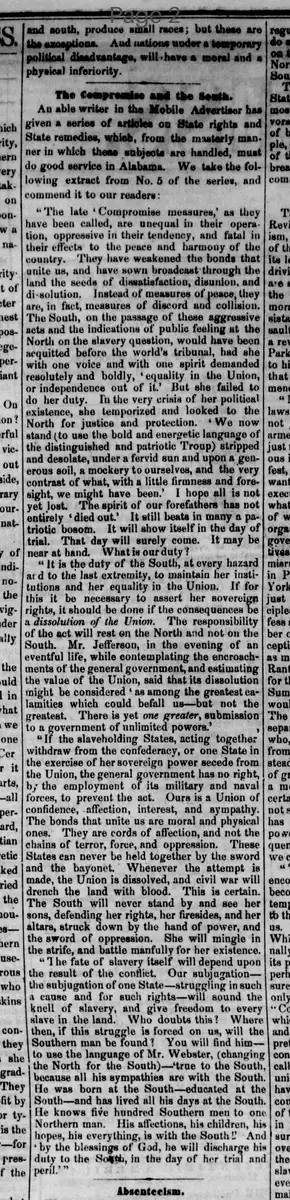
The Compromise and the South.
An able writer in the Mobile Advertiser has given a series of articles on State rights and State remedies, which, from the masterly manner in which these subjects are handled, must do good service in Alabama. We take the following extract from No. 5 of the series, and commend it to our readers:
"The late 'Compromise measures,' as they have been called, are unequal in their operation, oppressive in their tendency, and fatal in their effects to the peace and harmony of the country. They have weakened the bonds that unite us, and have sown broadcast through the land the seeds of dissatisfaction, disunion, and dis-solution. Instead of measures of peace, they are, in fact, measures of discord and collision. The South, on the passage of these aggressive acts and the indications of public feeling at the North on the slavery question, would have been acquitted before the world's tribunal, had she with one voice and with one spirit demanded resolutely and boldly, 'equality in the Union, or independence out of it.' But she failed to do her duty. In the very crisis of her political existence, she temporized and looked to the North for justice and protection. We now stand (to use the bold and energetic language of the distinguished and patriotic Troup) stripped and desolate, under a fervid sun and upon a generous soil, a mockery to ourselves, and the very contrast of what, with a little firmness and foresight, we might have been.' I hope all is not yet lost. The spirit of our forefathers has not entirely died out.' It still beats in many a patriotic bosom. It will show itself in the day of trial. That day will surely come. It may be near at hand. What is our duty?
"It is the duty of the South, at every hazard and to the last extremity, to maintain her institutions and her equality in the Union. If for this it be necessary to assert her sovereign rights, it should be done if the consequences be a dissolution of the Union. The responsibility of the act will rest on the North and not on the South. Mr. Jefferson, in the evening of an eventful life, while contemplating the encroachments of the general government, and estimating the value of the Union, said that its dissolution might be considered 'as among the greatest calamities which could befall us—but not the greatest. There is yet one greater, submission to a government of unlimited powers.'
"If the slaveholding States, acting together withdraw from the confederacy, or one State in the exercise of her sovereign power secede from the Union, the general government has no right, by the employment of its military and naval forces, to prevent the act. Ours is a Union of confidence, affection, interest, and sympathy. The bonds that unite us are moral and physical ones. They are cords of affection, and not the chains of terror, force, and oppression. These States can never be held together by the sword and the bayonet.' Whenever the attempt is made, the Union is dissolved, and civil war will drench the land with blood. This is certain. The South will never stand by and see her sons, defending her rights, her firesides, and her altars, struck down by the hand of power, and the sword of oppression. She will mingle in the strife, and battle manfully for her existence.
"The fate of slavery itself will depend upon the result of the conflict. Our subjugation—the subjugation of one State—struggling in such a cause and for such rights—will sound the knell of slavery, and give freedom to every slave in the land. Who doubts this? Where then, if this struggle is forced on us, will the Southern man be found? You will find him—to use the language of Mr. Webster, (changing the North for the South)—'true to the South, because all his sympathies are with the South He was born at the South—educated at the South—and has lived all his days at the South. He knows five hundred Southern men to one Northern man. His affections, his children, his hopes, his everything, is with the South!' And by the blessings of God, he will discharge his duty to the South, in the day of her trial and peril.'"
An able writer in the Mobile Advertiser has given a series of articles on State rights and State remedies, which, from the masterly manner in which these subjects are handled, must do good service in Alabama. We take the following extract from No. 5 of the series, and commend it to our readers:
"The late 'Compromise measures,' as they have been called, are unequal in their operation, oppressive in their tendency, and fatal in their effects to the peace and harmony of the country. They have weakened the bonds that unite us, and have sown broadcast through the land the seeds of dissatisfaction, disunion, and dis-solution. Instead of measures of peace, they are, in fact, measures of discord and collision. The South, on the passage of these aggressive acts and the indications of public feeling at the North on the slavery question, would have been acquitted before the world's tribunal, had she with one voice and with one spirit demanded resolutely and boldly, 'equality in the Union, or independence out of it.' But she failed to do her duty. In the very crisis of her political existence, she temporized and looked to the North for justice and protection. We now stand (to use the bold and energetic language of the distinguished and patriotic Troup) stripped and desolate, under a fervid sun and upon a generous soil, a mockery to ourselves, and the very contrast of what, with a little firmness and foresight, we might have been.' I hope all is not yet lost. The spirit of our forefathers has not entirely died out.' It still beats in many a patriotic bosom. It will show itself in the day of trial. That day will surely come. It may be near at hand. What is our duty?
"It is the duty of the South, at every hazard and to the last extremity, to maintain her institutions and her equality in the Union. If for this it be necessary to assert her sovereign rights, it should be done if the consequences be a dissolution of the Union. The responsibility of the act will rest on the North and not on the South. Mr. Jefferson, in the evening of an eventful life, while contemplating the encroachments of the general government, and estimating the value of the Union, said that its dissolution might be considered 'as among the greatest calamities which could befall us—but not the greatest. There is yet one greater, submission to a government of unlimited powers.'
"If the slaveholding States, acting together withdraw from the confederacy, or one State in the exercise of her sovereign power secede from the Union, the general government has no right, by the employment of its military and naval forces, to prevent the act. Ours is a Union of confidence, affection, interest, and sympathy. The bonds that unite us are moral and physical ones. They are cords of affection, and not the chains of terror, force, and oppression. These States can never be held together by the sword and the bayonet.' Whenever the attempt is made, the Union is dissolved, and civil war will drench the land with blood. This is certain. The South will never stand by and see her sons, defending her rights, her firesides, and her altars, struck down by the hand of power, and the sword of oppression. She will mingle in the strife, and battle manfully for her existence.
"The fate of slavery itself will depend upon the result of the conflict. Our subjugation—the subjugation of one State—struggling in such a cause and for such rights—will sound the knell of slavery, and give freedom to every slave in the land. Who doubts this? Where then, if this struggle is forced on us, will the Southern man be found? You will find him—to use the language of Mr. Webster, (changing the North for the South)—'true to the South, because all his sympathies are with the South He was born at the South—educated at the South—and has lived all his days at the South. He knows five hundred Southern men to one Northern man. His affections, his children, his hopes, his everything, is with the South!' And by the blessings of God, he will discharge his duty to the South, in the day of her trial and peril.'"
What sub-type of article is it?
Constitutional
Slavery Abolition
War Or Peace
What keywords are associated?
Compromise Measures
State Rights
Secession
Slavery Defense
Southern Equality
Civil War Threat
Union Dissolution
What entities or persons were involved?
Mobile Advertiser
Troup
Mr. Jefferson
Mr. Webster
South
North
Editorial Details
Primary Topic
Critique Of Compromise Measures And Southern State Rights
Stance / Tone
Strongly Pro Southern, Advocating Resistance And Potential Secession
Key Figures
Mobile Advertiser
Troup
Mr. Jefferson
Mr. Webster
South
North
Key Arguments
Compromise Measures Are Unequal, Oppressive, And Sow Discord
South Should Have Demanded Equality Or Independence
Duty To Maintain Southern Institutions At All Costs
Secession Responsibility Lies With The North
Union Cannot Be Held By Force; Would Lead To Civil War
Subjugation Would End Slavery Nationwide
Southern Loyalty To The South In Conflict