Thank you for visiting SNEWPapers!
Sign up free
M'arthur Democrat
Mcarthur, Vinton County, Ohio
What is this article about?
Mr. Sumner introduces a resolution for a constitutional amendment declaring all persons equal and free from slavery. The Judiciary Committee reports adversely and proposes the 13th Amendment instead, banning slavery except as punishment for crime. Commentary questions its ratification feasibility and criticizes the process using legislatures over conventions.
Clipping
OCR Quality
Full Text
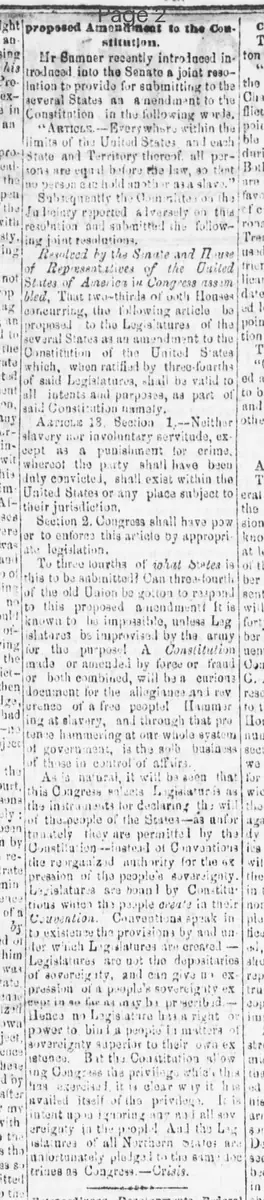
Mr. Sumner recently introduced into the Senate a joint resolution to provide for submitting to the several States an amendment to the Constitution in the following words,
"Article.--Everywhere within the limits of the United States and each State and Territory thereof, all persons are equal before the law, so that no person can hold another as a slave."
Subsequently the Judiciary Committee reported adversely on the resolution and submitted the following joint resolutions.
Resolved by the Senate and House of Representatives of the United States of America in Congress assembled. That two-thirds of both Houses concurring, the following article be proposed to the Legislatures of the several States as an amendment to the Constitution of the United States which, when ratified by three-fourths of said Legislatures, shall be valid to all intents and purposes, as part of said Constitution namely.
Article 13. Section 1.--Neither slavery nor involuntary servitude, except as a punishment for crime, whereof the party shall have been duly convicted, shall exist within the United States or any place subject to their jurisdiction.
Section 2. Congress shall have power to enforce this article by appropriate legislation.
To three-fourths of what States is this to be submitted? Can three-fourths of the old Union be gotten to respond to this proposed amendment? It is known to be impossible, unless Legislatures be improvised by the army for the purpose! A Constitution made or amended by force or fraud or both combined, will be a curious document for the allegiance and loyalty of a free people! Hammering at slavery, and through that process hammering at our whole system of government, is the sole business of those in control of affairs.
As is natural, it will be seen that this Congress substitutes Legislatures as the instruments for declaring the will of the people of the States--as unfortunately they are permitted by the Constitution--instead of Conventions the recognized authority for the expression of the people's sovereignty. Legislatures are bound by Constitutions when the people create them in their Conventions. Conventions speak into existence the provisions by and under for which Legislatures are created--Legislatures are not the depositories of sovereignty, and can give an expression of a people's sovereignty except in so far as may be prescribed--Hence no Legislature has right or power to bind a people in matters of sovereignty superior to their own existence. But this Constitution allowing Congress the privilege which it has exercised it is clear why it has availed itself of the privilege. It is intent upon ignoring any or all sovereignty in the people and the Legislatures of all Northern states; are unfortunately pledged to the same doctrines as Congress.--Crisis.
What sub-type of article is it?
What themes does it cover?
What keywords are associated?
What entities or persons were involved?
Where did it happen?
Story Details
Key Persons
Location
United States Senate
Story Details
Mr. Sumner proposes an amendment declaring equality and ending slavery; Judiciary Committee counters with the 13th Amendment banning slavery except for criminal punishment. Editorial criticizes the submission to legislatures over conventions and doubts ratification without force.