Thank you for visiting SNEWPapers!
Sign up free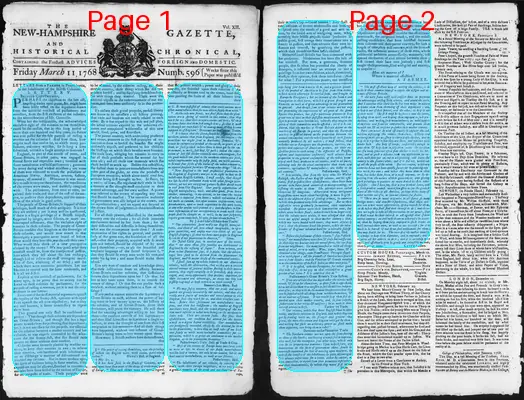
The New Hampshire Gazette And Historical Chronicle
Portsmouth, Greenland, Rockingham County, New Hampshire
What is this article about?
In Letter V of 'Letters from a Farmer in Pennsylvania,' the author argues against the Townshend Acts' duties on paper, citing over 150 years of parliamentary precedent against taxing colonies for revenue, emphasizing colonial self-taxation rights, historical dependence without direct taxes, and mutual benefits of the colonial trade system to Britain.
Merged-components note: This is the continuation of 'Letters from a Farmer in Pennsylvania, Letter V' across pages 1 and 2, a political opinion piece signed 'A FARMER'. Relabeled from 'literary' to 'editorial' as it fits opinionated partisan content better than serialized fiction.
Clippings
1 of 2
OCR Quality
Full Text
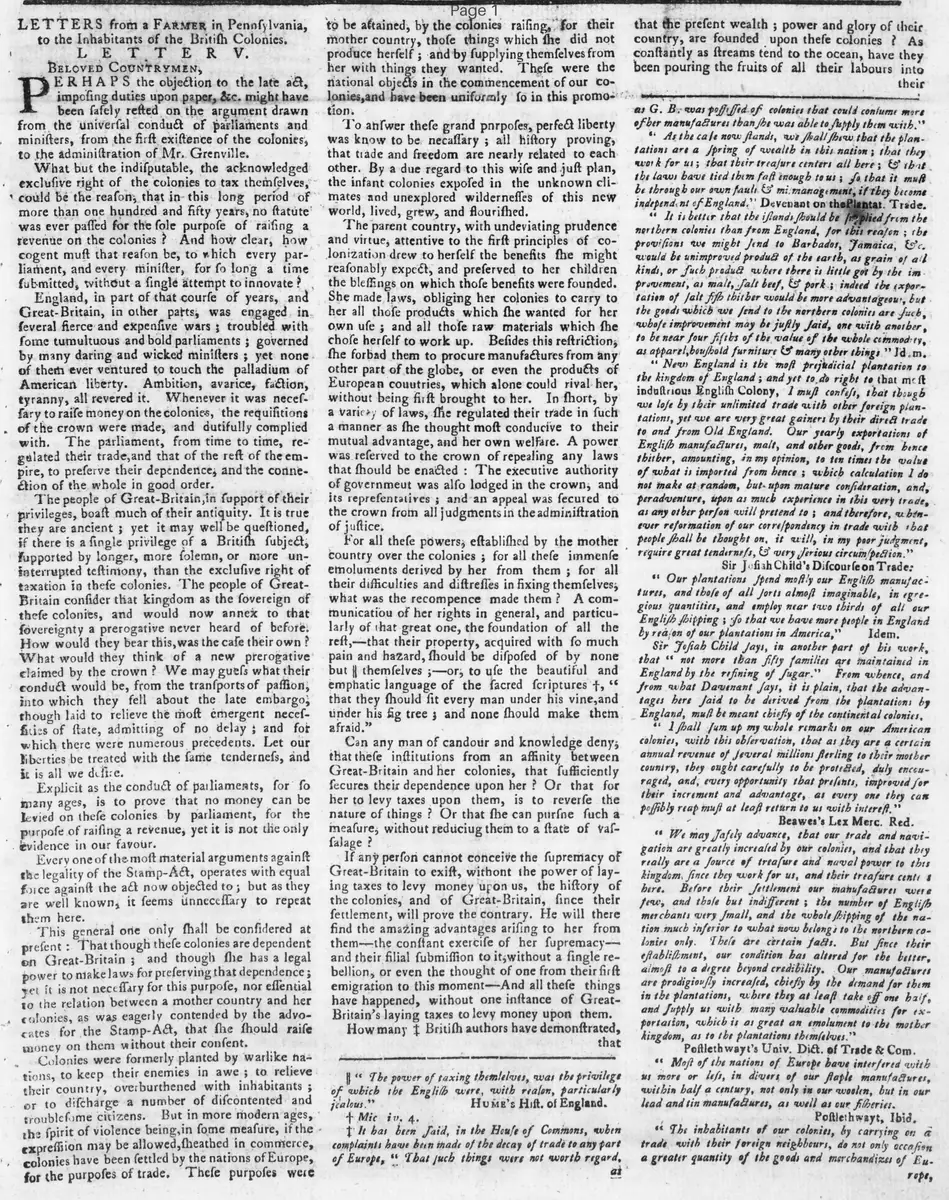
LETTER V.
Beloved Countrymen,
Perhaps the objection to the late Act, imposing duties upon paper, &c. might have been safely rested on the argument drawn from the universal conduct of parliaments and ministers, from the first existence of the colonies to the administration of Mr. Grenville.
What but the indisputable, the acknowledged exclusive right of the colonies to tax themselves, could be the reason, that in this long period of more than one hundred and fifty years, no statute was ever passed for the sole purpose of raising a revenue on the colonies? And how clear, how cogent must that reason be, to which every parliament, and every minister, for so long a time submitted, without a single attempt to innovate?
England, in part of that course of years, and Great-Britain, in other parts, was engaged in several fierce and expensive wars: troubled with some tumultuous and bold parliaments; governed by many daring and wicked ministers; yet none of them ever ventured to touch the palladium of American liberty. Ambition, avarice, faction, tyranny, all revered it. Whenever it was necessary to raise money on the colonies, the requisitions of the crown were made, and dutifully complied with. The parliament, from time to time, regulated their trade, and that of the rest of the empire, to preserve their dependence, and the connexion of the whole in good order.
The people of Great-Britain, in support of their privileges, boast much of their antiquity. It is true they are ancient; yet it may well be questioned, if there is a single privilege of a British subject, supported by longer, more solemn, or more uninterrupted testimony, than the exclusive right of taxation in these colonies. The people of Great-Britain consider that kingdom as the sovereign of these colonies, and would now annex to that sovereignty a prerogative never heard of before. How would they bear this, was the case their own? What would they think of a new prerogative claimed by the crown? We may guess what their conduct would be, from the transports of passion into which they fell about the late embargo; though laid to relieve the most emergent necessities of state, admitting of no delay: and for which there were numerous precedents. Let our liberties be treated with the same tenderness, and it is all we desire.
Explicit as the conduct of parliaments, for so many ages, is to prove that no money can be levied on these colonies by parliament, for the purpose of raising a revenue, yet it is not the only evidence in our favour. Every one of the most material arguments against the legality of the Stamp-Act, operates with equal force against the Act now objected to; but as they are well known, it seems unnecessary to repeat them here.
This general one only shall be considered at present: That though these colonies are dependent on Great-Britain; and though she has a legal power to make laws for preserving that dependence; yet it is not necessary for this purpose, nor essential to the relation between a mother country and her colonies, as was eagerly contended by the advocates for the Stamp-Act, that she should raise money on them without their consent.
Colonies were formerly planted by warlike nations, to keep their enemies in awe; to relieve their country, overburdened with inhabitants; or to discharge a number of discontented and troublesome citizens. But in more modern ages, the spirit of violence being, in some measure, if the expression may be allowed, sheathed in commerce, colonies have been settled by the nations of Europe, for the purposes of trade. These purposes were to be attained by the colonies raising, for their mother country, those things which she did not produce herself: and by supplying themselves from her with things they wanted. These were the national objects in the commencement of our colonies, and have been uniformly so in this promotion.
To answer these grand purposes, perfect liberty was known to be necessary; all history proving, that trade and freedom are nearly related to each other. By a due regard to this wise and just plan, the infant colonies exposed in the unknown climates and unexplored wildernesses of this new world, lived, grew, and flourished.
The parent country, with undeviating prudence and virtue, attentive to the first principles of colonization drew to herself the benefits she might reasonably expect, and preserved to her children the blessings on which those benefits were founded. She made laws obliging her colonies to carry to her all those products which she wanted for her own use: and all those raw materials which she chose herself to work up. Besides this restriction, she forbade them to procure manufactures from any other part of the globe, or even the products of European countries, which alone could rival her, without being first brought to her. In short, by a variety of laws, she regulated their trade in such a manner as she thought most conducive to their mutual advantage, and her own welfare. A power was reserved to the crown of repealing any laws that should be enacted: The executive authority of government was also lodged in the crown, and its representatives; and an appeal was secured to the crown from all judgments in the administration of justice.
For all these powers, established by the mother country over the colonies; for all these immense emoluments derived by her from them: for all their difficulties and distresses in fixing themselves; what was the recompence made them? A communication of her rights in general, and particularly of that great one, the foundation of all the rest, that their property, acquired with so much pain and hazard, should be disposed of by none but themselves; or, to use the beautiful and emphatic language of the sacred scriptures, "that they should sit every man under his vine, and under his fig tree; and none should make them afraid."
Can any man of candour and knowledge deny, that these institutions from an affinity between Great-Britain and her colonies, that sufficiently secures their dependence upon her? Or that for her to levy taxes upon them, is to reverse the nature of things? Or that he can pursue such a measure, without reducing them to a state of vassalage?
If any person cannot conceive the supremacy of Great-Britain to exist, without the power of laying taxes to levy money upon us, the history of the colonies, and of Great-Britain, since their settlement, will prove the contrary. He will there find the amazing advantages arising to her from them—the constant exercise of her supremacy—and their filial submission to it, without a single rebellion, or even the thought of one from their first emigration to this moment—And all these things have happened, without one instance of Great-Britain's laying taxes to levy money upon them.
How many British authors have demonstrated, that "The power of taxing themselves, was the privilege of which the English were, with reason, particularly jealous." Hume's Hist. of England.
+ Mic. iv. 4.
It has been said, in the House of Commons, when complaints have been made of the decay of trade to any part of Europe, "That such things were not worth regard, that the present wealth, power and glory of their country, are founded upon these colonies? As constantly as streams tend to the ocean, have they been pouring the fruits of all their labours into their mother country."
As G. B. was possessed of colonies that could consume more of her manufactures than she was able to supply them with."
As the case now stands, we shall show that the plantations are a spring of wealth in this nation; that they work for us; that their treasure centers all here; & that the laws have tied them fast enough to us; so that it must be through our own fault & mismanagement, if they become independent of England. Devenant on the Plantation Trade.
"It is better that the islands should be supplied from the northern colonies than from England, for this reason; the provisions we might send to Barbados, Jamaica, &c. would be unimproved product of the earth, as grain of all kinds, or such product where there is little got by the improvement, as malt, salt beef, & pork.; indeed the exportation of salt fish thither would be more advantageous, but the goods which we send to the northern colonies are such whose improvement may be justly said, one with another, to be near four fifths of the value of the whole commodity, as apparel, household furniture & many other things." Idem.
"New England is the most prejudicial plantation to the kingdom of England; and yet to do right to that most industrious English Colony, I must confess, that though we lose by their unlimited trade with other foreign plantations, yet we are very great gainers by their direct trade to and from Old England. Our yearly exportations of English manufactures, malt, and other goods, from hence thither, amounting, in my opinion, to ten times the value of what is imported from thence; which calculation I do not make at random, but upon mature consideration, and peradventure, upon as much experience in this very trade, as any other person will pretend to; and therefore, whatever reformation of our correspondency in trade with that people shall be thought on, it will, in my poor judgment, require great tenderness, & very serious circumspection."
Sir Josiah Child's Discourse on Trade:
"Our plantations spend mostly our English manufactures, and those of all sorts almost imaginable, in egregious quantities, and employ near two thirds of all our English shipping; so that we have more people in England by reason of our plantations in America,"
Idem.
Sir Josiah Child says, in another part of his work, that "not more than fifty families are maintained in England by the refining of sugar." From whence, and from what Davenant says, it is plain, that the advantages here laid to be derived from the plantations by England, must be meant chiefly of the continental colonies.
"I shall sum up my whole remarks on our American colonies, with this observation, that as they are a certain annual revenue of several millions sterling to their mother country, they ought carefully to be protected, duly encouraged, and, every opportunity that presents, improved for their increment and advantage, as every one they can possibly reap must at least return to us with interest."
Beawes's Lex Merc. Red.
"We may safely advance, that our trade and navigation are greatly increased by our colonies, and that they really are a source of treasure and naval power to this kingdom, since they work for us, and their treasure centers here. Before their Settlement our manufactures were few, and those but indifferent; the number of English merchants very small, and the whole shipping of the nation much inferior to what now belongs to the northern colonies only. These are certain facts. But since their establishment, our condition has altered for the better, almost to a degree beyond credibility. Our manufactures are prodigiously increased, chiefly by the demand for them in the plantations, where they at least take off one half, and supply us with many valuable commodities for exportation, which is as great an emolument to the mother kingdom, as to the plantations themselves."
Postlethwayt's Univ. Dict. of Trade & Com.
"Most of the nations of Europe have interfered with us more or less, in divers of our staple manufactures, within half a century, not only in our woolen, but in our lead and tin manufactures, as well as our fisheries."
Postlethwayt, Ibid.
"The inhabitants of our colonies, by carrying on a trade with their foreign neighbours, do not only occasion a greater quantity of the goods and merchandizes of Eu. their mother's lap.--Good heaven! And shall a total oblivion of former tenderness and blessings be spread over the minds of a good and wise na- tion, by the sordid arts of intriguing men, who, covering their selfish projects under pretences of public good, first enrage their countrymen into a frenzy of passion, and then advance their own in- fluence and interest, by gratifying the passion, which they themselves have basely excited.
Hitherto Great-Britain has been contented with her prosperity. Moderation has been the rule of her conduct. But now, a generous, humane people, that so often has protected the liberty of strangers, is inflamed into an attempt to tear a privilege from her own children, which, if executed. must, in their opinion, sink them into slaves: And for what? For a pernicious power, not necessary rope being sent from hence to th i, and a greater quantity. of the product of America to be sent from them thither. which would otherwise be carried from, and brought to Europe by Foreigners; but an increase of the Seamen and navigation in those parts, which is of great strength and Security, as well as of great advantage to our plantations in general. And though some of our colonies are not only for preventing the importations of all goods of the same Species they produce, but Suffer particular planters to keep great runs of land in their possession uncultivated, with de- sign to prevent new Settlements, whereby they imagine the prices of their commodities may be affected; yet if it be con- sidered, that the markets of Great Britain depend on the markets of all Europe in general, and that the European markets in general depend on the proportion between the annual consumption, and the whole quantity of each Species annually produced by all nations; it must follow, that whether we or Foreigners are the producers, carriers, im- porters and exporters of American produce, yet their re- spective prices in each colony (the difference of Freight, customs and importations considered) will always bear proportion to the general consumption. of the whole quan- tity of each Sort, produced in all colonies, and in all parts, allowing only for the usual contingencies that trade and commerce, agriculture & manufactures. are liable to in all countries."
Postlethwayt. Ibid.
"It is certain, that from the very time Sir Walter Raleigh, the Father of our English colonies, and his asso- ciates, first projected these establishments, there have been persons who have found an interest in misrepresenting, or lessening the value of them. The attempts were called commercial & dangerous. Afterwards many malignant Suggestions were made about Sacrificing so many English men to the obstinate desire of settling colonies, in countries which then produced very little advantage. But as these difficulties were gradually surmounted, those complaints vanished. No sooner were these lamentations over; but others arose in their stead; when it could be no longer said, that the colonies were useless, it was alledged that they were not useful enough to their mother country; that. while we were loaded with taxes, they were absolutely free; that the planters lived like princes, while the inha- bitants of England laboured hard for a tolerable subsis- tence."
"9 Postlethwayt. Ibid.
"Before the settlement of these colonies." says Postleth- wayt," our manufactures were few.& those but indifferent. In those days we had not only our naval stores, but our ships from our neighbours. Ger many furnished us with all things made of metal, even to nails. Wine. paper, linens, & a thousand other things, came from France. Portugal suppli- ed us with sugar; all the products of America were poured into us from Spain; and the Venetians & Genoese retailed to us the commodities of the East Indies.at their own price."
"s If it be asked. ' whetherForeigners, for what goods they take of us, do not pay on that consumption a .great portion of our taxes? It is admitted they do."
Postlethwayt's Great Britain's True System.
"If we are afraid that one day or other the colonies will revolt. & set up for themselves. as some seem to apprehend let us not drive them to a necessity to feel themselves indepen- dent of us; as they will do,the moment they perceive that they can be supplied with all things from within themselves. & do not need our assistance. If we rwould keep them still de- pendent upon their mother country, and. in some respects, subservient to her views & welfare; let us make it their interest always to be so.
Tucker on Trade.
"Our colonies, while they have English blood in their veins, and have relations in England. and while they can get by trading with us, the stronger and greater they grow, the more this crown and kingdom will get by them; and nothing but such an arbitrary power as shall make them desperate, can bring them to rebel."
Davenant on the Plantation Trade.
as The Northern colonies are not upon the same footing as those of the South; and having a worse soil to improve, they mu find the recompence some other way, which only can be in property and dominion: Upon which score, any innovations in the form of government there. should be cautiously examined. for fear of entering upon measures, by which the industry of the inhabitants be quite discouraged.
"lis always unfortunate for a people, either by consent, or upon compulsion, to depart from their primitive institutions, and those fundamentals, by which they were first united together."
Idem.
6 The to her, as her own experience may convince her; but horribly dreadful and detestable to them. It seems extremely probable, that when cool, dispassionate posterity.shall consider the affectionate intercourse, the reciprocal benefits, and the unsus- pecting confidence, that have subsisted between these colonies and their parent country, for such a length of time,they will execrate,with the bitterest curses, the infamous memory of those men, whose pestilential ambition unnecessarily, wantonly, first opened the sources of civil discord between them; first turned their love into jealousy: and first taught these provinces,filled with grief and anxiety, to enquire--
Mens ubi materna est?
Where is maternal affection?
A FARMER.
s. The most effectual way of uniting the colonies. is to make it their common interest to oppose the designs and at- tempts of Great-Britain.
"All wise states will well consider how to preserve the advantages arising from colonies, and avoid the evils. And I conceive that there can be but two ways in nature to hinder them from throwing off their dependence; one, to keep it out of their power, and the other. to keep it out of their will. The first must be by force; and the latter. by using them well, and keeping them employed in such pro- ductions, and making.such manufactures, as will support them/elves and families comfortably, and procure them wealth too, & at least not prejudice their mother country. Force can never be used effectually to answer the end. without destroying the colonies themselves. Liberty and encouragement are necessary to carry people thither, and to keep them together when they are there, and violence will hinder both Any body of troops, considerable enough to awe them, & keep them in subjection. under the direction too of a needy governor often sent thither to make his for- tune, and at such a distance from any application for re- dress, will soon put an end to all planting, and leave the country to the soldiers alone, and if it did not. would eat up all the profit ofthe colony. For this reason. arbitrary countries have not been equally successful in planting colo- nnies with free ones; and what they have done in that kind, has either been force, at a vast expense, or by de- parting from the nature of their government, and giving such privileges to planters as were denied to their other subjects. And I dare say. that a few prudent laws, and a little prudent conduct, would soon give us far the greatest share of the riches of all America, perhaps drive many of other nations out of it. or into our colonies for shelter.
6s There are so many exigencies in all states. so many foreign wars, and domestic disturbances, that these colo- nies can never want opportunities, if they watch for them. to do what they shall find their interest to do; and there- fore we ought to take all the precautions in our power, that it shall never bi their interest to act against that of their native country; an evil which can no otherwise be avert- ed, than by keeping them fully employed in such trades as will increase their own, as well as our wealth; for it is much to be feared. if rwe do not find employment for them; they may find it for us. The interest ofthe mother country; is always to keep them dependent, and /o employed; and it requires all her address to do it; and it is certainly more easily and effectually done by gentle and insensible methods, than by power alone.'
Cato's Letters.
What sub-type of article is it?
What keywords are associated?
What entities or persons were involved?
Editorial Details
Primary Topic
Opposition To Parliamentary Revenue Acts On Colonies Like Townshend Duties
Stance / Tone
Strongly Defending Exclusive Colonial Right To Self Taxation And Critiquing British Attempts To Impose Revenue Duties
Key Figures
Key Arguments
- over 150 years of parliamentary precedent against taxing colonies for revenue
- colonies' dependence on britain secured by trade regulation, not direct taxation
- mutual economic benefits from colonial trade system without taxation
- taxation without consent violates fundamental british privilege of self-taxation
- historical submission of colonies without rebellion under non-taxing supremacy
- british authors affirm colonies as source of wealth through trade, not taxes