Thank you for visiting SNEWPapers!
Sign up free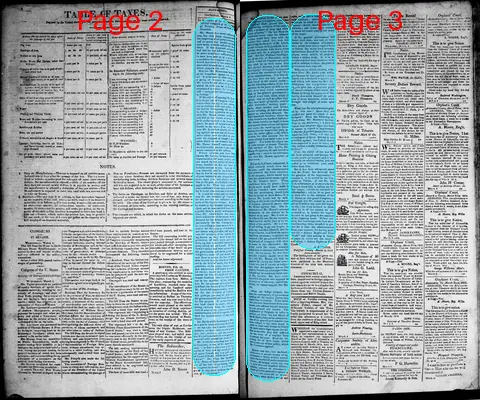
Alexandria Gazette, Commercial And Political
Alexandria, Virginia
What is this article about?
A pseudonymous letter defends Congressman Lewis's re-election against challenger Mason in Virginia's Fairfax-Prince William-Loudoun district, praising Lewis for opposing the War of 1812's Canada invasion, related taxes, and militia drafts that caused suffering, while accusing Mason of inconsistent war support and favoring oppressive policies.
Merged-components note: Continuation of the same political letter to voters across pages, with matching content flow; relabel editorial portion to match.
Clippings

1 of 2
OCR Quality
Full Text
Mr. Mason in a recent address to you, has very justly recommended the forgetting of all party irritations. and as peace has blessed our land others had once had more if its this to due think honorable influence and act with him sentiment like he never would have suffered himself to have been held up by a party as a candidate for Congress -It is to be feared that there is too much bitter concealed beneath the smooth words which compose this address.
Why has Mr. Mason come forward as the Candidate against Mr. Lewis?
It is because he either clings to a party. or because he condemns Mr. Lewis for not advocating a war, which he tells you he rejoices has terminated in a peace, that he hopes will "assuage the bitterness of party feelings."
If the object of opposing Mr. Lewis is to get out of Congress a Federalist-then the object and address are at variance with each other. If the motive for opposing Mr. Lewis, is, that he was opposed to the war- then Mr. Mason cannot really be satisfied at the return of peace ; if he is really rejoiced at the return of peace, he must of course have been hostile to the war ; if so, why oppose Mr. Lewis's re election for voting against the war and all the measures which were intended to prosecute the conquest of Canada; measures which we are bound to believe Mr. Mason himself condemned. if we believe him sincere in the sentiments contained in his address.
Fellow citizens, you have long known Mr. Lewis ; he has been your representative for many years ; you are asked by the writer of this address, whether he has not been a faithful servant to you. Can one of you, sincerely and in truth declare, that he has in any instance neglected your interest in any respect whatever; have you not always found him at his post, as a faithful sentinel ought to be. Then why withdraw your confidence from him, and transfer it to one who remains to be tried?
It is said he voted against raising men for the invasion of Canada; for this was the use intended to be made of the regular troops. In this he stands in my humble opinion justified, and no man not tied down like a galley slave to party, will condemn him: Mr. Lewis knew that large fleets and armies of the enemy were destined for the Atlantic shores, and particularly for the Chesapeake ; he was willing to raise men to be retained for the purpose of defending our shores and fire sides, and to prevent the necessity of the militia being drawn as they were from the protection of their wives and children, against a dreadful internal enemy which we all feared. If Mr. Lewis's policy had been pursued by the government and the majority in Congress ; many of you would not now have to mourn the loss of sons dear to your hearts, who have fallen not in the field of battle, but by the pestilence of the camp: many a widow whose tears still bedew her pallid cheeks, would not now have to lament the loss of a kind and affectionate husband, who was torn from her by the mandate of the militia law, for the purpose of sending him to defend the shores of the Potomac.
Mr. Lewis did oppose raising any army for the invasion of Canada. the government did not want the men But perhaps, you may be told that for this purpose.
If an assertion of this kind should be made; the following extracts from the declarations of some of the members of the administration and of Congress, will shew the incorrectness of any such denial.
" we can take the Canadas without soldiers, we have only to send a few mentu ill rally around our stand. rl." disaffected towards their own government, in a public communication declared, Dr. Eustis while Secretary at War into the province, and the people,
in Congress. in one of his speeches, Mr. Calhoun, a leading war man said, " in four weeks after a declaration of war, and my word for it all upper Canada and a major part of Lower Canada, will be in our possession."
of the House of Representatives and session."
Mr. Clay, the Speaker in Congress declared " I would never accede to any peace without the cession of the Canadas." one of the late Negotiators, when
"General Hull passed into the communications to Congress, stated that The President in one of his communications to Congress, neighboring territory of the enemy, with a prospect of easy and victorious progress." Do not these declarations prove what the administration would have done with the armies they asked for; with this knowledge on the part of Mr. Lewis, would he have been justifiable in involving the nation with heavy taxes to raise men for a purpose of this kind? But the National Intelligencer of the 5th of November, 1813, tells us "that the Canadas once ours, they shall be as these states have been, forever divorced from British sovereignty." This paper is supposed to contain the sentiments and views of the administration. For this object then, have not only our lands been taxed to the utmost extent—but the following articles of the first necessity to the poor, as well as the rich, have been taxed enormously by the general government— Iron of every kind, nails, brads & sprigs; wax as well as tallow candles; hats made of leather, wool or other materials; writing paper; leather including all hides and skins, boots, shoes, saddles and bridles, tanned or otherwise dressed. Besides household furniture where the value exceeds two hundred dollars— Mr. Lewis voted as he ought to have done against these odious and oppressive taxes; he voted against introducing into our houses that petty tyrant, the excise officer.—My fellow citizens, for what purpose was the money arising from these taxes to be applied? You know the object was to raise armies to invade Canada. This conduct of Mr. Lewis, Mr. Mason disapproves of, and therefore opposes him; what is the inference, it is that Mr. Mason approves of these taxes. If Canada had been conquered, & which certainly would have been the case, could the administration have procured the force necessary for the purpose; where would have been that peace which seems to gladden Mr. Mason's heart. There would have been no peace; Great Britain never would have made it until the Canadas were restored. This our government would have been too proud to have done.—It is because Mr. Lewis has by withholding as far as he could the means of conquest, procured peace, that Mr. Mason opposes him. The inconsistency of Mr. Mason's acts and declarations is too obvious to be doubted on by any. Mr. Lewis never refused his vote for any measure, which carried on the face of it, the defence of the nation. He was ready and willing to go any length, to make any sacrifice himself, and for his constituents, to defend his native land from invasions; to protect our seaboard; for measures of this kind, the journals of Congress will show his name in the affirmative. Mr. Lewis voted for every measure which went to increase and foster the navy. On the ocean, he was desirous his country should meet the foe; will Mr. Mason say that he opposes Mr. Lewis for these votes? I trust not, but if we are to conjecture what his opinions are on this subject, from those, who support him I should say he condemns these votes of Mr. Lewis's. Mr. Love while himself in Congress was opposed to the increase of the navy: and if consistent, he cannot support Mr. Mason. What, my fellow citizens, has been the consequence of government sending all the regular forces they could raise to Canada. It has been, that you have been drawn from your homes, and suffered beyond measure in your persons and estates. The Legislature of Virginia, in order to protect you from the sad effects of the ill fated policy of the administration of the general government; has been obliged to lay state taxes in order to raise state troops to defend the state rather than expose the militia to the evils they had suffered for the want of a regular force to protect the state. Following list of state taxes, which have grown out of that policy, which Mr. Lewis has opposed. Read the following— Houses and lots: lots enclosed; ordinaries, or private houses of entertainment; livery stables according to the number of stalls; tanneries; ferries; toll bridges where the rent is more than one hundred dollars; printing presses of newspapers; slaves of twelve years old or upwards; slaves of nine years old or under; horses, asses mules, mares and colts, cattle and a long list of household furniture; among which are bedsteads in whole or in part of mahogany; chairs, window shutters & curtains; and many other articles to name all would take up too much of my paper. If the general government had done their duty, and had not been intent on the conquest of Canada they would have had a regular force to defend the states from invasion, and not have forced the states to tax almost every article of property which a citizen holds. It is to be recollected that these taxes are to be paid in addition to those, the general government have imposed Will you my fellow citizens, withdraw from Mr. Lewis your suffrages because he has opposed a policy which was calculated to oppress you and which will when the Rev. Mr. Littlejohn, the tax gatherer calls on you, give you a practical proof of the correctness of his course. Mr. Mason by being the opponent of Mr. Lewis, does avow himself the advocate of those measures, which have brought this weight of taxes upon you. What has the administration gained by this war? Have they not yielded the point for which it was declared? Read the following extracts from Mr. Monroe's instructions to our ministers; "I have to repeat that the great object you have to secure in regard to impressment, is that the flag shall protect the crew." Again he tells them, "if this encroachment of Great Britain is not provided against, the United States have appealed to arms in vain; and they cannot consider themselves independent." Then the object of the war has not been obtained, and because Mr. Lewis would not support such a war and such an administration, you are called on to withdraw your confidence from him. But it has been whispered about that Dr. Peake has declared that the question of the impressment of seamen is to be settled by the Congress at Vienna. If the Dr. has been so fortunate as to ascertain this I would thank him to inform his fellow voters, whence he obtained his information; will he be so good as to state who is the minister of the U. States at this grand Congress.— Although the Dr. cannot be so stupid as to believe any such idle report as this; yet I am inclined to think that he is of the opinion we are so stupid as to believe the report, because he has given it the sanction of his imposing name. Fellow citizens, this is nothing more than an electioneering trick, intended to protect for a time the administration from your censure, for having made war for "Sailors Rights and Free Trade" and then making a treaty of peace in which not one word is said about "Sailors Rights or Free Trade."
A FARMER.
What sub-type of article is it?
What themes does it cover?
What keywords are associated?
What entities or persons were involved?
Letter to Editor Details
Author
A Farmer
Recipient
To The Voters Of The Congressional District Composed Of The Counties Of Fairfax, Prince William And Loudoun
Main Argument
voters should re-elect mr. lewis over mr. mason because lewis faithfully opposed the unnecessary invasion of canada during the war of 1812, avoiding oppressive taxes and militia drafts that caused suffering, while mason's opposition to lewis reveals inconsistent support for war policies that prolonged conflict.
Notable Details