Thank you for visiting SNEWPapers!
Sign up free
Editorial
August 5, 1934
Mcallen Daily Monitor
Mcallen, Brownsville, Harlingen, Hidalgo County, Cameron County, Texas
What is this article about?
Editorial urges Reconstruction Finance Corporation to refinance distressed road bonds in the Valley at reduced rates, similar to water districts, to save taxpayers, protect investments, and counter bondholder proposals for full value refunding. Calls for congressional legislation.
Clipping
OCR Quality
98%
Excellent
Full Text
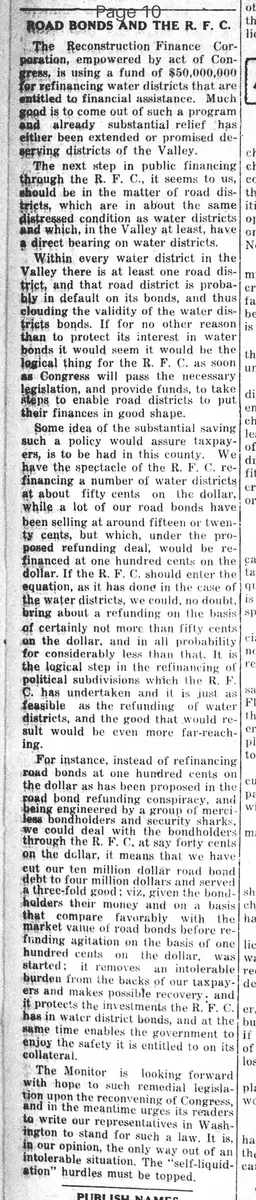
ROAD BONDS AND THE R. F. C.
The Reconstruction Finance Corporation, empowered by act of Congress, is using a fund of $50,000,000 for refinancing water districts that are entitled to financial assistance. Much good is to come out of such a program and already substantial relief has either been extended or promised deserving districts of the Valley.
The next step in public financing through the R. F. C., it seems to us, should be in the matter of road districts, which are in about the same distressed condition as water districts and which, in the Valley at least, have direct bearing on water districts.
Within every water district in the Valley there is at least one road district, and that road district is probably in default on its bonds, and thus clouding the validity of the water districts bonds. If for no other reason than to protect its interest in water bonds it would seem it would be the logical thing for the R. F. C. as soon as Congress will pass the necessary legislation, and provide funds, to take steps to enable road districts to put their finances in good shape.
Some idea of the substantial saving such a policy would assure taxpayers, is to be had in this county. We have the spectacle of the R. F. C. refinancing a number of water districts at about fifty cents on the dollar, while a lot of our road bonds have been selling at around fifteen or twenty cents, but which, under the proposed refunding deal, would be refinanced at one hundred cents on the dollar. If the R. F. C. should enter the equation, as it has done in the case of the water districts, we could, no doubt, bring about a refunding on the basis of certainly not more than fifty cents on the dollar, and in all probability for considerably less than that. It is the logical step in the refinancing of political subdivisions which the R. F. C. has undertaken and it is just as feasible as the refunding of water districts, and the good that would result would be even more far-reaching.
For instance, instead of refinancing road bonds at one hundred cents on the dollar as has been proposed in the road bond refunding conspiracy, and being engineered by a group of merciless bondholders and security sharks, we could deal with the bondholders through the R. F. C. at say forty cents on the dollar, it means that we have cut our ten million dollar road bond debt to four million dollars and served a three-fold good: viz, given the bondholders their money and on a basis that compare favorably with the market value of road bonds before refunding agitation on the basis of one hundred cents on the dollar was started; it removes an intolerable burden from the backs of our taxpayers and makes possible recovery; and it protects the investments the R. F. C. has in water district bonds, and at the same time enables the government to enjoy the safety it is entitled to on its collateral.
The Monitor is looking forward with hope to such remedial legislation upon the reconvening of Congress, and in the meantime urges its readers to write our representatives in Washington to stand for such a law. It is in our opinion, the only way out of an intolerable situation. The "self-liquidation" hurdles must be topped.
The Reconstruction Finance Corporation, empowered by act of Congress, is using a fund of $50,000,000 for refinancing water districts that are entitled to financial assistance. Much good is to come out of such a program and already substantial relief has either been extended or promised deserving districts of the Valley.
The next step in public financing through the R. F. C., it seems to us, should be in the matter of road districts, which are in about the same distressed condition as water districts and which, in the Valley at least, have direct bearing on water districts.
Within every water district in the Valley there is at least one road district, and that road district is probably in default on its bonds, and thus clouding the validity of the water districts bonds. If for no other reason than to protect its interest in water bonds it would seem it would be the logical thing for the R. F. C. as soon as Congress will pass the necessary legislation, and provide funds, to take steps to enable road districts to put their finances in good shape.
Some idea of the substantial saving such a policy would assure taxpayers, is to be had in this county. We have the spectacle of the R. F. C. refinancing a number of water districts at about fifty cents on the dollar, while a lot of our road bonds have been selling at around fifteen or twenty cents, but which, under the proposed refunding deal, would be refinanced at one hundred cents on the dollar. If the R. F. C. should enter the equation, as it has done in the case of the water districts, we could, no doubt, bring about a refunding on the basis of certainly not more than fifty cents on the dollar, and in all probability for considerably less than that. It is the logical step in the refinancing of political subdivisions which the R. F. C. has undertaken and it is just as feasible as the refunding of water districts, and the good that would result would be even more far-reaching.
For instance, instead of refinancing road bonds at one hundred cents on the dollar as has been proposed in the road bond refunding conspiracy, and being engineered by a group of merciless bondholders and security sharks, we could deal with the bondholders through the R. F. C. at say forty cents on the dollar, it means that we have cut our ten million dollar road bond debt to four million dollars and served a three-fold good: viz, given the bondholders their money and on a basis that compare favorably with the market value of road bonds before refunding agitation on the basis of one hundred cents on the dollar was started; it removes an intolerable burden from the backs of our taxpayers and makes possible recovery; and it protects the investments the R. F. C. has in water district bonds, and at the same time enables the government to enjoy the safety it is entitled to on its collateral.
The Monitor is looking forward with hope to such remedial legislation upon the reconvening of Congress, and in the meantime urges its readers to write our representatives in Washington to stand for such a law. It is in our opinion, the only way out of an intolerable situation. The "self-liquidation" hurdles must be topped.
What sub-type of article is it?
Economic Policy
Infrastructure
What keywords are associated?
Road Bonds
R.F.C. Refinancing
Water Districts
Taxpayer Relief
Bond Default
Public Financing
Valley Districts
What entities or persons were involved?
Reconstruction Finance Corporation
Congress
Bondholders
Security Sharks
Water Districts
Road Districts
The Monitor
Editorial Details
Primary Topic
Advocacy For R.F.C. Refinancing Of Road Bonds
Stance / Tone
Strong Advocacy For Government Intervention To Refinance Road Bonds At Reduced Rates
Key Figures
Reconstruction Finance Corporation
Congress
Bondholders
Security Sharks
Water Districts
Road Districts
The Monitor
Key Arguments
R.F.C. Should Extend Refinancing To Road Districts Similar To Water Districts
Road Districts In Distress Affect Water District Bonds
Refinancing At 50 Cents On The Dollar Would Save Taxpayers Significantly
Opposes Full Value Refunding Proposed By Bondholders
Would Reduce $10 Million Debt To $4 Million At 40 Cents On The Dollar
Protects R.F.C. Investments In Water Bonds
Urges Readers To Lobby Representatives For Legislation